

What is the 'Stand Your Ground' law in the U.S.?
Having lived in LA for a long time, I often find that U.S. laws differ significantly from what I think in Korea.
One of those differences is Stand Your Ground. It means 'you are not legally required to flee if you feel threatened.'
For example, let's say I'm in a convenience store parking lot and a robber comes at me with a knife, swinging it as if to kill me.
Even if there is a way to escape, in places where the Stand Your Ground principle applies, if the conditions for self-defense are met, there is no legal obligation to flee first.
It's important to note that this is not a law that says 'you must fight back with a weapon' or 'you can shoot your gun freely.'
Simply being insulted or provoked is not enough.
There must be an imminent threat of death or serious injury right in front of you, and you must be able to reasonably judge that such a level of defense is necessary.
Ultimately, in Stand Your Ground, 'Ground' means that when you are threatened in a place where you have a right to be, 'you are not required to turn your back and flee.'
When I first heard this, I thought it was a law for someone with a gun to protect their property. But it turns out the core issue is neither the property nor the gun.
The key question is, "If your life is under threat, are you required to flee even if you can?"
Originally, the common law of self-defense included the concept of Duty to Retreat, meaning that if there is a safe way to escape, you should do so before using deadly force.
However, the situation changes when you are at home.
Is it reasonable to demand that a homeowner who has a robber in their house should have fled through the back door?
This led to the old concept of Castle Doctrine. It means 'my home is my castle,' which states that there is no duty to retreat in certain self-defense situations within your home.
Because of the Castle Doctrine, it is commonly accepted in the U.S. that if someone unlawfully enters your home and gets shot, it can be considered self-defense.

So, you can understand Stand Your Ground as an extension of this idea outside the home.
If you are in a public place like a street or store where you have a legal right to be and you face an imminent threat of death or serious injury, you do not lose your right to defend yourself just because someone might say, "You could have fled."
In particular, Florida clearly defined this in law in 2005, making the term Stand Your Ground known throughout the U.S.
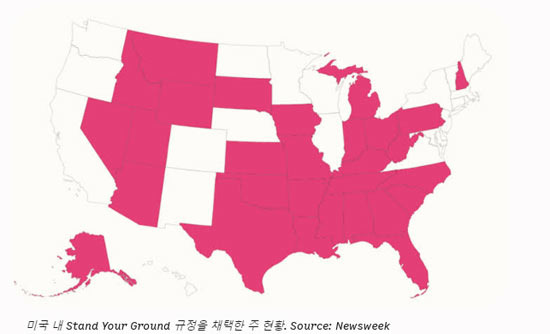
Currently, over 30 states recognize the principle that there is no duty to retreat in places where one has a legal right to be, either through law or case law.
However, this does not mean that "if you feel threatened, you can shoot."
You cannot shoot just because someone insulted you, nor can you pull out a gun because you got angry during a parking dispute. Generally, using deadly force requires a reasonable belief that you or someone else is in imminent danger of death or serious injury.
Florida law also emphasizes this 'imminent death or serious bodily harm' as a crucial condition.
So, what about California, where I live?
This is where it gets interesting. California does not have a law called the 'Stand Your Ground Act' like Florida.
However, California jury instructions state that a defendant has no duty to retreat in situations where self-defense or defense of others applies.
So, even though the name is different, a similar principle exists in case law and jury instructions.
For example, if someone pulls out a gun in a park and starts shooting at people, a person who is legally carrying a firearm and shoots the shooter to protect others may be recognized as acting in self-defense, specifically 'defense of others,' in California.
The important thing is whether it was reasonable to believe that deadly force was necessary to protect lives at that moment.
In the end, there is no need to overthink Stand Your Ground.It is not a law that says "you can shoot," but rather a principle that states "you are not required to flee first in a dangerous situation where self-defense is justified."
I also served in the military in Korea and have fired a gun, but once a bullet is fired, it is not something you can just pick up again.
Having the legal right to confront someone and actually jumping into a gunfight in real life are completely different issues.
If you can avoid a fight, it is best to do so and return home safely.
However, when the moment comes when you truly cannot escape, the question is how far U.S. law recognizes self-defense, and that is where Stand Your Ground comes into play.
 NightMoonPop
 DdoliSquad
 MelonSearch







 Victory 1988 |
 El Dorado |
 lightyear |
 Moscow Kim |
 coloradoman |
 Weekend Movie Blog |
 Beauty, Health, Lifestyle Blog |
 Superman Cat Blog |
 Noodle Noodle |
  Burbank Lee |
  Olivia's Blog |
  Bushing Around Life |
  Active |
  Cherokee Rose |
  Kor. Master |
  Holey Moley |
  Conflite Teacher |
  Hodong Prince Over Flex |
  Mist inn |
  citrus pop |
  Onion Ring |
  phoenixia |
  viewtop |
  loverun |
  Kim Do Sun |
  SEVEN SEVEN |
  yentra |
  Make My Day |