

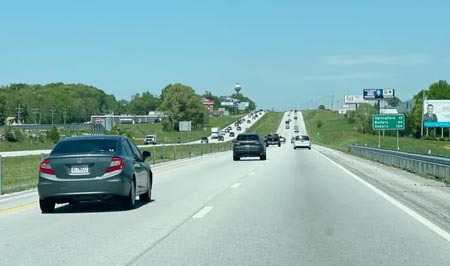
The traffic situation in Springfield, MO is designed around automobiles, and public transportation infrastructure is limited compared to larger cities.
Springfield is located at a key traffic junction where I-44 (connecting west to Oklahoma along Route 66) and US-65 (north towards Kansas City and south towards Arkansas) intersect. Movement within the city is primarily by car, and the typical commute time is around 15 to 25 minutes, with less congestion compared to larger cities.
Looking at the main highway traffic in Springfield, the area where I-44 and US-65 intersect (northwest of Springfield) is noted as the most congested point. During peak commute times (7-9 AM and 4-6 PM), congestion occurs around this area, but it does not reach the levels of traffic jams seen in cities like Seoul or Los Angeles, which can stretch for dozens of kilometers.
Traffic volume is still relatively manageable, and according to Google Maps, the average commute time in Springfield is about 16 to 20 minutes, which is considered short within the U.S. However, as the city grows, traffic volume is continuously increasing, especially in the commercial areas near Republic Road and Campbell Avenue in eastern Springfield, which become congested on weekends and holidays.
Public transportation is provided by City Utilities Transit (CU Transit), which operates bus routes. There are about 16 fixed bus routes running throughout downtown Springfield, operating from 6 AM to 10 PM on weekdays.
The fare is $1.50 for a one-way trip, and monthly passes are also available. However, the limited routes and frequency make it inconvenient to live without a car. The bicycle lane infrastructure is continuously being expanded by the city, with dedicated bike paths connecting major parks and trails in the city. However, the use of bicycles as a practical commuting option is still limited.
The overall condition of roads in Springfield is good, but winter freeze and snow can lead to icy roads, which are a major cause of traffic accidents. The city authorities carry out snow removal and de-icing operations on major thoroughfares, but side streets and residential roads may experience delays in treatment.
Springfield is pursuing long-term plans to improve traffic infrastructure, with goals including enhancing public transportation and creating a pedestrian- and bicycle-friendly urban environment. While cars are essential in the city, parking spaces are generally ample and parking costs are low, so the inconvenience of car ownership is not significant. Most parking lots in downtown Springfield are free or charge low rates of $1 to $2 per hour.
 Top Real Estate



 Premium Gas Camp |
 CA Real Estate |
 cheesepup |
 breezem |
 yentra |
 moname |
 calvor |
 ramen |
 menmo |
 Let's Be Like a Salt-like City Person |
  Belgray Miscellany |
  sweetvan |
  Augusta Univ |
  Round and Round Children's Song Kingdom |
  butter 90 |
  Lando Mao |
  Washington Denzel DJ |
  LIZ Legal Information Blog |
  vegas mom |
  Sandiego Auntie |
  Things to know |
  TEXAS Fishing Boat |
  AUTO OK |
  aaoaa |
  Florida King |
  Encyclopedia of New York and Surrounding Areas |
  Study Abroad Life Know-How Tips |
  Conflite Teacher |