
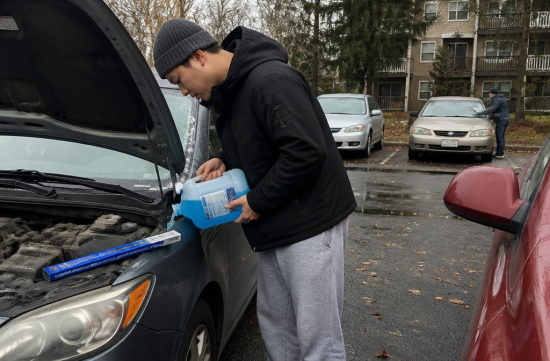
This morning, when I started my car and saw the foggy frost on the windshield, I pressed the washer fluid button, but nothing came out. Just the sound of the pump whirring and then silence. At that moment, I realized, oh, I still have summer fluid in there.
Honestly, most people don't pay attention to wipers and washer fluid until they break down. But in winter, they are crucial for visibility, and if you miss it, it can be quite scary.
So today, I've compiled data on when to switch to winter fluid and what to buy. To cut to the chase, now, in early November, is essentially the deadline.
Let's look at the evidence. According to a report by News 5 Cleveland citing the National Weather Service (NWS) climate averages, the average first frost in the Cleveland area is October 14, and the average first freeze is October 28.
The average date for measurable snowfall, meaning a day when at least 0.1 inches of snow accumulates, is November 10. Looking at the calendar, that's just next week.
Of course, these days, the first freeze has been trending later. According to an Axios analysis, Cleveland's first freeze occurs an average of 16 days later than in 1970, typically between October 16 and 31.
However, the latest date in this range is October 31. If you're still using summer washer fluid in November, you're already in overtime.
The problem with summer washer fluid is that it has little to no antifreeze components. When temperatures drop, it can freeze in the tank or hoses, and in severe cases, right on the glass.
AAA warns that summer washer fluid can freeze in the tank, leaving you without a way to clear frost or thin ice when you need it most.
So, what should you buy? If you look at the store shelves, you'll see numbers like -20 and -25, which indicate the product's freezing point. This is the temperature it can withstand.
A common tip from various maintenance sources is to choose a grade that is about 20 degrees Fahrenheit lower than the typical low temperature where you live. This means giving yourself a good margin.
For reference, the all-time low temperature recorded at Cleveland Hopkins Airport was -20 degrees Fahrenheit on January 19, 1994. While it doesn't happen every year, it's enough evidence that winters in this area can be serious.
Also, keep in mind that the stated numbers are approximate, and cheaper products may perform poorly near their limit. If in doubt, it's best to go for a grade that's one step colder.
There's also a common mistake when replacing fluid. People often pour winter fluid on top of summer fluid that's still partially left in the tank. Mixing them will raise the freezing point, resulting in the product not performing as labeled.
The cleanest method is to use up as much of the summer fluid as possible before filling with winter fluid. I intentionally sprayed the remaining fluid a few more times to make sure the bottom was visible before I switched it out.
Never dilute it with water. The moment you add water, the antifreeze performance drops significantly. It's not worth saving a few dollars only to end up paying for a tow as a financial conservative.
Also, remember that washer fluid runs out faster than you might think. The saltwater from melted snow splashes up, and in winter, you'll find yourself spraying it several times a day. AAA representatives advise not to assume you have enough left.
That's why I keep a spare gallon of winter fluid in my trunk. The cost of a gallon of washer fluid is about the same as one or two cups of coffee, making it a great value for insurance.
Now, let's talk about wipers. According to AAA data, the lifespan of wiper blades is typically 6 to 12 months, depending on exposure to heat, dirt, sunlight, and ozone.
The signs for replacement are simple. If you notice streaks after wiping, areas that aren't clearing, or if the rubber is cracked and hardened, it's time to replace them. AAA recommends checking their condition once a month.
Wipers that have been exposed to the sun all summer may look fine on the outside, but the rubber can be hardened. When they meet snow, they'll just squeak loudly without clearing the glass.
It's also worth considering the type. Standard wipers with exposed metal frames can have issues with snow and ice getting stuck in the joints, preventing them from making proper contact with the glass.
Beam-type wipers, which are one solid piece without a frame, are often praised for being less prone to ice buildup, making them better for winter. However, they tend to be a bit pricier.
There are also winter-specific wipers. These have a rubber boot covering the metal frame to prevent snow and ice buildup, and AAA states that these products can be helpful in snowy regions.
However, whether beam or winter-specific, neither is perfect. User reviews indicate that both can still freeze up, so it's wise not to have overly high expectations for wipers.
That's why you should also change your habits. Trying to scrape off frozen glass with wipers will only damage the rubber and strain the motor. Leave ice removal to a scraper and the heater.
To summarize: switch to a winter-grade washer fluid immediately, replace wipers if you see streaks, and keep a spare gallon of washer fluid in your trunk.
If it were me, I'd finish all this by this weekend before the first snow forecast. It only takes about 10 minutes to buy washer fluid and beam wipers at the store and do it in the parking lot. It's much cheaper than regretting it on the morning of the first snowfall.
 PopTV
 NightSnackHvn



 Caribbean |

 tredolo |

 Anjollinya Blog |

 Kitchen Ideas |

 Spaghetti Flying Religion |

 excited |

 Mr Cleveland |


 sunny90 |

 Gleeee |
 softmoony |
 My Love DS |
 Hardworking CPA |
 People Moon |
 Carolina border |
 korian87 |
 dancing in the rain |
 bravo777 |
 yolo1990 |
 Valley Hong |
 zentra95 |
 wishi |
 abox |
 Belgray Miscellany |
 Spaghetti Pasta Fan |
 Karina's Blog |
 Moscow Kim |
 steadyo |
 Michigan Enthusiast |
 Shinbaram Dr. Blog |