
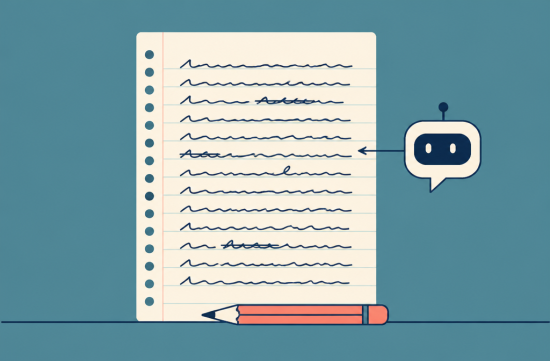
A while ago, a friend sent me a message asking if it was okay for his high school senior niece to "slightly" edit her Common App essay using ChatGPT.
Since I work in IT, he thought I might know the answer. Honestly, I wasn't sure, so I took the opportunity to look into it properly.
To cut to the chase, the key factor is not whether "AI was used" but rather "whose writing it is." And this line varies quite a bit from school to school.
First, the biggest framework is the Common App. The Common App's Fraud Policy explicitly states that submitting substantive content or output created by AI platforms, technologies, or algorithms as one's own writing is considered fraudulent.
If deemed fraudulent, the Common App reserves the right to limit or revoke that user's access. There are also mentions that notifications may be sent to the schools applied to.
The problem is that there is no clear definition of what "substantive" means. It's unclear from the policy wording whether grammar corrections are allowed or if rearranging sentence order is permissible.
So ultimately, you need to look at the AI policies set by each university. This is where the differences become significant.
Yale is relatively specific. They state that reviewing grammar or spelling, and getting general advice or topic ideas early in the writing process is not considered application fraud.
However, there is an underlying premise that the substantive content of the essay must be the student's own. Brainstorming ideas is okay, but having someone else write the sentences is not.
Caltech has separate ethical guidelines for AI use. They cited copying and pasting directly from an AI generator as a prohibited practice, and they also stated that translating an essay written in another language using AI is not allowed.
This translation aspect seems particularly important for Korean families. Organizing thoughts in Korean first and then translating them into English using AI is, at least according to Caltech's standards, prohibited use.
Notre Dame has stated that they follow the Common App's Fraud Policy, and Johns Hopkins also considers submitting AI-generated content as one's own writing to be application fraud under Common App policies.
So what about other schools? According to a survey of admissions officers released by Kaplan in November 2025, a clearer picture emerges.
Only 2% of schools officially allow the use of generative AI in essay writing. About 30% have policies against it, while 68% have no policy at all.
Compared to the previous year's survey, the percentage of schools with bans increased from 25% to 30%, while those with no policy decreased from 72% to 68%. This indicates that rules are gradually being established.
In the same survey, 50% of admissions officers responded negatively to the trend of AI being used in essays. Only 14% responded positively.
I find these numbers quite significant. Just because a school has no policy doesn't mean they welcome AI-generated writing.
Many people are also curious if AI detection tools can catch everything. It's hard to say definitively since the tools and methods used by schools are not publicly disclosed.
However, admissions officers review the entire application of a student together. If the tone of the recommendation letters, activity descriptions, and other short essays is significantly different, it tends to stand out more.
Personally, I believe that the bigger loss is not whether you get caught by detection but that the writing becomes bland. Sentences polished by AI may be smooth, but they often read similarly.
So I told my niece to check the admissions site of each school she is applying to and search for "AI policy" first.
If there is a policy, she should follow it; if not, she should adhere to the Common App standard, meaning the content must be 100% her own.
And if she is going to use AI, it's safest to use it only for "questioning purposes." This means asking whether this paragraph conveys the intended meaning well, where the confusion lies, and making corrections herself.
I also recommend saving draft versions by date. Just keeping the version history in Google Docs shows that I wrote it myself.
From a parent's perspective, it's much better to read the school policies together rather than suspecting the child. Kids often don't realize how different the rules are from school to school.
In fact, I don't think it's realistic to completely ban AI. It has already become a tool in kids' daily lives, so it's up to adults to clearly communicate where the fair line is.
Policies can change every year, so make sure to double-check right before submitting applications. If it were me, I would check each school on my list about two weeks before the deadline.
Ultimately, what admissions officers want to read is not perfect English but the student's voice. Even if it's a bit clumsy, a piece that tells my story wins out.
 WinterPlus
 Marshmallow

 Texas Migration Story |

 seadoll |

 Round and Round Children's Song Kingdom |

 new sugar |

 Way to easy |

 softmoony |

 Gleeee |

 Mr Cleveland |


 solid90 |

 uplifted |
 ssome |
 skykong |
 Shining Our Own World |
 gardener 007 |
 golfmaster |
 Nanana Nanana Nanana |
 Who's watching? |
 endone |
 RockStar |
 Casa Mia |
 You Only Live Once |
 Hardworking CPA |
 Joyce 77 |
 Runner Kim |
 My Town My Way Blog |
 My Miami Stories |
 Entip |
 Tony Park |
 DJ DC BLOG |