

As the fall of their senior year approaches, families everywhere face the same question at the dinner table: Should we go straight to a four-year college, or are there other options?
In Massachusetts, the answer to this question has changed quite a bit in recent years. Thanks to the state government's MassEducate program, if certain conditions are met, community college tuition and fees can effectively be zero.
MassEducate started in the fall semester of 2024. It applies to all 15 public community colleges in the state.
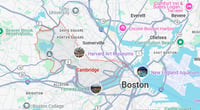
If you're a student in Cambridge, your closest options are Bunker Hill Community College, located in Charlestown and Chelsea, abbreviated as BHCC. Middlesex Community College, with campuses in Bedford and Lowell, is also a nearby candidate.
The eligibility criteria are simpler than you might think. After reading the guidelines from the Massachusetts Board of Higher Education (BHE), the key points can be summarized as follows.
First, you must have lived in Massachusetts for at least one year as of the start of the semester. Eligible individuals include citizens, permanent residents, and non-citizens who qualify under federal financial aid regulations.
Students recognized under the state's Tuition Equity Law are also included. In this case, you would submit the state application, MASFA, instead of the FAFSA.
Submitting either the FAFSA or MASFA is mandatory. You need to submit it every year, so don't think you can just do it once and be done.
You cannot already have a bachelor's degree, and you must be officially enrolled as a student taking at least 6 credits per semester. You also need to maintain satisfactory academic progress (SAP) as defined by the school.
There are also set time limits for support. For associate degree programs, full-time students can receive support for a maximum of 6 semesters, while part-time students can receive it for up to 10 semesters.
Let's clarify the financial aspect a bit more. MassEducate operates on a last-dollar basis. It applies federal and state grants, like the Pell Grant, first, and then covers the remaining tuition and fees.
Additionally, students who meet income criteria will receive an Allowance and Support Award for books and supplies.
According to the guidelines for the 2025-26 academic year, this amount can be up to $1,200. Interestingly, this amount was cut to $1,000 due to budget issues last September, but was restored to $1,200 in November.
I find this point quite significant. It illustrates that the program's funding depends on the state legislature's budget each year. Just because it's free this year doesn't guarantee it will be the same next year.
Therefore, I recommend checking with the school's financial aid office for the specific amounts for the 2026-27 academic year. As far as I could find, the official guidelines for this year have not yet been publicly released.
So, what has changed for high school students? We need to address a common misconception here.
MassEducate does not apply to dual enrollment courses taken while still in high school. The eligibility requirement is a high school diploma, meaning this program can only be used after graduation.
College courses taken during high school are a separate track. BHCC has designated Cambridge Rindge and Latin School (CRLS) as a dual enrollment partner school.
However, BHCC itself indicates that dual enrollment funding is limited. CRLS students are advised to email their advisor to confirm eligibility and costs before registering.
The city of Cambridge previously conducted its own experiment. In 2023, the Cambridge Promise pilot program supported 20-30 CRLS graduates to attend BHCC tuition-free, with the first-year funding provided by MIT and Harvard at $25,000 each.
Now, the state-level MassEducate is taking on that role on a much broader scale. In June of this year, 518 students graduated from CRLS and HSEP, and among those who meet residency and FAFSA criteria, they can start community college without worrying about tuition.
Let's summarize the pros and cons. Supporters argue that students can avoid student loans for two years and significantly reduce overall costs by transferring to a four-year institution like UMass after earning an associate degree.
On the skeptical side, critics point out that graduation rates and transfer success rates should be considered. Even if tuition is free, living expenses and transportation costs remain, and if students drop out midway, they've wasted their time.
Both arguments have merit. Ultimately, whether the fact that it's free matters depends on having a plan.
In Korean families, there is still a perception that community college is a backup option. Honestly, when you break it down, that perception often doesn't hold up.
If I were a parent, here's what I would do. First, I would submit the FAFSA in the fall of 12th grade. Whether or not you go to a four-year college, this is a step you won't regret.
Second, I would check in advance which courses are transferable under the transfer agreements of the four-year colleges I'm interested in, such as MassTransfer. If credits don't transfer, the value of free tuition diminishes.
Third, if my child is still in high school, I would have them take one or two courses through BHCC dual enrollment. Just getting a taste of college courses can clarify their career path significantly.
Free community college is not a one-size-fits-all solution. However, data shows that it certainly provides one more option, and I believe that dismissing this card from the table from the start is a bigger loss.
 FishBunOp



 MacMorningBlog |
 Texas Migration Story |

 seadoll |

 Round and Round Children's Song Kingdom |

 new sugar |
 Spaghetti Pasta Fan |

 sprinkletop |

 sweetpepe |

 lollipop |
 My Love DS |
 Hardworking CPA |
 People Moon |
 Carolina border |
 korian87 |
 dancing in the rain |
 bravo777 |
 yolo1990 |
 Valley Hong |
 zentra95 |
 wishi |
 abox |
 Belgray Miscellany |
 softmoony |
 Karina's Blog |
 Moscow Kim |
 steadyo |
 Michigan Enthusiast |
 Shinbaram Dr. Blog |