
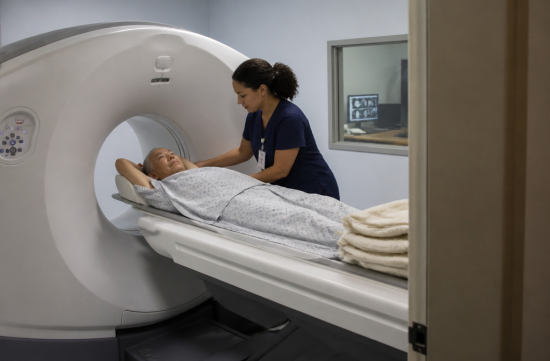
Recently, I was shocked to hear about a friend's father. He smoked for quite a long time when he was younger and hasn't smoked for several years, but he has never had a lung exam.
He said he feels fine, with no cough or shortness of breath. However, lung cancer is best detected during the time when there are "no symptoms at all."
So today, I want to summarize the topic of low-dose CT scans for lung cancer, known as LDCT. I will explain who is eligible, whether insurance covers it, and what you need to know in order.
First, let's talk about the criteria. The U.S. Preventive Services Task Force (USPSTF) updated its recommendations in March 2021.
The target group includes individuals aged 50 to 80, with a smoking history of 20 pack-years or more, and who are either current smokers or have quit within the last 15 years. The key point is that these individuals should receive a low-dose CT scan once a year.
The previous criteria started at age 55 and required a smoking history of 30 pack-years or more. The age limit has been lowered and the smoking amount requirement has been reduced, significantly expanding the eligible population.
Many people get confused about what "pack-year" means. Smoking one pack, which is 20 cigarettes, for one year equals one pack-year.
The calculation is simpler than you might think. Smoking one pack a day for 20 years equals 20 pack-years, and smoking half a pack a day for 40 years also equals 20 pack-years.
So even if you think, "I only smoke half a pack a day," if you've been doing it for a long time, you might still be eligible. Be sure to calculate this yourself.
Now, when should you stop getting these scans? According to USPSTF guidelines, you should consider stopping if it has been 15 years since you quit smoking or if you are in a situation where surgery is not feasible due to health issues.
However, the American Cancer Society (ACS) released slightly different guidelines in November 2023. They recommend that anyone aged 50 to 80 with a smoking history of 20 pack-years or more should get annual screenings, regardless of how long it has been since they quit.
The ACS cited data showing that the risk of lung cancer does not sufficiently decrease even after 15 years of quitting. Honestly, I was quite pleased with this change, as many older individuals who quit a long time ago often think, "I'm fine now."
However, insurance coverage still often follows the USPSTF guidelines. Under the ACA (Affordable Care Act), private insurance is required to cover USPSTF recommended screenings without cost-sharing.
So, if you have quit for more than 15 years, it's wise to check with your insurance company to see if your plan covers it. You can call the number on the back of your card and ask about coverage for "LDCT lung cancer screening."
Medicare has slightly different criteria. Since February 2022, CMS covers one low-dose CT scan per year under Part B.
The eligible age for Medicare is 50 to 77. You must have a smoking history of 20 pack-years or more, be a current smoker or have quit within the last 15 years, have no symptoms of lung cancer, and have a doctor's order.
Individuals aged 78 to 80 are included in the USPSTF recommendations but are excluded from Medicare criteria. This difference is a bit disappointing.
Additionally, Medicare requires a "shared decision-making" consultation before the first scan. This involves discussing the benefits and risks of the test with your doctor, as well as receiving counseling on quitting smoking.
This consultation may seem like a formal procedure, but I believe it is essential. Low-dose CT scans have their downsides.
The most common issue is false positives. Sometimes nodules appear, leading to additional tests, but it turns out they are not cancer.
There are also concerns about overdiagnosis and, although minimal, radiation exposure. Therefore, I do not recommend that individuals who are not eligible get scans just because they feel anxious.
On the other hand, for those who are eligible, the benefits are clear. In a large study published in 2011, the low-dose CT group had a 20% lower lung cancer mortality rate compared to the chest X-ray group.
Lung cancer often progresses significantly by the time symptoms appear. Detecting it early increases the chances of being able to treat it surgically.
Let's summarize the practical steps. First, calculate your pack-years, and when you make an appointment with your primary care physician, mention that you want to confirm your eligibility for lung cancer screening.
If you feel uncomfortable with English, you can request interpreter services. Most hospitals are required to provide free interpretation, so there's no need to feel embarrassed.
Next, check your insurance coverage, and remember to get your scans annually at the same time each year. It's not just a one-time thing; the key is "every year."
If you are still smoking, I hope you will start your quit journey along with the screening. You can call 1-800-QUIT-NOW for free smoking cessation counseling.
Of course, individual health conditions and medical history may affect your decisions. Be sure to discuss whether and when to get screened with your doctor or pharmacist.
I always feel concerned that such information is often communicated later to immigrant families. If you know anyone among your parents or older relatives who might be affected, please take a moment to call them this evening and ask.
 CashLegend
 TingHowUSA

 The Emperor Must Grow |

 squidogame |

 daddyyo |

 Top Beaches |

 Solo Yolo |

 softmoony |

 Gleeee |

 Mr Cleveland |


 solid90 |

 uplifted |
 ssome |
 skykong |
 Shining Our Own World |
 gardener 007 |
 golfmaster |
 Nanana Nanana Nanana |
 Who's watching? |
 endone |
 RockStar |
 Casa Mia |
 You Only Live Once |
 Hardworking CPA |
 Joyce 77 |
 Runner Kim |
 My Town My Way Blog |
 My Miami Stories |
 Entip |
 Tony Park |
 Jean Claude Bundang Blog |
 DJ DC BLOG |