
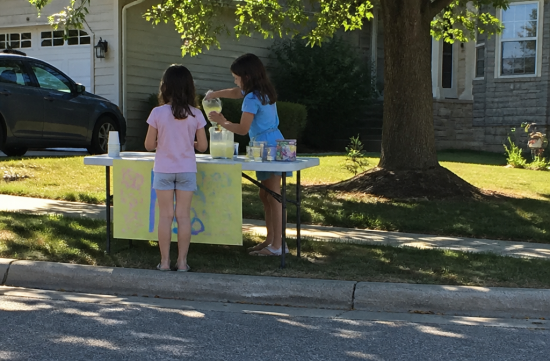
As you walk through the neighborhood, there's a scene you can't miss every summer. Kids set up a table made of cardboard boxes in front of their yard, with a sign written in crooked letters saying lemonade for $1 a cup.
Every time I see this, I wonder. Why lemonade? Is it just because it's an easy drink to make?
But upon researching, I found that there's a surprisingly long history behind this scene. The oldest recorded lemonade stand appeared in New York in 1839.
It wasn't always the romantic summer activity we think of today. It actually started with underprivileged kids selling lemonade on the streets to make a living.
There was a turning point that changed this image into the charming children's activity we know now. In 1921, a memoir by Edward Bok won the Pulitzer Prize, and it included a story about his childhood lemonade stand.
The timing was also right. Around 1918, all states in the U.S. established compulsory education laws, which led to the concept of summer vacation. During the months when kids weren't in school, running a lemonade stand was a perfect fit.
Then, a significant event gave this simple summer pastime a whole new weight. It's the story of a girl named Alex Scott.
Alex, who was battling childhood cancer, set up a lemonade stand in her front yard in 2000 and raised $2,000 in just one day. Before she passed away in 2004 at the age of eight, similar stands across the country continued, raising over $1 million in donations.
The year after Alex's passing, her family established the Alex's Lemonade Stand Foundation. To date, the total donations have exceeded $300 million, and the number of supported childhood cancer research projects has surpassed 1,500, showing how a simple neighborhood stand could grow to such an extent.
Around the same time, someone turned this into a formal educational program. In 2007, Houston entrepreneur Michael Holtshaus started a nonprofit called Lemonade Day.
In its first year, 2,600 stands opened in Houston alone, and over 1.5 million kids have participated in the program since then. They learn everything from goal setting to budgeting and profit calculation, making it more than just a drink sale but a mini business class.
However, there's an ironic aspect to this. Despite being packaged as a heartwarming story, lemonade stands have found themselves in legally ambiguous positions.
In Denver, a stand run by siblings was shut down by police for not having a $125 business license. This happened even after they had already donated $200 to a charity, which is a bit disheartening.
In Montgomery County, Maryland, six kids received a $500 fine for operating without a permit. As these cases piled up, some states began to change their laws.
Texas Governor Greg Abbott signed a law prohibiting the requirement of permits for minor-operated lemonade stands. The Georgia State Senate also passed a lemonade stand law with an overwhelming vote of 52 to 2.
Honestly, when I first heard this story, I was a bit shocked. The fact that police were called to stop a few kids from selling lemonade in the summer seems to illustrate how American society handles rules.
Ultimately, the reason lemonade stands have survived for so long cannot be explained by just one factor. It's a combination of summer vacation, a way to learn about capitalism through play, and a means for some to remember a sick child.
Personally, I find the story of the Alex's foundation to be the most impactful. Seeing how a simple paper cup in a child's hand can create such a significant movement makes me look at this seemingly trivial summer scene in a new light.
 RapidStone70


 Victory 1988 |
 Panorama Kstar |
 Giant Squid and Sweet Potato Soup |
 Lol Life |
 lavender |
 solid90 |
 uplifted |

 lidus |

 nixon |
  mini hometown |
  Gleeee |
  MacMorningBlog |
  ASURA |
  Elastico |
  shaket |
  vionoo |
  chocolate |
  Whisper |
  Star Voyager |
  InDiGo |
  Rocky Mountains |
  Whoever It Is, I Don't Know |
  Why Not Me |
  Plastic Rose |
  Rice Shop Uncle BLOG |
  Gook Rule |
  Rowland Mama |