

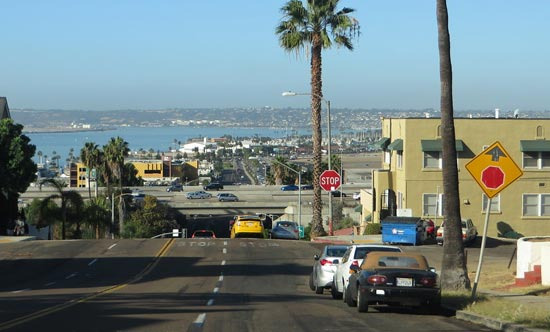
This isn't just a random comment. The longer someone has lived in the U.S., the more they understand how special San Diego's weather really is.
Unlike New York, where you have to shovel snow in the winter, or Texas, where it can be oppressively hot and humid, and not like Seattle, which has months of dreary rainy weather, living here makes you realize that the saying "the weather is nice all year round" is not an exaggeration.
San Diego is a prime example of a Mediterranean climate. Simply put, summers are dry and warm, while winters are mild with some rain. The average annual temperature is about 63-65 degrees Fahrenheit, which is around 17-18 degrees Celsius.
Among major U.S. cities, this is a remarkably stable temperature. Even in the dead of winter, January, daytime temperatures usually range from 57-66 degrees, reminiscent of fall in Korea.
Unlike other regions, you hardly ever experience freezing temperatures or icy roads. Many people who move from the East Coast to San Diego say that their winter stress decreases significantly.
Summer is also surprisingly bearable. Typically, from June to September, the coastal areas see daytime highs of around 70-80 degrees Fahrenheit. In Celsius, that's about 21-27 degrees, but the key point is the low humidity.
The sun is strong, but once you step into the shade, it feels cool. Of course, the inland areas tell a different story. Places like El Cajon, Santee, and Escondido can experience days over 90-100 degrees in the summer. Especially in August and September, there are days when opening your car door lets out a wave of heat. However, it's less suffocating than the humid summers in Korea.
Another surprising thing for newcomers to San Diego is the weather in June. Many people ask, "Isn't it California? Why is it cloudy?"
This is due to the famous June Gloom phenomenon. Along the coast, morning fog often rolls in during early summer, making it cloudy until the afternoon when it suddenly clears up. Locals are so used to it that they just accept it, but first-timers sometimes find it unexpectedly cool and end up buying hoodies.

Rainfall is indeed minimal. The average annual precipitation is about 10-11 inches, making it one of the drier major cities in the U.S.
For reference, New York receives about 46 inches annually, and Seattle gets close to 38 inches. In San Diego, most of the rain falls during the winter months from November to March, but it doesn't rain every day. Often, it comes down heavily a few times and then stops.
However, when it does rain heavily, it can be quite intense. In recent years, due to the influence of atmospheric rivers, there have been days when several inches of rain fell in a single day, causing road flooding and freeway closures. Interestingly, even after heavy rain, the sun usually shines again within a few days.
Cold weather is very rare. There aren't many days when temperatures drop below 40 degrees in downtown San Diego.
Occasionally, in the winter mornings, temperatures may hit 39-42 degrees, and locals will come out wearing puffy jackets. People from the East laugh at this, but for San Diegans, that's considered "really cold." Snow is almost nonexistent.
However, in the eastern mountainous areas like the Cuyamaca Mountains or Laguna Mountains, it does snow occasionally in winter. Many San Diegans drive 1-2 hours to see the snow.
Another well-known phenomenon is the Santa Ana winds. In the fall, hot, dry winds blow in from the desert, causing the perceived temperature to rise suddenly. Humidity drops significantly during this time. The problem is that this period is also the highest risk season for wildfires. In fact, the eastern regions of San Diego County frequently issue wildfire warnings.
Overall, San Diego's weather is nearly unparalleled in the U.S.
It's said that there are over 260 sunny days a year, and when you live here, there aren't many days that you think, "The weather isn't great today."
This is why people continue to flock here, even with high housing prices. Ultimately, the saying that San Diego's greatest luxury is not the ocean but the weather is not without reason.
 NDakotaButler







 Baguette Blog |
 novapixel |
 UNI Lover |
 NE Hodori Preik |
 parlon |
 Learn English Accurately |
 Tainami American Travel Story |
 Karina's Blog |

 Miju Communication News Blog |
  Coco and Lulu |
  washington mom |
  yorvik12 |
  HVAC will prosper |
  mortrix |
  Panorama Kstar |
  MAX009 BLOG |
  K-POP TV News |
  My Beloved Hometown Hwagae Market |
  Tart Tart |
  Min's blog |
  Tora Tora |
  pixel77 |
  cuteasducks |
  Lemon Kim |
  What can make money? |
  An ant castle |
  Haha and Bomi Blog |
  glenview 89 |