
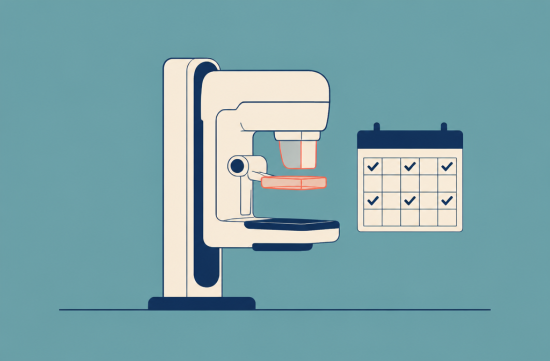
Last week during lunch, a colleague at work was rummaging through a salad and suddenly asked me, "I'm over forty, do I really need to get a mammogram? I thought it was supposed to start at fifty."
I paused for a moment. I remembered hearing something like that before. So that evening, I did some research and found there was more to sort out than I expected, which is why I'm writing this down.
To get straight to the point, the guidelines have changed. The U.S. Preventive Services Task Force (USPSTF) issued final recommendations on April 30, 2024, stating that women at average risk should receive breast cancer screenings every two years from ages 40 to 74.
The grade is B. This means the evidence is moderately certain, and the benefits are clear.
So what was it like before? The 2016 recommendations left the decision for screenings in the 40s up to the individual, with a blanket recommendation starting at age 50. So, my colleague's memory of starting at fifty wasn't entirely wrong.
Why was it moved up by ten years? The Task Force cited the increasing rates of breast cancer diagnoses among women in their 40s. They noted that particularly for Black women, the mortality rate is higher, so starting screenings earlier could have a greater impact.
One thing to clarify: for those aged 75 and older, the Task Force has withheld judgment on whether to continue screenings due to insufficient evidence. This doesn't mean they shouldn't, but rather that there isn't enough data to make a decision.
The issue of dense breasts is also worth noting. The Task Force concluded that there isn't enough evidence to recommend additional tests like ultrasounds or MRIs for women with high breast density.
However, this doesn't mean to ignore the situation. The FDA has changed regulations to require that mammogram results indicate whether the breasts are dense starting September 10, 2024.
So if you see the word "dense" on your results, don't just brush it off. Consider it a signal to discuss with your doctor whether additional testing is necessary based on your risk level.
Now, let's move on to the topic everyone is most curious about: the cost.
Under the Affordable Care Act (ACA), most private insurance plans are required to cover preventive services rated A or B by the Task Force without any out-of-pocket costs, including deductibles or copays.
This structure has faced challenges. A lawsuit claiming the Task Force's authority was unconstitutional (the Braidwood case) reached the Supreme Court, which ruled in favor of the Task Force on June 27, 2025.
Personally, I felt quite relieved when I heard this ruling. The fact that preventive screenings are free is a significant safety net. I believe such systems should be refined gradually rather than overhauled hastily.
What about Medicare? Medicare Part B covers screening mammograms for women over 40 once every 12 months, and if the healthcare provider accepts assignment, there are no out-of-pocket costs.
However, there is a catch. If the mammogram is classified as diagnostic rather than screening, the situation changes. Under Medicare, you would need to pay the Part B deductible first and then 20% of the approved amount.
Many private insurance plans have a similar structure. If an abnormal finding arises during a screening and additional imaging is required, it then transitions to a diagnostic test, and a bill will follow.
For those living in Oklahoma, there is good news. A bill (HB 1389) introduced by state representative Melissa Provenzano has passed, overturning the governor's veto, and will take effect on November 1, 2025.
This law requires state-regulated insurance to cover supplemental breast imaging tests, such as contrast-enhanced mammograms, without out-of-pocket costs. The governor vetoed it citing increased insurance premiums, but the legislature overrode the veto with a two-thirds majority.
However, there is something important to check. Self-funded plans, where the company directly manages the funds, are often not subject to state law due to federal law (ERISA).
Federal programs like Medicare and plans issued in other states may also be exempt. The quickest way to find out what type of insurance you have is to call the number on the back of your insurance card.
When you call, ask this: "Is our plan fully insured or self-funded?" And also, "Are diagnostic mammograms or breast ultrasounds covered without cost sharing?"
I sent this information to my colleague, and the next day they emailed HR. It turned out their company plan was self-funded.
Another point: the American Cancer Society (ACS) has slightly different guidelines. They recommend annual screenings from ages 45 to 54, and then every two years or annually after age 55, and they state that women can start annual screenings at 40 if they wish.
Since different organizations have varying numbers, it can be confusing. The common thread is to seriously consider screenings starting in your 40s.
For those at high risk due to family history or genetic mutations like BRCA, these guidelines may not apply. They may need to start screenings earlier or use different methods, so it's essential to discuss a separate plan with a doctor.
If it were me, I would schedule my first mammogram within this year if I were over forty, check for density on the results, and ask my insurance company about the type of plan I have.
Honestly, it's just a one-hour investment every two years. If the reason for postponing is "it's a hassle," isn't that a rather unfortunate excuse?
 VelvetStone81


 nivex85 |
 Old English |
 nixxon |
 LIZ Legal Information Blog |
 Karina's Blog |
 daisypat |

 Chimhanbang Korea ACU |

 hazelnut |
 Balan |
  neroyo |
  Dreams Come True as Desired |
  Khan Film Blog Production |
  coloradoman |
  Living Economy Information Blog |
  rustley |
  Shim Ramen |
  Cool Beach Freeway |
  Exploring American Life Information |
  Mental Health Psychiatrist |
  element |
  Koreab Date |
  CA Real Estate |
  yolanda78 |
  Round and Round Children's Song Kingdom |
  Mia Flori |
  nova nova |
  healthy |
  leaves |