

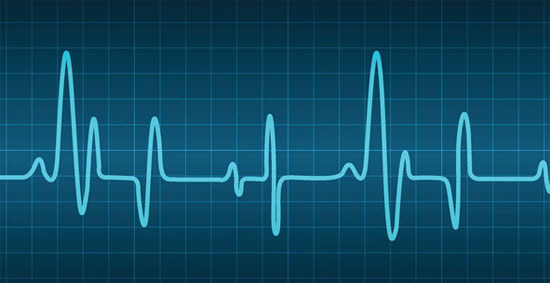
Commonly, the phrase 'the heart beats' means that there is a heartbeat.
When measuring the pulse of a living person, the numbers come out to be around 70 or 80 beats per minute.
However, in today's world of cutting-edge medical devices, the expression 'the heart beats' no longer applies in some cases.
This refers to people who have a total artificial heart or a left ventricular assist device (LVAD).
These devices do not push blood by contracting and relaxing like a natural heart, but rather circulate blood 'continuously' using an electric motor.
In simple terms, it is a structure that keeps rotating like a pump to circulate blood.
Therefore, when medical staff check the patient's condition, they no longer ask, "What is the pulse rate?" but instead, "What is the RPM?"
RPM, or Revolutions Per Minute, has become the new 'heartbeat rate.'
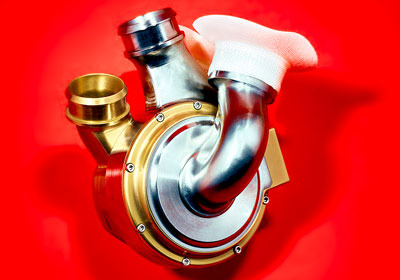
In fact, when checking the pulse of a patient with an LVAD, there is 'no pulse.'
Strictly speaking, the traditional heartbeat is absent, so the 'thump' rhythm we feel is gone.
Instead, blood flows continuously at a constant speed. In hospitals, the RPM value of the machine is adjusted to optimize blood flow.
For example, if it runs at 5,000 RPM, that amount of blood circulates through the body at that speed all day long.
The advantages of this method are clear.
First, maintaining a constant blood flow reduces the risk of heart attacks or arrhythmias.
Second, even if the existing heart muscle is too weak, the motor can do the work, allowing life to be sustained.
Third, adjusting the speed allows for customized blood flow supply tailored to the patient's condition.
Of course, there are drawbacks. If the RPM decreases, blood pressure drops, and if it increases, it can put a strain on the blood vessels.
Also, since there is no heartbeat, the traditional method of assessing condition through pulse in emergencies does not work.
Therefore, these patients receive special training in hospitals and inform those around them that "they may not feel my pulse."
Interestingly, this technology has made it clear that human 'life' does not solely depend on heartbeats.
For the first time in human history, we have entered an era where one can live without a beating heart.
There are several types of artificial heart motor devices, but in the case of LVAD (Left Ventricular Assist Device), the small tube at the end of the left ventricle is called the inflow cannula, which sucks in blood at the timing when the heart is supposed to pump it out.
The blood that enters is then sent directly to the aorta through an artificial blood vessel called the outflow graft from the pump.
Thus, even if the heart is weak, the pump pushes blood throughout the body instead. The artificial blood vessels used here are usually made of a special synthetic material called ePTFE, which reduces the likelihood of blood clots and minimizes the body's rejection response.
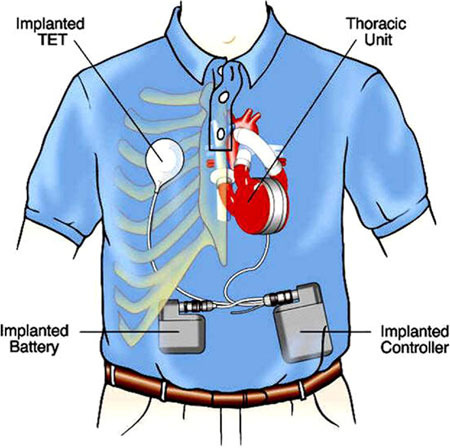
In terms of power supply, since the artificial heart operates with an electric motor, it stops immediately if the power is cut off. This can lead to accidents where immediate death occurs due to battery issues.
However, it is currently impractical to place a battery inside the body, so the power is sourced externally. The pump body is located inside the abdomen, but the power cable penetrates the skin to connect to a small controller (computer) and two batteries outside, which the patient carries on a belt or shoulder strap.
Finally, regarding the total artificial heart (TAH), this involves removing the entire heart and placing two mechanical pumps in its place. The structure that connects the left ventricle to the aorta and the right ventricle to the pulmonary artery is replicated mechanically, and the power and control methods use external batteries and cables, similar to LVAD.
While I am writing about the information I researched, it is truly astonishing. Now, the heart has entered the realm of being managed by RPM values like mechanical parts.
In other words, the statement "the artificial heart is now measured in RPM, not beats" accurately describes the actual technology used in current medical practice.
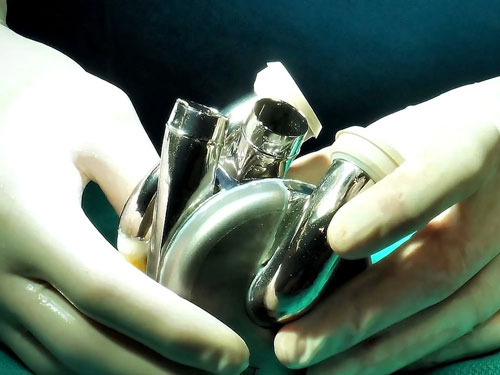
In the United States and Europe, many patients with LVADs live their daily lives for years while waiting for a heart transplant.
When I first heard this story, I felt a bit eerie yet, on the other hand, amazed.
As a child, I thought the 'thump' sound was life when I saw a doctor listening to a heart with a stethoscope on TV, but now future doctors might be looking at RPM values on a laptop screen instead of using a stethoscope.
"Today's heart rotation is 5,200 RPM. Very stable." Something like that.
In the future, the expression 'the heart beats' may change from an emotional phrase for our generation to mean 'the heart RPM is good' for the next generation.
As the paradigm of life maintenance shifts from beats to rotations, the human body is entering a new mechanical-human hybrid era that transcends the limits of nature.
If we have to install an artificial heart that operates with a motor, there may come a time when we ask for it to be installed as a Turbo.







 El Dorado |
 lightyear |
 Moscow Kim |
 coloradoman |
 Montgomery Mom |
 Living Economy Information Blog |
 Shining Our Own World |

 California Kangaroo |
 laro90 |
  MEDBIO American Doctor Blog |
  SWAT TEAM BLK |
  DREAM BIG |
  frostbite |
  330 Forever My Love |
  dralix58 |
  Gorama Round |
  Skydiving |
  dreamport |
  Yellow Snowman |
  Toaster Pizza Magic Show |
  velvetnom |
  Anytime Journey |
  Mrs. Duluth |
  jaxter |
  Atlanta Mama |
  Baguette Blog |
  Tan Sol |