
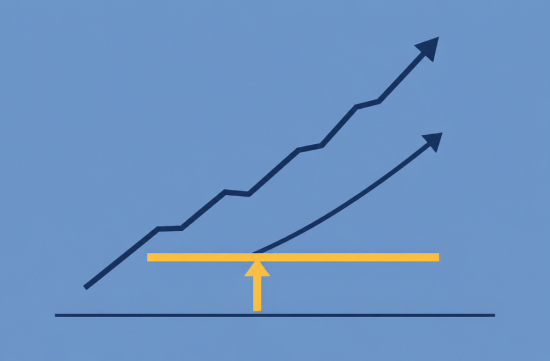
Last week, the Social Security COLA for 2027 was announced at 3.6%. After seeing that news, a friend who receives CalPERS pension asked me why our pension is capped at 2% each year.
That's a good question. There is a clear reason why the numbers differ even though they are based on the same inflation rate. Today, I will break down those differences one by one.
First, let's look at this year's CalPERS numbers. The CPI-U increase for the year 2025 was 2.63%. This figure was reflected in the pension checks starting May 1, 2026.
However, most retirees received 2.00% instead of 2.63%. According to CalPERS data, 95.9% of retirees are bound by a 2% COLA contract.
This is where the first difference arises. CalPERS COLA is not an automatic formula set by law but a benefit contracted by the employer. State governments and school agencies can choose a maximum of 2%, while general public agencies can choose from 2%, 3%, 4%, or 5%.
The actual increase rate is determined by the lower of the two figures. It compares the cumulative inflation rate since retirement with the compounded rate of the contracted COLA each year.
An example provided by CalPERS makes this easy to understand. If a retiree with a base pension of $1,000 retired in 2019 under a 2% contract, the cumulative inflation would be 25.93%, while the compounded COLA would be 12.62% in the sixth year.
The lower figure of 12.62% is applied, resulting in a pension of $1,126.20. Even though inflation has risen over 25%, the pension has only increased by about 12%. Honestly, seeing this gap is disheartening.
The second difference is the benchmark used. CalPERS uses the CPI-U, which is based on all urban consumers as mandated by law. Social Security uses the CPI-W, which focuses on wage earners.
The calculation periods also differ. CalPERS looks at the inflation from the previous year, while Social Security compares the average for the third quarter from July to September with the same period in the previous year.
The third difference is the timing of payments. Social Security increases take effect from the January payments, while CalPERS is reflected in the checks issued on May 1 as mandated by law. Therefore, those receiving both pensions may feel the timing of the increases differently.
The fourth difference is whether there is a cap. Social Security COLA has no cap, so if inflation is high, it increases accordingly. You might remember that it was 8.7% in 2023.
In contrast, CalPERS has a contractual cap, meaning that no matter how high inflation rises, the contracted rate is the ceiling. However, due to cumulative calculations, retirees suffer less in years of low inflation.
The fifth difference is the timing of the first increase. CalPERS COLA starts in the second year after retirement. If you retired in 2025, you would not be eligible for the COLA in May 2026.
Social Security, on the other hand, is different. Once you turn 62, even if you haven't started receiving benefits, the COLA is reflected in the benefit calculation starting that year.
So, do those bound by the 2% continue to fall behind? This is where the PPPA, or Purchasing Power Protection Allowance, comes into play.
PPPA is a mechanism that compensates when the cumulative COLA does not keep up with inflation, causing purchasing power to drop significantly. According to CalPERS guidance, it raises purchasing power to 75% or 80% of the original amount, depending on the type of agency.
Thus, this year, retirees from long ago received 2.63%. This applies to those who retired between 1965 and 1986 under state government and school contracts.
However, according to CalPERS board data, PPPA typically applies only after 25 to 30 years of retirement. This is a distant concern for younger retirees.
One more thing to note is that the CalPERS increase rate applies to the base allowance at the time of retirement, not the current amount received. Therefore, even if the compounded rate accumulates, the perceived increase may be less than expected.
There was also good news for those receiving both pensions. In January 2025, the Social Security Fairness Act abolished WEP and GPO. This means the reduction in Social Security benefits due to public employee pensions has been eliminated.
So now, it makes sense to calculate the COLA for both pensions separately and then combine them. Social Security will be 3.6% in January next year, while CalPERS will be determined in May based on the 2026 inflation rate.
The CalPERS increase rate for May 2027 has not yet been announced. If the 2026 CPI-U exceeds 2%, it is likely that those with a 2% contract will receive 2% again.
If you're curious about your numbers, log in to myCalPERS to check your Benefit Summary. The expected COLA is posted in the spring each year. The phone number is 888-225-7377.
Of course, calculations can vary significantly depending on the year of retirement, the contracting agency, and whether there is a spousal pension. Since it varies by individual circumstances, be sure to check with CalPERS or a financial expert.
Personally, I think the 2% cap makes sense for fund stability. However, when inflation remains high for several years, retirees relying on fixed income are the first to feel the pinch.
Therefore, safety nets like the PPPA must be maintained. If it were me, I would prepare for the weak inflation-linked portions separately rather than relying on the pension increase to increase spending.
Remember that there are reasons for the differing numbers; just keeping that in mind will make next year's pension notice much less confusing.
 ColorPasta








 vivavida |

 MEDBIO American Doctor Blog |

 Burbank Lee |
 vibranto |

 sparkling |
 Physical Laws and Science |

 Kor. Master |

 Grow Your Gut Bacteria Well |

 Only Dentalbay |

 What can make money? |
 breaddough |
 Michigan Enthusiast |
 postcard |
 Buckwheat Muktudari Notebook |
 Kitchen Ideas |
 Jellia Angel |
 Victory 1988 |
 Rice Shop Uncle BLOG |
 ASURA |
 hot chocolate |
 rapids |
 Softember |
 mykiwi blog |
 Maria Mom |
 Watch for possible danger |
 northpeak |
 Far East Movement |
 Light of the World |
 mariashin |