
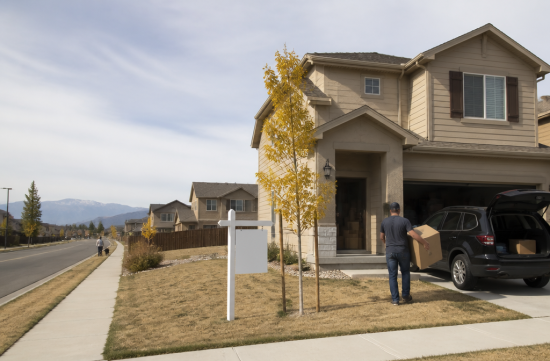
These days, when looking at listings in Colorado Springs, you might often see the phrase "Assumable VA loan." This means you can take over a loan with an interest rate in the 2-3% range, which might make first-time viewers wonder if it's real.
To put it simply, it is real. However, the conditions can be quite strict, and both the seller and buyer have specific things to consider.
The reason there are many such properties in this area is simple. Fort Carson, Peterson Space Force Base, and Schriever Space Force Base are nearby, resulting in a high number of military families who purchased homes with VA loans.
Military personnel receive PCS orders every few years, which means they are transferred. Families who bought homes during the low-interest period of 2020-2021 are now moving and listing those loans with the properties.
At that time, the average 30-year fixed rate from Freddie Mac dropped to 2.65% in January 2021. Compared to the rates available now, the difference in monthly payments is significant.
So, who can take over these loans? Surprisingly, you don't have to be a military member or veteran.
According to VA regulations, the buyer must pass credit and income assessments at the same level as the original borrower, and the existing loan must be in good standing without any delinquencies. The assessment is handled by the servicer managing the loan, not the VA.
If the term "servicer" is unfamiliar, think of it as the company that sends out your monthly mortgage statements. It may be different from the bank that originally issued the loan.
The costs are relatively low. The buyer pays a VA funding fee of 0.5% of the remaining loan balance.
If the balance is $400,000, the funding fee would be $2,000. If the buyer is a veteran receiving VA disability compensation, they may be exempt from this fee.
The maximum fee for the assumption processing charged by the servicer is capped at $300 according to VA regulations. If the servicer does not have automatic approval authority, it can be up to $250.
In the past, there were many complaints about assumption approvals taking months. To address this, the VA issued Circular 26-23-27, requiring servicers to notify whether the assumption is approved within 45 days of receiving the document package.
However, this does not guarantee that everything will be resolved in 45 days. If any documents are missing, the clock resets, so it's safer to allow ample time for the closing date in the contract.
There is a real obstacle to consider: the equity gap, which is the difference between the home's value and the remaining loan balance.
For example, if the sale price is $500,000 but the remaining balance is $380,000, you would need to come up with $120,000 separately. This difference usually needs to be paid in cash instead of taking over the low-interest loan.
If cash is tight, you can cover it with a second mortgage. The VA clarified the criteria for using a second mortgage during an assumption in Circular 26-24-17 in August 2024.
The condition is that the VA loan must maintain the first lien position, and the second mortgage can only be used for the equity gap and allowed closing costs. You cannot withdraw cash from this.
However, the interest rate on a second mortgage is typically higher than that of the first mortgage, so you should compare the combined monthly payments of both loans against a new loan. Sometimes, the difference may be less than expected.
There are also important considerations for the selling military family. First is the Release of Liability.
If you do not formally receive this document from the servicer, the original borrower may still be held responsible if the buyer defaults later. Simply hearing that everything is fine is not sufficient.
Second is the entitlement, which is the limit guaranteed by the VA. If the buyer is a civilian, the seller's entitlement remains tied to that home.
This means that when they buy a home with a VA loan at their next duty station, their available limit will be reduced. To release this, the buyer must be a qualified veteran and must perform a Substitution of Entitlement using their own entitlement.
Therefore, military sellers often prefer buyers who are veterans if the prices are similar. This is also helpful for buyers to know during negotiations.
Finding listings is not difficult. You can search for the word "assumable" in the property descriptions or use websites that specifically show assumable properties.
If you find a property you like, check the servicer's name, remaining balance, current interest rate, and any delinquencies through the listing agent before making a contract. All four of these must be confirmed for calculations to be made.
It's also advisable to connect with an agent and loan officer who have experience with assumptions. The process is different from a standard sale, and if inexperienced individuals handle it, paperwork can easily get tangled.
Personally, I don't believe assumable properties are the right answer for everyone. If you have cash reserves and plan to stay in the home long-term, it is definitely worth considering first.
On the other hand, if there is a large equity gap and you might move again in a few years, it makes sense to compare the numbers side by side with a new loan. I would start by calculating the total costs over five years for both scenarios.
The VA regulations mentioned in this article are based on the official VA guidance and Circulars 26-23-27 and 26-24-17, as of October 2026. Specific conditions may vary by servicer, so be sure to confirm directly before entering into a contract.
 BeatTheBluff








 |
| 
 Premium Gas Camp |
 CA Real Estate |
 cheesepup |
 breezem |
 Springs Korea |
 Colorado Lee |
 Questions about firearms while living in America |

 Victory 1988 |
  summita |
  business lim |
  Make My Day |
  Fros Pro |
  lioness |
  La Bean |
  American History This and That |
  Monte Sori |
  U donn |
  Sarah's Blog |
  Holy Cow |
  monster |
  houston mama |
  Reggae Party |
  Thou Thou |
  Tennessee Land |
  custardnew |
  Chimhanbang Korea ACU |