
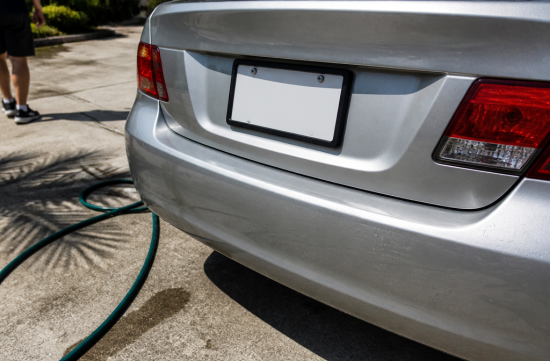
Last week, after washing my car, I noticed the silver frame that the dealer installed on my rear license plate. The website address at the bottom was partially covered. I suddenly remembered that there were rumors last fall about getting a ticket because of such frames.
So, I did some research this weekend. To cut to the chase, the rules have been clarified as of October 1. Most standard frames are fine, and you just need to avoid covering two specific areas.
First, let's recap what happened last year. On October 1, 2025, a law known as HB 253 went into effect.
This law elevated the act of covering or altering a license plate from a simple traffic violation to a second-degree misdemeanor. The original intent was to catch people who hide their license plates to avoid paying tolls.
The issue was with the wording. It was broadly stated that you cannot cover anything on the license plate that makes it difficult to identify any features or details.
This led to confusion. Questions poured in about whether frames that slightly cover the state name or dealer logos were acceptable. There were even comments that interpretations could vary by police officer.
Ultimately, the Florida Department of Highway Safety and Motor Vehicles (FLHSMV) released clarification materials in December 2025. They stated that the frame itself is not prohibited as long as the license plate number and the registration sticker in the upper right corner are visible.
However, honestly, the weight of the traffic department's clarification and the law text are different. So, this year, the state legislature solidified it into law with SB 488.
Governor DeSantis signed it on April 21, 2026, and it goes into effect on October 1, 2026. As of today, it has just taken effect.
I read the law text, and it's shorter and clearer than I expected. It states that as long as two specific areas are not covered, having a frame or decorative border is not a violation.
The first area is the license plate number, which is the combination of letters and numbers. The second area is the registration sticker in the upper right corner.
As long as these two are clearly visible, it's acceptable. Interpretations suggest that covering the website address or slogan at the bottom with the frame is not an issue.
Some places are a bit vague about the state name. The traffic department's materials indicate that as long as the police can identify which state the license plate is from, it's fine. Still, I would prefer to use a slim frame that doesn't cover the top just to be safe.
So, what is still illegal? This is actually more important.
Items like tint covers, reflective covers, or clear plastic covers that go over the license plate still need to be approached with caution. The text of the law still prohibits covers or coatings that obstruct readability or identification from different angles.
Devices that flip or cover the license plate are also out of the question. It's surprising to see that there are people selling things that look like they belong in a movie.
It's also worth noting the penalties. If you knowingly violate the law, it's a second-degree misdemeanor, which under Florida law can lead to up to 60 days in jail or a maximum fine of $500.
I was a bit shocked to realize that what I thought was just a traffic ticket could lead to a criminal record. It's really not worth the risk for just one license plate cover.
For reference, Florida has a rule that license plates must be readable from 100 feet away. This is an old standard in traffic law and continues to apply regardless of this new law. Even if the frame is fine, if the license plate is blurry or dirty, you could still get pulled over.
One more thing. Earlier this year, a bill to eliminate the yellow registration sticker (HB 841) passed the House with a vote of 93 to 17, and many were hopeful.
However, it didn't make it through the Senate and ultimately failed. So, the requirement to keep the sticker remains, and the rule that the frame cannot cover it is still in effect.
In Korea, covering license plates is a target for enforcement, so everyone is careful. In the U.S., the culture of customizing cars is so free that I didn't expect frames to be an issue, but I'm glad they've drawn a clear line this time.
I went home and checked right away. My dealer frame shows both the number and the sticker, so I decided to leave it as is.
For those who want to check, here's the order of steps. First, take a few steps back from the rear of the car to see if any part of the license plate number is cut off.
Next, check if the entire border of the sticker in the upper right is visible. Finally, if there's a cover on it, it's best to just remove it for peace of mind.
If you're going to buy a new frame, a slim one with thin edges at the top and right corners seems to be the safest choice. Thick decorative frames often get caught on the sticker area.
Personally, I think this revision is quite reasonable. It maintains the intent to catch toll evaders while alleviating the worry that an ordinary driver could become a misdemeanor offender just because of a dealer frame.
However, the final judgment is still up to the police, so if you feel uncertain, it's best to ask the traffic department's website or your local county tax collector's office. It's a quick check that can be done in five minutes, so take a look at the back of your car this weekend.
 BlueStone91








 Let's Be Like a Salt-like City Person |
 Springs Korea |
 US Legal Consultation on Trials |
 Study Abroad Life Know-How Tips |
 Best Frozen Yogurt |
 Florida King |
  Victory 1988 |
 Mr Song Song |
 My Miami Stories |
  vrixen73 |
  AZ Road Master |
  summita |
  business lim |
  Colorado Lee |
  Make My Day |
  Fros Pro |
  lioness |
  La Bean |
  American History This and That |
  Monte Sori |
  U donn |
  Sarah's Blog |
  Holy Cow |
  monster |
  houston mama |
  Reggae Party |
  Thou Thou |
  Tennessee Land |