
When you first hear that a river caught fire, most people think it's a joke. How can water burn? However, the Cuyahoga River, which runs through Cleveland, has actually caught fire several times.
Records show it has burned at least 13 times. Between 1868 and 1952, it reportedly caught fire nine times.
It wasn't the water itself that burned. There was a thick layer of oil, industrial waste, and debris like wood chips floating on the surface, which acted as kindling.
The most damaging fire occurred in 1952, with damages recorded at $1.5 million. Considering the value of money at that time, that was no small amount.
Yet, it didn't make national news back then. It was considered normal for a river in an industrial city to be dirty. The perception at the time was that smoke from chimneys meant jobs.
The atmosphere changed on June 22, 1969. Sparks from a train passing over a bridge ignited debris on the river.
This fire was extinguished within 30 minutes and was completely out in two hours. The damage was limited to two bridges being affected. Honestly, compared to the 1952 fire, it was a small blaze.
However, history doesn't always move in proportion to scale. This is where it gets interesting.
At the time, the mayor of Cleveland was Carl Stokes, who was elected as the first African American mayor of a major city in 1967. He held a press conference at the site the day after the fire.
Mayor Stokes' message was clear: the city couldn't save the river alone, and the federal government needed to step in. His brother, Congressman Louis Stokes, also raised his voice in support.
There was one more decisive moment. On August 1 of the same year, Time magazine addressed America's environmental crisis and featured the Cuyahoga River fire.
Interestingly, the photo of the burning river in that article wasn't from 1969. It was from the larger fire in 1952. The 1969 fire was extinguished so quickly that there were hardly any proper photos taken.
In today's terms, it was a kind of viral moment. A single photo brought a decades-old issue to the national agenda all at once.
Let me point out one thing. At that time, there was no federal agency dedicated solely to the environment. Water quality issues were managed by states and cities independently.
The subsequent developments were quite rapid. The first Earth Day was celebrated in 1970, and in December of that year, the Environmental Protection Agency (EPA) was established.
Then in 1972, the Clean Water Act was passed. President Nixon vetoed it over cost concerns, but Congress overturned his veto and established the law.
The core of this law was to set national water quality standards. For the first time, there was a federal-level brake on the practice of factories discharging wastewater into rivers at will.
Of course, it would be an exaggeration to say that a single fire created the law. Environmental law scholars note that pollution issues had already been accumulating in various cities, and the Cuyahoga River served as a symbol.
Still, the power of symbolism cannot be ignored. People react more strongly to a photo of a burning river than to statistics. After all, policies are ultimately driven by people.
So, what about the river now? In 1987, the Cuyahoga River watershed was designated as one of 43 Areas of Concern in the Great Lakes region. At that time, there were 10 registered water quality impairment items.
These items are being lifted one by one. In early 2019, the Ohio EPA announced that it had lifted the fish consumption advisory for the Cuyahoga River.
In 2023, items related to fish tumors and deformities were also lifted. Considering it was once a river where fish could hardly survive, this is a remarkable change.
However, it's not over yet. There are still remaining items, and it will take more time to completely remove it from the Areas of Concern. Even after over 50 years of effort, this shows the weight of reversing pollution.
I tend to believe in a market economy and remain cautious of excessive regulation. It's also true that the costs of regulation ultimately fall back on businesses and consumers.
However, the case of the Cuyahoga River is different. The river water is not owned by any one person, and the costs of pollution are borne by residents and future generations, not the factories. This is precisely the area where the government needs to set standards.
What I learn from this story is about balance. While it's true that industry has sustained the city, unchecked growth ultimately set the river on fire.
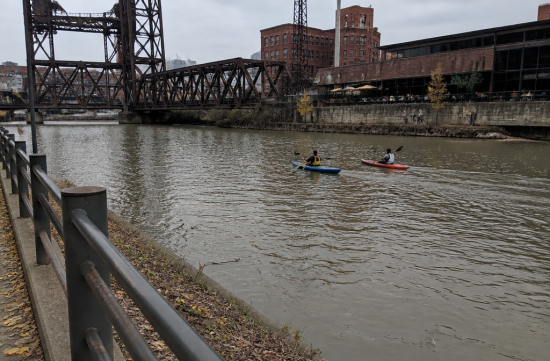
Nowadays, along the banks of the Cleveland River, there are people kayaking and riverside restaurants. Knowing that the once-burning river has transformed like this gives the scenery a different perspective.
If you ever find yourself in the area, I encourage you to take a walk along the riverbank. There's no better way to study history than to see where the starting point of U.S. environmental law was with your own eyes.
 MayoBike


 Anova US Beauty Information |
 anchor |
 Korea Tiger News |
 Alpha and Omega World |
 Florida King |
 uplifted |
 Gleeee |
 Mr Cleveland |

 lidus |
 solid90 |
  Mr Bull Jung |
  radiant |
  Georgia 88 |
  Great TOWN NEWS |
  Open Flex Mind |
  Hartford Blog |
  unified |
  Generation X |
  ringwinds |
  American Food Information & Calories |
  Hawaii Maui Kahului |
  calvorn |
  fernando park |
  newyorker 101 |
  coffeee |
  |
|  Christopher |
  sylven |
  Sammy Beach |
  Bliss O |