
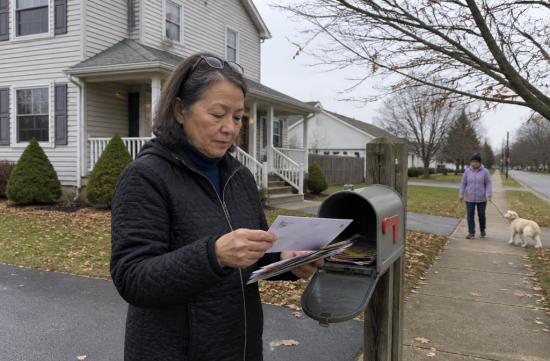
Last week, while waiting in line at the Kroger checkout, I overheard two seniors discussing property taxes. They were wondering if they needed to apply again for a reduction that would appear on next year's bill.
I perked up at that. There's no better news for someone managing a household than hearing about tax reductions. So, as soon as I got home, I did some digging.
To get straight to the point, if you are already receiving the homestead exemption in Ohio, you will see a one-time credit added to your 2026 property tax bill.
The basis for this is House Bill 479, which was signed into law by Governor DeWine in June of this year.
This bill has set aside $350 million specifically for reducing property taxes for those eligible for the homestead exemption. This money will be distributed to eligible homeowners as a deduction on their bills.
So, how much will each household receive? According to announcements from state representatives and estimates from the county auditor, the amount is projected to be between $450 and $500.
This means that the rumored $500 is not a fixed amount but rather the upper end of an estimate. The exact figure will be known once the bills are issued.
The timing is also important. This credit will be reflected as a second homestead credit on the 2026 bill, which will be sent out in January 2027.
If you are already registered, there's no need to apply again. The county will automatically apply it. So, the answer to the seniors' question at the checkout is, "You don't need to do anything."
However, let me clarify one thing: this is a one-time credit. It does not change the homestead program or provide annual reductions.
Honestly, I find this a bit disappointing. Considering how much property taxes have skyrocketed due to home value reassessments, a one-time credit feels like just a band-aid. Still, it's better than nothing.
So, who qualifies for the basic homestead exemption? This is where the real household information comes in.
First, you must live in the home. Properties rented out as investments do not qualify.
Second, you must be 65 years or older, turn 65 within the year, or have a permanent total disability. Surviving spouses who meet certain conditions may also qualify.
The third requirement is income-based. If you apply this year, they will look at last year's income, and your combined income with your spouse must be $41,000 or less.
For those who applied last year, the threshold was $40,000. Since it increases slightly each year, those who narrowly missed out last year should reconsider.
A common point of confusion is Social Security. Ohio excludes Social Security from taxable income, so according to county guidelines, it does not count towards this income calculation.
On the other hand, pensions or IRA withdrawals may count. Don't give up just by looking at the numbers; check the income line on your Ohio tax return.
The amount of the exemption varies by neighborhood. Since it deducts taxes on a certain amount of the home's value, areas with higher tax rates will see greater benefits.
The Franklin County Auditor's website has a table of estimated reductions by tax district. If you find your home address, you can get a rough idea.
Even within Franklin County, tax rates can vary significantly depending on school district and city boundaries. It's easy to miscalculate based on what a friend in a neighboring area received.
The application form is DTE 105A. You can submit it online through the auditor's website, and if you haven't filed Ohio income taxes, you'll need to submit additional documentation for income verification.
Be sure to remember the deadline. According to Franklin County guidelines, you must apply by December 31 to receive the exemption for that year. Since it's now late November, there's just about a month left.
However, there's a catch. The county was required to report the number of people eligible for this one-time credit to the state government by November 1.
So, I can't guarantee whether someone applying now will still qualify for this credit. It's best to call the auditor's office and ask directly.
Even if you miss out on this credit, the basic homestead exemption is something you receive every year, so it's definitely worth applying. Once registered, you'll continue to qualify as long as you meet the requirements.
And since tax calculations can vary based on individual circumstances, if you're unsure, be sure to check with the auditor's office or a tax professional.
This is the order I recommend to seniors in my community: Pull out last year's Ohio tax return.
Check if your income is below $41,000. Verify your registration status on the auditor's website.
If you're not registered, submit DTE 105A by the end of December. When the January bill arrives, check to see if there are two lines for the homestead credit. That's it.
Money is something you need to be aware of. If you know any seniors who might qualify, please mention this to them within the week. You can think of it as a friendly reminder from a household expert.
 googleidea







 Casa Mia |

 Conflite Teacher |
 Tainami American Travel Story |
 tarve7 |

 puddingcat |

 Ohio Ohayoung Hello |

 strongman |

 fixed |


 rigid |
 Website Design Artisan |
 Raccoon Ramen Night |
 Folding Instructions |
 hulu 1978 |
 average life |
 aaoaa |
 Mr. Midwest America |
 Taek Jun |
 molten |
 Kondae Garusong Blog |
 micos |
 Living Economy Information Blog |
 vintage |
 vorame |
 rosem |
 Various Knowledge and Information in the USA |
 aloeverame |
 coffeee |