
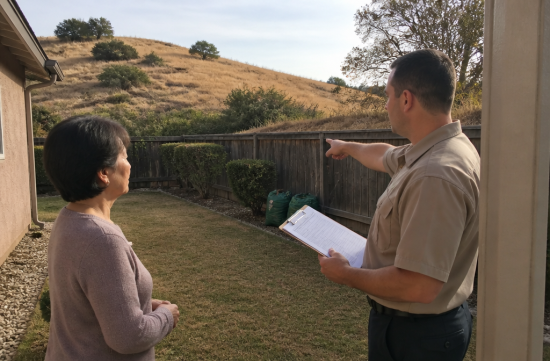
These days, I have a question for those looking to sell their homes in Thousand Oaks: When was the last time you cleared the brush around your home?
This question is not just a trivial concern. If your home is in a fire hazard area, the sales documentation must actually include information related to defensible space.
The basis for this is California Assembly Bill 38, which was passed in 2019. This law established Civil Code Section 1102.19, which has been in effect since July 1, 2021.
The target is residential properties in areas designated by the state as having a High or Very High fire hazard severity. Sellers must provide documentation to buyers that they have complied with defensible space standards.
The situation can vary quite a bit even within the same city. Neighborhoods adjacent to hillsides and open spaces may have different ratings compared to flat residential areas near the 101 Freeway.
So, the first thing to check is the rating of your home address. You can look it up on the CAL FIRE website, and the city GIS map also has a natural disaster layer.
The map is not static; it changes every year. Since a new local jurisdiction map was released in 2025, those who remember it not being an issue in the past should check again.
The second point is who conducts the inspection. Thousand Oaks falls under the jurisdiction of the Ventura County Fire Department (VCFD), which has a separate inspection request form for AB 38.
When submitting the request, you will need the Assessor's Parcel Number (APN) from the county's property tax bill. It's helpful to have this information ready in advance.
Once the request is submitted, the fire department typically informs that an inspector will contact you to schedule an appointment within 2 to 3 business days. However, it's wise to allow extra time during busy seasons like spring.
The third point is whether you can use an already obtained approval. If you received approval from the county's Fire Hazard Reduction Program (FHRP) within six months of the sale contract date, it counts as meeting the AB 38 requirements.
Surprisingly, many people are unaware of this and apply for another inspection. The fire department does not conduct a new inspection unless specifically requested by the seller, so it's advisable to check the date of the existing approval.
Properties under the FHRP must be cleared by June 1 each year. Before that, a Notice to Abate Fire Hazard will be mailed to you.
The standard is at least 100 feet from the building. California Public Resources Code Section 4291 and Government Code Section 51182, along with county fire regulations, all require this same distance.
Within the 100 feet, the area is divided into zones. The first 30 feet from the building is Zone 1, and if the slope exceeds 20%, it can extend to 50 feet. Zone 2 is the area beyond that.
Additionally, there is a new area of concern called Zone 0, which is within 5 feet of the house wall. This includes decks and stairs.
The California Forest Fire Prevention Commission adopted the first Zone 0 regulations this August. Existing homes have a grace period, so it's essential to confirm with the fire department whether this affects your sale.
The specifics that inspectors look for are more detailed than you might expect. Common issues include dry leaves piled on roofs and gutters, firewood stacked against walls, and branches growing up to the eaves.
According to CAL FIRE guidelines, in Zone 1, you should remove dead grass and leaves, and in Zone 2, keep grass trimmed to 4 inches or less. They also check the spacing between trees.
For homes that back directly onto a canyon, the 100 feet may extend beyond your property line. In such cases, you are only responsible for your property boundary as defined by law, so there's no need to encroach on your neighbor's land.
I advise finishing the clearing before taking listing photos. It makes inspections easier and significantly improves the first impression for buyers.
There is one more document required. If your home was built before 2010 and is in a hazard area, you must also provide a fire hardening notice under Civil Code Section 1102.6f.
This notice warns that the home was built before the latest fire safety construction standards and lists any structures that are vulnerable to embers. You can also note any upgrades the seller has made.
However, it is not mandatory to complete upgrades before selling. The law requires accurate notification, not the completion of construction.
If you did not receive the inspection documents before closing, there is a way to handle it. The seller and buyer can agree in writing that the buyer will receive them within one year after closing.
I do not recommend this method. From the buyer's perspective, it adds an extra burden, giving them another reason to negotiate a lower price.
These days, buyers in this area are starting with insurance inquiries. Having the defensible space documentation neatly prepared alleviates one concern for them, ultimately benefiting the seller.
In summary, the order of steps is as follows: check the address rating, verify the existing FHRP approval date, request a VCFD inspection if necessary, and prepare the notice if it's a home built before 2010.
Regulations change slightly each year and by jurisdiction. It's safest to double-check with the fire department, your agent, and, if necessary, a real estate attorney based on your home's specifics before signing a contract.
 OmingOming
 MisoRadio





 Something is popping in the situation |

 lumix88 |

 quiet river |

 Doori Ark |

 My Town My Way Blog |

 US Embassy |


 Archaic Kim |

 Old English |

 Thou Thou |
 Raymond K. |
 gravity |
 714 Success Era Real Estate |
 Investment Beginner Company Information Encyclopedia |
 musicque |
 The Gelaton |
 ovelion |
 Chicagonian |
 Freedom Yea |
 AZ Road Master |
 glenix39 |
 orvella |
 vella |
 comets |
 Banana |
 Yes Dorian |
 Minnesota Sonata N |
 zentar |
 mykiwi blog |