
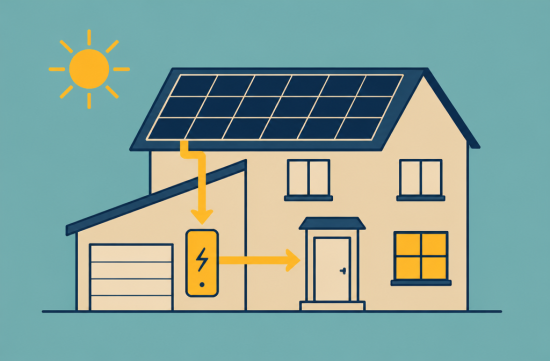
These days, one of the most common questions from those who have contracted for new construction in Chino is whether they should include a battery as an option, given that solar panels are standard on the roof.
To put it simply, the answer varies by home. However, the criteria for making that decision are quite clear. Let's break it down step by step.
First, we need to look at what rate the new solar installation falls under. Solar systems connected after mid-April 2023 are subject to what is commonly referred to as NEM 3.0, or the Net Billing Tariff.
Most new constructions being built today fall under this category. Homes installed before this typically retain the old NEM conditions for about 20 years.
The key change is straightforward. The credits received for sending excess electricity back to the grid are now calculated based on the Avoided Cost Calculator (ACC) rather than retail electricity rates.
This value varies by time of day, month, and whether it's a weekday or weekend. Industry analysis suggests that the value of export credits has decreased by 60-80% compared to NEM 2.0.
This ACC value is updated every two years. Therefore, simply applying the neighbor's bill numbers to your own can lead to inaccuracies.
In simple terms, the formula that allowed you to offset nighttime electricity costs by selling excess daytime electricity has largely broken down. It has shifted to a structure where you sell during the day at a low rate and buy back at a higher rate in the evening.
This difference is particularly noticeable in SCE areas. The TOU-D-4-9PM or TOU-D-PRIME rate plans have the highest costs from 4 PM to 9 PM.
However, the sun is already setting during that time. The peak usage time coincides with when people return home, turn on the air conditioning, prepare dinner, and charge their EVs.
This is where a battery becomes significant. Instead of selling excess daytime electricity at a low price, you store it and use it during peak hours.
Some are waiting to see if regulations will change again due to lawsuits. However, it's reasonable to consider this matter largely settled.
In August 2025, the state Supreme Court sent the case back to the appellate court, but in March 2026, the appellate court reaffirmed the CPUC's Net Billing Tariff. In June, the state Supreme Court decided not to rehear the case.
So, it's realistic to abandon expectations of reverting to previous conditions and to make calculations based on the current situation. The reasons for delaying decisions while waiting for regulatory changes have significantly decreased.
There are also changes for new constructions. Starting January 1, 2026, the 2025 California Energy Code mandates that new single-family homes with electrical services exceeding 125 amps must have battery-ready (BESS-ready) systems.
If you install a battery from the beginning, you are exempt from this ready condition. Additionally, if you install a compliant battery, you can receive credits that reduce the required solar capacity.
So, if the builder offers a battery option, it's worth getting a quote. Asking how much the cost difference is between just installing the ready system and including a battery will make your decision easier.
When getting a quote, don't just look at the battery capacity numbers. You should also ask how many peak hours it can cover for a proper comparison.
On the flip side, there are some disadvantages. The federal 30% tax credit (25D) that applied to batteries purchased by homeowners will no longer be available for installations after December 31, 2025.
This means you shouldn't calculate payback periods based on last year's figures. If the sales materials are based on old criteria, you need to ask about this aspect again.
Solar systems installed through leases or PPAs have different tax credit structures, so the quoting process will also differ. Be sure to check who the owner is in the contract.
There's also some good news. If SCE and PG&E residential customers apply for connection before the end of 2027, they will receive a slight increase in export credits (ACC Plus), which will be maintained for nine years.
So how do you actually make a decision? Personally, I would consider three things.
First, how much electricity you use between 4 PM and 9 PM. If both partners work and the house is empty during the day, but they use a lot of electricity in the evening, the battery effect will be significant.
Second, whether you have an EV or plan to get one. If you can charge it late at night, you might manage without a battery, but if you need to plug it in right away in the evening, that changes the situation.
Third, whether you need backup power for outages. If you're worried about power shutoffs during fire season, it's hard to make a decision based solely on cost.
Checking is simple. You can obtain time-of-use export rate data from the SCE solar billing plan page, and you can ask the builder for the connection application date and rate plan.
Personally, if a household has high evening usage, I recommend including a battery during the new construction phase. It's cleaner in terms of wiring and permits than adding it later.
Conversely, if there are people at home during the day and electricity usage is low, there's no rush. Since battery-ready systems are already in place, it's fine to observe the rate flow for about a year before making a decision.
 DineWithDol














 ovelion |

 Something is popping in the situation |

 lumix88 |

 quiet river |

 Doori Ark |

 Raccoon Ramen Night |

 Shoot Me |


 Website Design Artisan |
 Folding Instructions |
 hulu 1978 |
 average life |
 Casa Mia |
 aaoaa |
 Mr. Midwest America |
 Taek Jun |
 molten |
 Kondae Garusong Blog |
 micos |
 Living Economy Information Blog |
 vintage |
 vorame |
 rosem |
 Various Knowledge and Information in the USA |
 aloeverame |
 coffeee |
 Well Done Sir |