
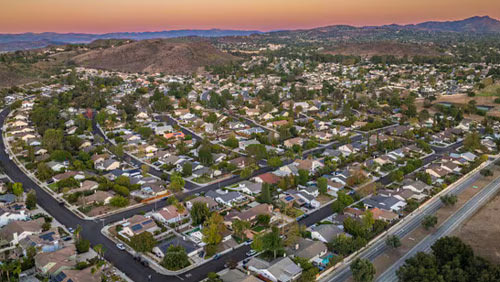
Thousand Oaks can be summed up as a "car-dependent city."
This is not an exaggeration; it's the reality. While public transportation does exist, if you ask whether it can replace a car in daily life, the honest answer is "not yet." The routes are not dense, the wait times are long, and it becomes even more inconvenient at night. When considering commuting, grocery shopping, and picking up kids, you ultimately end up reaching for your car keys.
However, if you do have a car, the story changes completely. The city's location is quite decent. The Ventura Freeway connects to the Moorpark Freeway and the Ronald Reagan Freeway, making travel straightforward. It usually takes about 40-50 minutes to downtown LA, around 30 minutes to Malibu, and about an hour and a half to Santa Barbara to the north. Just looking at the map, you might think, "This is a pretty good location!"
The issue is the timing. Especially heading east on the 101 towards LA, the roads become completely different during rush hour. It's common for a 40-minute drive to take over an hour between 7-9 AM and 5-7 PM. If you have to deal with this every day, the fatigue can build up more than you might expect. As a result, many people living in this area work from home or intentionally avoid peak commuting times. This aspect significantly affects their overall satisfaction with life.
There are alternatives for those who find a car burdensome. You can take the Metrolink Ventura County Line to get to LA by train. It involves driving about 10-15 minutes to the Moorpark station and transferring, which helps reduce driving stress for some. However, there is the limitation of having to stick to the schedule.
Internal city transportation is handled by Thousand Oaks Transit. The fares are low, and it connects to major shopping centers, hospitals, and government offices, but the limited routes make it insufficient to cover "the whole lifestyle." Ultimately, it serves as a supplementary option. Uber and Lyft are also available, but if you start using them daily, transportation costs can rise quite quickly.
So the conclusion is simple. This city truly requires a car to be fully appreciated. Without one, your living radius shrinks significantly, and your options become limited. Conversely, if you have a car and can accept some traffic congestion, you can live quite comfortably here.
To put it a bit more emotionally, the reason people stay in this city despite the inconveniences is different. It's the quietness, safety, and closeness to nature. For those who value these aspects, they feel they can tolerate the condition of driving.
Thus, Thousand Oaks can be a frustrating city for some and a perfect fit for others.
Ultimately, the standard is singular: what do you value more?






 moo moo |
 ultron78 |
 garlic bread |
 Sugar Cream Door Bulletproof Noodles |
 urbanmint |
  Pronunciation Yo |
 Archaic Kim |
 US Embassy |

 vivavida |
  Way to easy |
  limestone |
  oster |
  daddyyo |
  neapolis |
  seadoll |
  ansdal |
  Vivid U.S. Regional Information |
  Vasila's Newlywed Blog |
  Arizona Cowboy |
  merry merry |
  Fragile Me |
  Rowland Mama |
  foxtree |
  bayaa |
  loveyom |
  Coastal city |
  Spaghetti Flying Religion |