
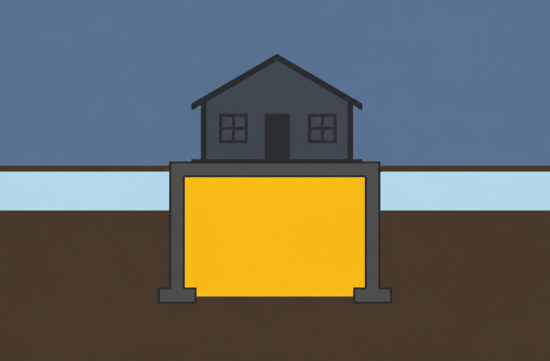
To put it simply, basements in American homes are not just a matter of preference. It's about how deep the ground is and how much it costs to gain additional space by digging that depth.
When comparing new listings in Texas to those in Pennsylvania, the difference is immediately noticeable. In the former, basements are a standard feature, while in the latter, it's hard to find that option.
The numbers make it even clearer. According to data from the NAHB analyzing census construction statistics, the proportion of single-family homes with full or partial basements starting construction in 2025 is 67.7% in New England and 64.4% in West North Central.
Pennsylvania, which is part of the Middle Atlantic, has a rate of 48.7%. In contrast, the West South Central region, which includes Texas, has a slab foundation rate of 97.7%.
When you add up all the other foundation types, only 2.3% are left. I was surprised by this gap when I first saw it.
Nationally, basements account for 16.4%, while slabs make up 73%. So, just looking at the averages doesn't reveal the full story.
The key variable is the frost line. When moisture in the ground freezes in winter, it expands and can push the foundation upward, a phenomenon known as frost heave.
Therefore, in colder regions, footings must be placed below the frost line. How deep that needs to be varies by location.
According to the 2015 Minnesota state regulations, unless determined otherwise by an engineer, the minimum depth is 5 feet for Zone I and 3.5 feet for Zone II. There have been revisions since then, so anyone planning to build should refer to the current version.
In southeastern Pennsylvania, a construction article from JLC states the minimum is 36 inches. However, since these numbers are set by local codes, it's best to check with the local township for accuracy.
This is where the calculations flip. If you have to dig that deep for the walls anyway, it becomes attractive to dig a little more to gain room for a basement.
In investment terms, this is a low marginal cost option. It's not free, but it feels like a loss if you don't take advantage of the price.
In the south, the starting point is different. With a shallow frost line, foundations are also shallow, and a basement becomes a separate excavation project rather than an added option.
Cost estimates vary by page. HomeAdvisor's main guide lists slab foundations at $4–7 per square foot and basements at $15–20, while the 2025 data table shows $5–16 and $20–37, respectively.
Whichever you believe, basements are more expensive. Finishing costs are not included in these figures.
There are also issues with the land itself in the south. An article from Mental Floss states that in some areas of Houston, water comes up even after digging just 10 feet.
Much of East Texas is made up of expansive clay that swells when wet and shrinks when dry. In such areas, basement walls can crack.
In central and western Texas, the shallow limestone bedrock makes excavation costly. Florida also has many areas where the water table is close to the surface, leading to similar issues.
History plays a role too. Census data shows that in 1940, 55% of American households were heated with coal or coke, and by 1970, that figure had dropped to 2.9%.
During the coal era, furnaces were placed in basements, and fuel was stored there as well. The small iron doors on old house walls were the entrances for coal delivery.
Before that, there were root cellars used for storing root vegetables and apples. In the days before refrigerators, the consistent temperature underground served as infrastructure.
Even after coal disappeared, basements remained. They were filled with heating units, water heaters, and washing machines.
What I find particularly interesting is that the IRC requires frost protection, not necessarily a basement, and recognizes methods like frost-protected shallow foundations or construction on bedrock.
Thus, basements are not merely a product of regulation but the result of calculations by builders and buyers. Those calculations are still evolving.
In the East North Central region, by 2025, slabs surpassed half of new constructions, while basements dropped to 43.0%. Even in the cold Great Lakes region, the pressures of housing costs change the answers.
The risks of basements should not be overlooked either. They are the first space to encounter water, making sump pump checks a routine task.
There's also radon. According to data from the Pennsylvania Department of Environmental Protection (DEP), 40% of tested homes exceeded the EPA action level of 4 pCi/L, but this figure only reflects the homes that were tested, so it shouldn't be interpreted as the overall state percentage.
If I were in the north, I would choose a house with a basement. However, I would first check for flooding history and radon levels, and if there are structural or health concerns, I would listen to professionals like inspectors before making a decision.
There's no reason to say that a slab home in the south is lacking. In that land, it's a reasonable solution.
Ultimately, basements are a landscape shaped more by geology and cost than by culture. When viewing a home, one should consider the land beneath it as much as the number of rooms above.
 skyhightraveler1963



 Noodle Noodle |

 Chino Min |

 Glow Yo |

 Michigan Enthusiast |
 xylora |

 fantastic |


 ansdal |
 Northeastern |

 refresh |
 rainyday |
 springw |
 American History This and That |
 goldenleaf |
 mistily |
 selviro |
 strongman |
 Waiting for Godot |
 Sunny Mom |
 Blondee |
 El Dorado |
 passive |
 gardener 007 |
 zanero |
 Arlington house |
 Cali M Law Group |
 Delicious Food Finder |
 ultron78 |
 pet dog |