

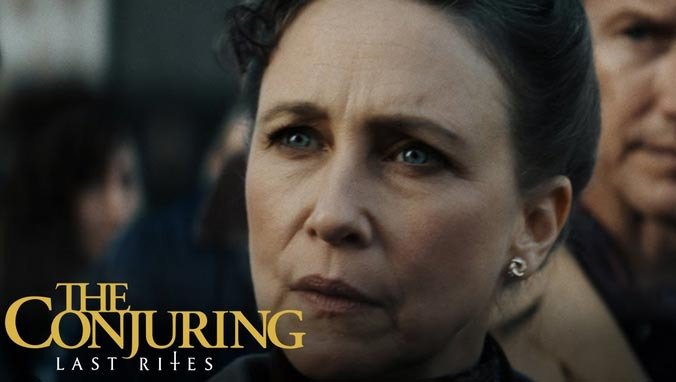
The word "conjuring" is not commonly used, so it may not be familiar, but it means "to cast a spell, to summon" in English.
Perhaps that's why the Conjuring film series deals with summoning unseen entities and the events that unfold as a result.
Starting with the first film released in 2013, the Conjuring series has consistently captured the hearts of horror movie fans worldwide by telling stories based on the real-life experiences of the Warren couple.
When the news of this fourth film's opening came out, I honestly couldn't help but feel excited as a man in my 30s.
This is because it continues the story of a family within the larger narrative of the "Conjuring Universe," rather than just focusing on scary scenes.
This film particularly begins with a prologue set in 1964, where Lorraine and Ed Warren, who are expecting Judy, take on a case that starts in an antique shop.
The client runs an antique store inherited from his father, who committed suicide, and he expresses feeling as though someone is watching him when he is alone.
In response, the Warrens investigate the storage area, where they encounter a "full-length mirror with three angel faces carved into it." When Lorraine touches it, the mirror cracks, and a sudden pain hits her, leading directly to a hospital scene.
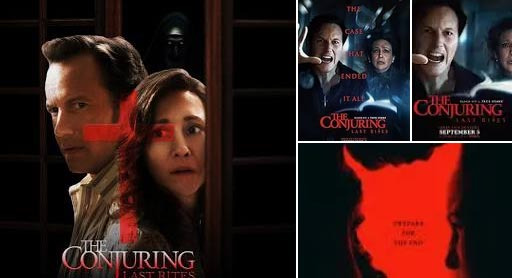
The childbirth scene seems to be one of the most intense moments in this film.
A shadow of a malevolent spirit appears from the hospital ceiling, and a power outage occurs, causing Lorraine to be overwhelmed with fear that she might lose her child. However, the baby ultimately survives and cries, bringing tears of joy to the couple.
This moment, where horror meets miracle, shows that the Conjuring is not just a simple "jump scare" movie.
Time passes to 1986. This film depicts the Warrens in retirement, giving lectures, but their students take their stories lightly. Responses like, "How is this different from Ghostbusters?" evoke a bittersweet feeling, as the weight of a couple who once dominated an era seems to have faded. However, with the appearance of Judy, now an adult, a new development hinting at generational continuity emerges.
Looking back briefly at the Conjuring series, the first film focused on the "Annabelle doll" and the "Harrisville farmhouse incident," while the second centered on the supernatural events in Enfield, England.
The third film expanded the stage by addressing a murder case and courtroom battles based on the true story of "The Devil Made Me Do It."
This fourth installment seems to connect the family story of the Warrens with the existence of another malevolent spirit.
The reason I love this series is simple. It showcases fear alongside family love and faith.
This film, with the mirror as an item, the human event of childbirth, and the element of generational change, seems to provide a feeling of a drama that deals with both life and death, rather than being just a horror film.
Personally, this fourth film holds deep significance as it goes beyond just a horror experience, tying together the "family story" of the entire series.
When we think of horror films, we often focus solely on jump scares or creepy ghost appearances, but the Conjuring has never lost sight of the keyword "family." This prologue also showcases the human side of the Warrens by intertwining the birth of life with the crisis of death.
Moreover, there is much speculation among fans about how much of this work is based on true events and what the identity of the new malevolent spirit is.
The mirror, as a medium, likely symbolizes something beyond a mere object, and I am curious about how it will connect to the series' future developments.
This fourth film seems to stand at the pinnacle of that connection. A work where chilling yet tearful moments intersect.
I am confident it will be an experience that horror movie fans cannot afford to miss.






 Day by day |
 Kitchen Ideas |
 Iowa Egen Aunt |
 Beauty, Health, Lifestyle Blog |
 Always Atlanta |
  Dollydori, Lover of Movies |
 peppermint |
 ringwinds |

 Anytime Journey |
  Atlanta Mama |
  Baguette Blog |
  US Embassy |
  Korean Mom |
  My NYC |
  moo moo |
  Mr Oh |
  forevergee |
  festival |
  manchester |
  constant |
  Leapfrog Move |
  vibranto |
  Tora Tora |
  yellowbutter |
  Dolly |
  NYC saladbar |
  Finding Superfoods |
  lightyear |
  song bang |