
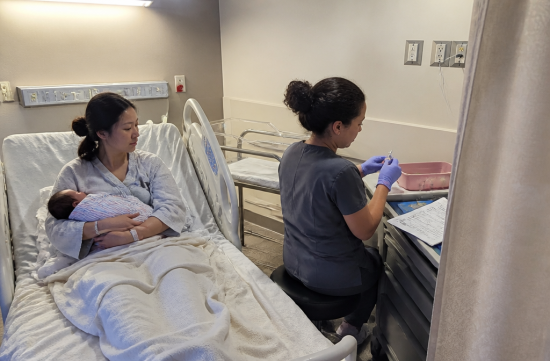
Recently, a friend who is about to become a grandparent asked me at church whether it is necessary to give the RSV shot to a newborn at the hospital.
To put it simply, if the baby is born between October and March, it is advisable to get the shot. However, there is one condition: whether the mother received the RSV vaccine during pregnancy.
RSV is a virus similar to the common cold known as respiratory syncytial virus. While it may just cause a runny nose in adults, it can lead to bronchiolitis or pneumonia in infants under one year old, making it a concern for pediatricians every winter.
In most parts of the United States, the RSV season runs from fall to spring. This is why the CDC recommends administering the antibody shot for babies from October to March.
Currently, there are two antibody shots available for infants: Sanofi's nirsevimab (Beyfortus) and Merck's clesrovimab (Enflonsia), both of which require only a single dose.
Technically, this is not a vaccine. It does not help the baby's body build immunity on its own; instead, it directly provides pre-made antibodies.
The CDC guidelines are straightforward. If the baby is under 8 months old and the mother did not receive the RSV vaccine during pregnancy, the baby is eligible for the antibody shot.
For babies born between October and March, it is recommended to administer the shot within the first week of life. It's a good idea to ask the hospital where you give birth if they can provide the shot before discharge.
For babies born between April and September, the shot is typically given just before the season starts, usually around October. So, if your baby was born in spring or summer, now is the right time.
Many people get confused about the maternal vaccine. Pfizer's RSV vaccine, Abrysvo, can be administered between 32 and 36 weeks of pregnancy, with the timing generally from September to January in most areas.
If the mother received this vaccine at least two weeks before giving birth, the baby usually does not need the antibody shot. The CDC clearly states that most babies do not need both shots.
Conversely, if the mother gave birth less than two weeks after receiving the vaccine or has immune issues, both options should be considered. This is something for the primary care physician to decide.
If you are expecting a second child, remember this: mothers who received the RSV vaccine during their previous pregnancy do not need to get it again this time; instead, the CDC recommends protecting the baby with the antibody shot after birth.
Some babies over 8 months old may still need protection. High-risk infants who have chronic lung disease due to prematurity or severely weakened immune systems may receive another dose between 8 and 19 months of age, just before the second RSV season.
At this time, only nirsevimab is applicable. Clesrovimab is not recommended for the second season.
This year, the federal situation is quite complicated. The CDC's pediatric vaccination schedule released on January 5 moved the RSV antibody from a general recommendation for all babies to a specific high-risk group.
Then, on March 16, a federal district court in Massachusetts temporarily suspended the effectiveness of this new schedule. So, currently, we are generally back to the schedule based on January 2025.
According to the Congressional Research Service (CRS), the CDC's recommendations for nirsevimab remain valid. However, it is unclear whether the recommendations for clesrovimab from the June 2025 vote are still in effect.
Honestly, I don't see anything wrong with federal health authorities re-evaluating vaccination policies. It's healthy to question what the government mandates rather than following it blindly.
However, the constant changes can be confusing for parents. I hope these matters can be properly addressed and clarified in one go.
California is relatively better off. Thanks to state law AB 144, health insurance regulated by the state must cover vaccinations recommended by the California Department of Public Health (CDPH).
The CDPH advises protecting babies with either the maternal vaccine or the infant antibody shot. HMO and Medi-Cal managed care plans are also included in this coverage requirement.
Babies without insurance or those eligible for Medi-Cal can receive free vaccinations through the VFC (Vaccines for Children) program. Underinsured babies with insufficient coverage are also eligible.
However, self-funded plans operated directly by companies often follow federal law rather than state law. If you have such a plan, it's wise to check with your insurance company about coverage beforehand.
So, what should you do? If you are about to give birth, first decide whether to get the RSV vaccine from your obstetrician.
If you decide against it, ask the hospital where you will give birth if they have the antibody shot ready for your baby. Also, make sure to check if the vaccination record is included in your discharge paperwork.
If your baby was born in spring or summer and hasn't received the shot yet, bring it up at the next pediatric visit. The recommended timing has already started in October.
Since each baby's health status and the mother's vaccination history are different, be sure to discuss what and when to vaccinate with your pediatrician or pharmacist. This article is meant to help you prepare questions to ask at the hospital, not to make decisions for you.
If I were a parent, I would take action without hesitation. Even if policies fluctuate, there seems to be little reason to hesitate in protecting a newborn's first winter.
 SuperBoss
 TofuGymKing







 zestorbit |

 hihihi |
 fruitflash |
 Anjollinya Blog |
 United States Army |

 Round and Round Children's Song Kingdom |

 Healthy Local Fresh Information |

 Lifestyle Information Search USA |

 Spaghetti Flying Religion |

 U.S. Weather Bureau News |
 Shining Our Own World |
 Raymond K. |
 gravity |
 714 Success Era Real Estate |
 Investment Beginner Company Information Encyclopedia |
 musicque |
 The Gelaton |
 ovelion |
 Chicagonian |
 Freedom Yea |
 AZ Road Master |
 glenix39 |
 Something is popping in the situation |
 orvella |
 vella |
 comets |
 Banana |
 Yes Dorian |
 Minnesota Sonata N |
 zentar |