

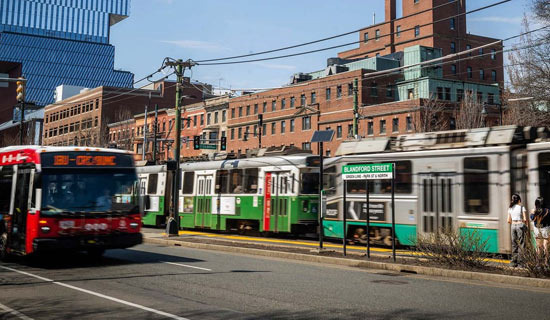
Boston is one of the few major cities in the U.S. where living without a car is possible.
Along with New York and Chicago, it is known for its high reliance on public transportation, with many residents in downtown, Cambridge, and Brookline not owning a car at all.
The Greater Boston public transportation system is operated by the Massachusetts Bay Transportation Authority, commonly known as the MBTA or 'T'. The MBTA is one of the oldest public transportation agencies in the U.S., operating subways, buses, commuter rail, ferries, and some local shuttle buses. Boston is historically significant as the city where the first subway in the U.S. opened in 1897.
The Boston subway consists of five main lines.
The most frequently used line is the Red Line. It is a key route connecting Cambridge and downtown Boston, extending to Harvard University, the Massachusetts Institute of Technology, South Station, and Quincy. This line is heavily used by students, researchers, and professionals.
The Orange Line connects Malden in the north to downtown and extends south to Forest Hills. It is widely used by commuters traveling between medical facilities and business districts, and recently, the vehicles have been upgraded, improving the riding experience.
The Blue Line connects Logan International Airport to downtown Boston. It is the most commonly used transportation option from the airport, and when combined with the airport shuttle bus, it offers a relatively inexpensive way to reach the city.
The Green Line is often the most confusing for first-time visitors to Boston. It is divided into four branches: B, C, D, and E, with some sections running on regular roads as streetcars. It passes through Brookline, Allston, Brighton, Boston University (BU), and Northeastern University, making it very popular among students.
The Silver Line, despite its name suggesting a subway line, is actually a bus-based rapid transit system (BRT). It uses dedicated roads and tunnels for some sections and plays a crucial role in connecting the airport to South Station.
The fare system is relatively straightforward. The MBTA uses CharlieCard and CharlieTicket.
CharlieCard is a rechargeable transit card that is the most widely used, and mobile payments are gradually expanding. There are also monthly and weekly passes that allow unlimited travel on subways and buses, which can save significant costs for daily commuters.
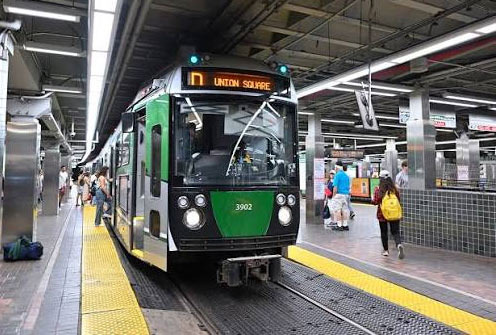
One of the advantages of Boston's system is the convenience of transfers. At South Station and North Station, commuters can use commuter trains, long-distance trains, and buses together. The commuter trains connect to outer cities like Lowell, Worcester, Framingham, and Providence, making them popular among workers living in the suburbs.
However, a major issue often pointed out is the aging infrastructure. Some lines use tunnels and tracks that are nearly 100 years old, leading to frequent maintenance work. This can result in slow zones or service interruptions on weekends in certain areas.
Particularly, the Green Line has many streetcar sections that are heavily affected by traffic signals and weather conditions. During winter snowstorms or strong winds, delays or service interruptions can occur.
Rush hour congestion is significant. From 7 AM to 9 AM and 4 PM to 6 PM, the influx of commuters makes vehicles very crowded. Especially on the Red Line and Green Line, it is common for students and professionals to stand during their rides.
Using a car does not necessarily make things easier.
Downtown Boston is one of the cities in the U.S. with the highest parking fees. It is common for private parking lots to charge over $40 to $60 for a day's parking, and monthly parking fees often exceed $300 to $500. Many street parking areas also require a resident parking permit, making it difficult to find available spots.
Traffic congestion is also severe. Various traffic research organizations consistently rank Boston as one of the most congested cities in the U.S. During rush hours, it is not uncommon for a trip that usually takes 20 minutes to take nearly an hour.
Winter brings additional challenges. Heavy snowfall can lead to temporary parking regulations due to snow removal efforts, and in some areas, you can see the 'Space Saver' culture. This unique Boston practice involves marking a cleared parking space with chairs or cones to prevent others from parking in it.
Ultimately, choosing a mode of transportation in Boston depends on your living area. In places with good subway access like downtown, Cambridge, and Brookline, living without a car can be more economical and convenient.
On the other hand, if you live in the outer suburbs or frequently travel with children, a car may be much more practical. Boston is one of the cities in the U.S. with the best-developed public transportation, but understanding the complex traffic environment that comes with being an older city is also essential for a comfortable life.
 SailorRadish


 TEXAS Fishing Boat |
 Study Abroad Life Know-How Tips |
 pravix22 |
 American Hardcore Band |
 Rice Shop Uncle BLOG |
 NO CAP LIFE |
  tiramisu |
 Tart Tart |
 Investment Information News Update |
 Healthy Local Fresh Information |
  molten |
  Way to easy |
  intact |
  Always Dreaming of Big Success |
  happy 9 |
  Park M.Y. |
  tredon |
  Poppin News |
  metsoo |
  dewyo |
  Casa Mia |
  Asparagus Blog |
  dorange |
  hiddenkong |
  some fame |
  Godory Life |
  Lime Juice |
  French fries |
  Rynex |