
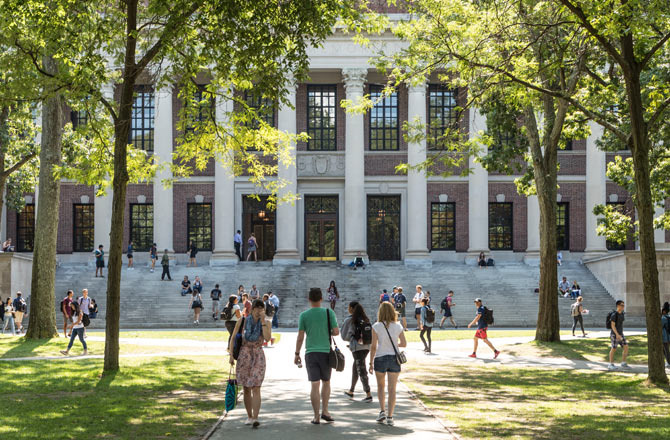
When talking about the lives of students attending Harvard University, one cannot overlook the 'dormitory'.
Harvard operates its residential system on campus in a very systematic manner. The dormitories at Harvard are among the most historically rich and diverse in American universities.
First, looking at the undergraduate case, Harvard's dormitory system is based on the principle of four years of dorm living. All first-year students live in traditional dormitories near Harvard Yard. This area is located in the heart of the school, with red brick buildings lined up, resembling a small town. Some of these buildings were constructed in the late 18th century, retaining old wooden floors, fireplaces, and narrow staircases, giving a strong sense of history.
At the end of the first year, students are assigned to the 'Harvard House' system, which is a hallmark of the school. This system is one of Harvard's prides, consisting of a community life divided into 12 houses. Notable houses include Adams House, Kirkland House, Lowell House, and the most famous Dunster House. Each house accommodates about 350 to 450 students, and within the house, there are dining halls, study rooms, music rooms, sports facilities, and libraries. It can essentially be considered a small campus.
The Harvard House system is designed not just as accommodation but as a 'community learning space'. Each house has faculty members who reside or visit periodically to share meals with students, provide mentoring, and offer advice on academics and career paths. Therefore, dormitories are regarded as spaces that provide experiences beyond studying at Harvard. In fact, most graduates say, "Memories of Harvard begin and end in the house."
So, what about graduate students? Harvard also provides separate dormitories for graduate students. Notable places include Perkins Hall, Pepperell House, and Graduate HLS Housing. Graduate dormitories are somewhat more independent than those for undergraduates, ensuring personal living space. Most are single rooms or studio-type accommodations, and there are also apartment-style lodgings that include kitchens. Due to the research-oriented nature of graduate studies, many students study or conduct experiments late into the night, so the school provides a relatively quiet and stable environment.
However, not all graduate students can live in school dormitories. Due to high demand, priority is given to freshmen and international students. Students who cannot get into the dormitory rent private apartments or houses around the school, with notable areas including Cambridgeport, Riverside, Allston, and Somerville. These areas are within a 10 to 20-minute bike ride from the Harvard campus, making them popular among students.
The cost of accommodation is somewhat high. For undergraduate dormitories, the annual cost is about $13,000 to $16,000, while graduate dormitories or nearby apartments can range from $1,500 to $3,000 in monthly rent. Cambridge is a bit quieter than Boston, but since both Harvard and MIT are located in the area, rental prices are relatively high. However, it has the advantage of good safety and the ability to commute by bike or on foot.
There are also well-equipped facilities for students near Harvard. Harvard Square is densely packed with bookstores, cafes, restaurants, and supermarkets, and it is safe to walk around even at night. You can often see students studying with their laptops open at nearby Starbucks or local cafes.
Harvard's dormitories are spaces filled with tradition and history, but they are also a small world where diverse cultures coexist. Students from all over the world live together in the same building, engaging in discussions, sharing meals, and learning languages, building experiences that help Harvard become a foundation for growth.





 candytip |
  Spaghetti Pasta Fan |
 lollipop |
 sprinkletop |
 Tonky |
  viroma |
  cookie |
  Live and that's it |
  Alright Twain |
  eatontown blog |
  HAWAII Korean Church News |
  Amore |
  linex |
  Balancework |
  laro90 |
  MEDBIO American Doctor Blog |
  SWAT TEAM BLK |
  DREAM BIG |
  frostbite |
  330 Forever My Love |
  El Dorado |
  dralix58 |
  Gorama Round |
  Skydiving |