

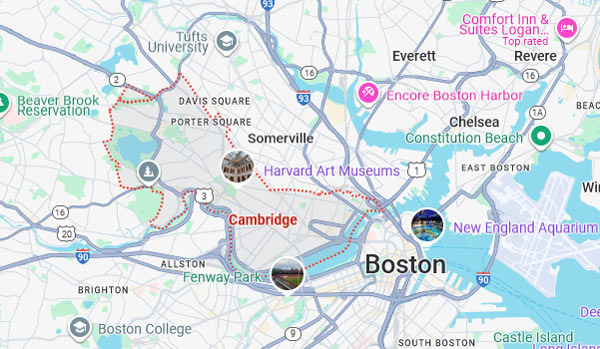
Cambridge is administratively a separate city from Boston, but in terms of living, economy, and culture, they are essentially one. While Boston, divided by the Charles River, is a city of history and finance, Cambridge is a city of knowledge and innovation.
First, looking at the geographical relationship, Cambridge is located just north of Boston, with the Charles River separating the two cities. A few bridges connect directly to downtown Boston, making it practically the same living area. You can easily travel back and forth through bridges like Harvard Bridge, Longfellow Bridge, and BU Bridge, and public transportation is well established. Taking the MBTA Red Line, you can reach Harvard Square in Cambridge from downtown Boston in just 10 minutes. As a result, many students and professionals commute between Boston and Cambridge.
Economically, the two cities serve as engines for each other. While Boston is a hub for finance, healthcare, and the biotech industry, Cambridge has established itself as a center for technological innovation and research. The fact that both Harvard University and the Massachusetts Institute of Technology (MIT) are located in Cambridge speaks volumes about the city's status.
These two universities are global centers for research and entrepreneurship, with numerous startups like Google, Facebook, and Dropbox originating in this area. In fact, Kendall Square, near MIT, is often referred to as "the most innovative square mile in the world," attracting technology startups and venture capital. The technologies developed here connect back to Boston's financial sector, hospitals, and research institutions, creating a structure where knowledge and capital circulate between the two cities.

Culturally, the two cities are perfectly intertwined. While Boston is centered around classical and historical themes, Cambridge has a younger and more experimental vibe. Harvard Square features traditional bookstores, independent cafes, and street performers, while heading towards Kendall Square or Central Square, you find artistic galleries, indie record shops, and small theaters.
In contrast, Boston is home to classical cultural assets like the Boston Symphony Orchestra and the Museum of Fine Arts (MFA). Thanks to the artists and students traveling between the two cities, Boston and Cambridge have become places where different styles of culture coexist and blend naturally.
Moreover, in terms of education and living environment, the two are closely linked. Cambridge feels a bit quieter and more residential compared to Boston. The historic brick houses and tree-lined streets around Harvard's campus, along with the walking paths along the Charles River, create an attractive living space for both students and professionals. On the other hand, Boston has an urban and dynamic atmosphere, with a variety of restaurants, shopping, and performance culture. Thus, many people live in Cambridge while commuting to Boston for work, or vice versa, studying in Cambridge while residing in Boston.
The bridges over the Charles River symbolically represent the relationship between the two cities. During the day, joggers and cyclists cross, and at night, students chat as they walk across the bridges with friends. Although they are different cities, the boundaries disappear on the bridges. When the lights of Boston reflect off the red brick buildings of Cambridge across the river, it reminds us of how deeply connected the two cities are.
The climate is also nearly identical in both cities. The four seasons are distinct, and it snows frequently in winter. Particularly, the scenery of the Charles River freezing in January and February is a common winter symbol for both cities. In summer, both Boston and Cambridge celebrate the Head of the Charles Regatta along the river, creating a festive atmosphere. This event is a representative traditional event enjoyed by residents of both cities, providing a moment to feel the sense of community that transcends city boundaries.
Ultimately, while Cambridge and Boston are administratively different, they can be considered one city in the context of life. Without one, the other would not be as it is today. If Boston symbolizes the history and tradition of the city, Cambridge represents the innovation that builds the future on top of that.





 candytip |
 Spaghetti Pasta Fan |
 lollipop |

 sprinkletop |
  Tonky |
  viroma |
  cookie |
  Live and that's it |
  Alright Twain |
  eatontown blog |
  HAWAII Korean Church News |
  Amore |
  linex |
  Balancework |
  laro90 |
  MEDBIO American Doctor Blog |
  SWAT TEAM BLK |
  DREAM BIG |
  frostbite |
  330 Forever My Love |
  El Dorado |
  dralix58 |
  Gorama Round |
  Skydiving |