
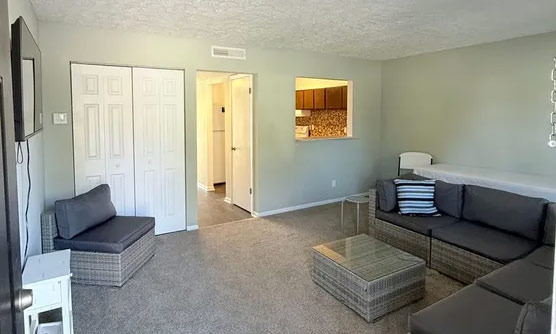
The average rent for a 1-bedroom in Los Angeles is about $2,095 as of August 2026.
Interestingly, this is about 10% lower than a year ago. In fact, a landlord I know raised the price thinking of last year's market, but couldn't find a tenant for nearly two months.
One of the most common mistakes for first-time landlords is thinking, "I got this much last year, so I should get it this year too."
You shouldn't think that way.
When setting rent, it's more important to look at similar listings around your property than the overall average for LA.
Check how much 1-bedrooms are going for in the same neighborhood, how much homes with parking are listed for, and what recent listings are advertising.
Once you've set a price, you can list it on sites like Zillow, Apartments.com, or Zumper.
Photos are also important.
It's good to clearly state conditions like the number of bedrooms and bathrooms, parking availability, laundry facilities, and whether pets are allowed from the start.
When inquiries come in, the next step is tenant screening.
Typically, landlords check credit scores, income, employment, and past rental history. Many landlords look for an income that is about three times the monthly rent.
What's important is not to change the criteria arbitrarily for each applicant. It's best to apply the same standards consistently to all applicants.
Once a tenant is chosen, a lease agreement is drafted.
You need to specify how much the rent is, when it's due, how much the security deposit is, the lease term, and who is responsible for repairs.
"We can discuss that later."
This is the most dangerous mindset.
If issues arise later, the memories of what was agreed upon may differ.
In California, you also need to be aware of security deposit regulations.
According to AB 12, which took effect in July 2024, security deposits generally cannot exceed one month's rent. However, small individual landlords who meet certain criteria can collect up to two months' rent.
When a tenant moves out, the security deposit must typically be returned within 21 days, or if any deductions are made, the landlord must inform the tenant of the reasons and amounts deducted.
The reason for taking photos of the home when the tenant moves in is precisely this.
If you document whether there were pre-existing scratches on the walls, whether the carpet was already worn, or if there were scratches on the refrigerator, it reduces the chances of disputes later.
If possible, it's good to check the home with the tenant and keep a record.
When accepting rental applications, you can't just charge any screening fee you want.
In 2026, California has a legal cap on application screening fees, so you need to check the latest amount each year.
You also need to be cautious when raising rent.
Many older rental properties are subject to AB 1482. For these properties, landlords cannot raise rent by 20% or 30% at will for a year.
Generally, the increase is limited to 5% plus the rate of inflation, with a maximum cap of 10%.
However, this does not apply uniformly to all properties. Certain single-family homes or condos may be exempt if they meet specific conditions and have provided necessary notices to tenants.
The same goes for ending a lease.
"It's my house, so I can just tell them to leave."
In California, it's not that simple.
Required notices and procedures can vary based on the length of residence, type of building, lease type, and reason for eviction.
Landlords also have responsibilities.
They must maintain basic facilities like plumbing and heating in usable condition and make appropriate repairs if issues arise.
So, if you're a first-time landlord, rather than overthinking, just remember a few principles.
Set a price that reflects the market, screen tenants properly, document all conditions in the lease, and take photos of the home's condition at move-in.
And if it's your first time, starting with a one-year lease is also a good idea. Finding a good tenant can alleviate vacancy worries for a year.
Renting out a home is not just about having rent deposited into your account every month.
It's similar to running a small business.
If you set up the contract properly from the start, it will be easier, but if you take shortcuts, it can lead to much bigger headaches later.
Especially in California, there are many rental regulations, and LA may have additional local rules.
If you encounter actual contract or eviction issues, it's safe to check the current laws and seek help from a real estate professional or a rental law attorney if necessary.
 SunnyBridge92
 urbanwavewalker1913








 urbanmint |
 |
| 
 Premium Gas Camp |
 CA Real Estate |
 Weekend Movie Blog |
 Victory 1988 |
 Superman Cat Blog |
 Anjollinya Blog |
 UCLA Captain |
  lattecu |
  dynamite |
  frostingline |
  Hakuna Matata |
  Your Curiosity Resolved |
  Way to easy |
  Chino Min |
  nexabyte |
  moonshine 7 |
  Sunset Oregon |
  victoria 68 |
  golfmaster |
  Montgomery Mom |
  squidogame |
  Noodle Noodle |
  Rhode Island Good People |
  Big North |
  Famous Attractions in the United States |
  Jin Soo V |