
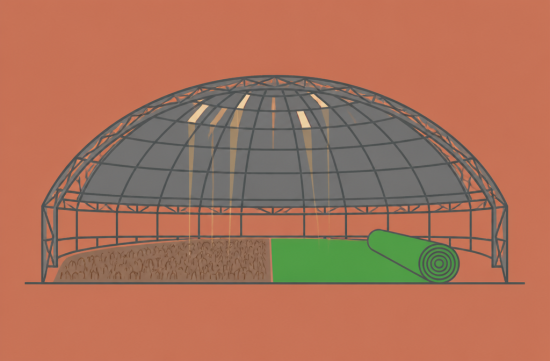
What happens when you put a roof over a baseball field? While it seems obvious now, in the early 1960s, this was quite a reckless idea. The Houston Astrodome was the place where this reckless idea was actually built.
The Astrodome opened in April 1965. It was the world's first indoor dome baseball stadium, and people referred to it as the "Eighth Wonder of the World." The New York Yankees were the opponents for the inaugural exhibition game.
You only need to experience a summer in Houston once to understand why a dome was necessary. It's hot, humid, and full of mosquitoes. Watching baseball in an air-conditioned indoor environment was revolutionary at the time.
The problem was the grass. The designers weren't foolish. They installed thousands of translucent panels in the roof to let sunlight in and chose a Bermuda grass variety that could grow indoors.
However, once it opened, an unexpected problem arose. The sunlight streaming through the panels during day games became blinding, causing outfielders to start missing fly balls. This was critical.
The team's solution was to cover some of the roof panels with paint. This reduced the glare, but it also decreased the sunlight reaching the grass.
The result was predictable. The grass began to wilt and eventually died as the season progressed. The maintenance team reportedly survived the 1965 season by spraying green paint over the dead grass and dirt.
This is an interesting point. Fixing one problem created another. It's a textbook example of the trade-offs discussed in engineering.
Enter Monsanto. A subsidiary of Monsanto had already developed synthetic turf made from synthetic fibers, named ChemGrass.
The Astrodome decided to install this product. On April 18, 1966, an official game was played on artificial turf for the first time in Major League history, with the Los Angeles Dodgers as the opponent, and the Dodgers won 6 to 3.
Interestingly, the artificial turf was only laid in the infield at that time. There wasn't enough production to cover the outfield in time. The entire outfield was covered by July of that year.
And then the name changed. ChemGrass became famous at the Astrodome and was renamed AstroTurf. The name of the product became synonymous with the stadium.
To summarize: putting a roof on caused glare, painting it killed the grass, and laying down plastic grass created an industry.
Afterward, artificial turf spread rapidly. In the 1970s, it was installed not only in dome stadiums but also in open baseball and football fields. Its low maintenance costs and the ability to play in the rain were significant advantages.
Of course, there were side effects. Early artificial turf was akin to a thin carpet laid over concrete. Players frequently complained about knee and ankle injuries, as well as the heat of the surface in the summer.
As time passed, many stadiums returned to natural grass. Today's artificial turf has evolved significantly, often incorporating infill to provide cushioning, but debates about player safety continue.
So, what has happened to the Astrodome itself? To put it simply, it still stands. However, it has remained unused for a long time, sitting on one side of NRG Park.
This building is already listed on the National Register of Historic Places and has been designated as a Texas historic landmark. This means it cannot be demolished easily.
In April 2026, the National Park Service (NPS) determined that the Astrodome meets the criteria for consideration as a National Historic Landmark. However, this is not a final designation but the beginning of the process. The final decision will require approval from the Secretary of the Interior and could take several years.
The financial aspect is even more sobering. According to cost estimates received by Harris County at the end of 2025, renovating the Astrodome to a usable level would cost $752,576,133. The estimated cost for demolition was $55 million.
Looking at the numbers alone, the difference is more than tenfold. The preservation group Astrodome Conservancy has proposed a multipurpose redevelopment plan, but no confirmed funding has been presented yet.
My position is clear. While I acknowledge its historical value, I oppose using taxpayer money to cover costs exceeding $700 million. I believe it is appropriate to proceed only when private capital is genuinely invested and a revenue model is proven by numbers.
That said, I won't assert that demolition is the answer. There are multiple legal protections in place, making demolition practically difficult. Ultimately, time exacerbates the problem, and I worry that this could be the most expensive choice.
AstroTurf was not a planned invention but a hasty fix. Yet, that fix changed the floors of stadiums worldwide for decades. There are more cases than you might think where failure leads to innovation, and this is one of the more dramatic examples.
If you find yourself in Houston or passing nearby, take a look at NRG Park. Under that quietly standing round roof, an industry began due to dying grass.
The next time you step on artificial turf in a local park or school sports field, it might be worth remembering that the beginning of that green carpet was the paint on the roof.
 70 mom
 Ooorah



 xylora |
 Tan Zoo |

 hot chocolate |
 Chichiki Chicago Train |
 Noodle Noodle |

 Shintongbangtong Shin Naerin James Park |
 TEX MEX STAR |
 Popcorn Popcorn Beer |
 California Information News |
 Things to know |
 fonix |
 MacMorningBlog |
 Encyclopedia of New York and Surrounding Areas |
 romeo JU |
 Folding Instructions |
 See It |
 memorabilia |
 H Leader |
 Carolina border |
 linex |
 Victory 1988 |
 washington mom |
 Deep South Mississippi |
 moomoon |
 premium |
 hexora |
 jammybear |
 chiobase |
 jondol |