
When you think of Houston, NASA immediately comes to mind. Thanks to the famous movie line "Houston, we have a problem," the city's name has become synonymous with space control.
However, if you ask why Houston was chosen, not many people can give a proper answer. I used to think it was simply because Texas has a lot of land.
Upon researching, I found the story to be much more interesting than I expected. In 1961, NASA visited 23 candidate sites, and Houston was not the top choice from the beginning.
Let's look at the background. In May 1961, President Kennedy officially announced the goal of landing on the moon, creating a need for a new center dedicated to human spaceflight.
At that time, the Space Task Group, responsible for the human program, was located in Langley, Virginia, but it was severely lacking space to handle the Apollo scale.
So, NASA Administrator James Webb formed a site selection team in August 1961. The team leader was John Parsons, the deputy director of the Ames Research Center.
The selection criteria were quite specific. Prior conditions included a navigable waterway for large barges, a mild climate, and commercial jet routes operating year-round.
Additionally, the site needed to have an existing industrial base, a skilled workforce, a cultural city with universities, sufficient power and water supply, and at least 1,000 acres of land.
The team first narrowed down the list to 22 cities based on climate and water conditions, focusing on areas near federal facilities, and then reduced it to 9 locations. They added 14 more to finalize the list of 23.
Site visits took place from August 21 to September 7, 1961. In Houston, the Rice University site and Ellington Air Force Base were among the candidates.
Now, here's a twist. After the tour, the team's top choice was not Houston but MacDill Air Force Base in Tampa, Florida.
The Air Force was planning to close the Strategic Air Command operations at MacDill. With existing runways and facilities, it was quite an attractive option for NASA.
However, as tensions with Cuba escalated, the Air Force reversed its plans. With MacDill dropping out, Houston's Rice site naturally rose to the top of the list.
So, was Houston just lucky? Honestly, I think it's hard to see it that way. They had some strong cards prepared.
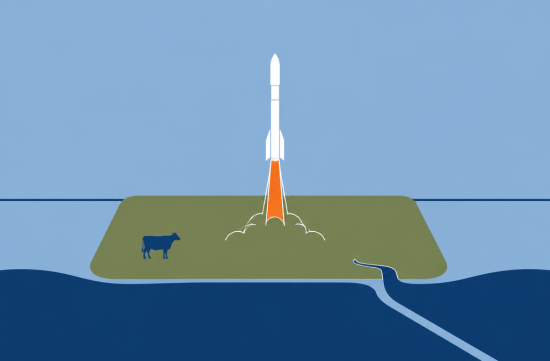
The biggest advantage was the land. Humble Oil donated 1,000 acres near Clear Lake to Rice University, which then offered that land to the federal government.
This land was originally a pasture for cattle, located 25 miles southeast of downtown Houston. It met all the criteria with waterways leading to the sea, ports, and refining industries.
And we can't overlook the political aspect. Houston's Congressman Albert Thomas was a key figure on the House Appropriations Committee that controlled NASA's budget.
Depending on the source, he is referred to as either the chairman of the Appropriations Committee or the chairman of the subcommittee handling NASA's budget. Either way, he had access to NASA's funding.
Additionally, Texas-born Vice President Lyndon Johnson was leading the National Space Council. Texas A&M historian Henry Desroches noted the significant political influence of Texas.
NASA itself acknowledged that while Tampa was the leading candidate, Texas politicians played a crucial role. In official history, this is quite a candid admission.
The decision was made quickly. On September 14, Webb reported to Kennedy, and on September 19, Houston was officially announced as the site for the new human space center.
There's an interesting anecdote as well. Right after the announcement on September 21, Robert Gillis and his team visited the site, which had just been hit by Hurricane Carla, leaving fallen trees and flooded fields.
Although the first impression was not great, the advantages of the land outweighed the concerns. Ultimately, the center was built on that windy pasture.
NASA later acquired additional land to secure access roads. Then, on September 12, 1962, Kennedy delivered his famous speech at Rice University, announcing the mission to go to the moon.
This center was renamed Johnson Space Center in 1973 after former President Johnson passed away. President Nixon signed the renaming resolution on February 19.
In summary, there isn't just one real reason. It was a combination of local elites offering suitable land for free, politicians controlling the budget, and the timing of a competitor dropping out.
Personally, I found this aspect the most impressive. It serves as a textbook example of how a significant government investment can completely change a city's industrial landscape.
Of course, the involvement of politics is subject to criticism. However, it is also true that this investment created jobs and a research ecosystem for decades.
If you ever find yourself in Houston, be sure to visit Space Center Houston. Knowing that this vast complex was once a hurricane-swept cattle pasture will change your perspective entirely.
 ChickenIntel
 GlamEditor







 Tan Zoo |

 hot chocolate |

 Chichiki Chicago Train |

 Noodle Noodle |

 Twist Kim |

 Shintongbangtong Shin Naerin James Park |
 TEX MEX STAR |

 Things to know |

 Popcorn Popcorn Beer |

 California Information News |
 ssome |
 skykong |
 Shining Our Own World |
 gardener 007 |
 golfmaster |
 Nanana Nanana Nanana |
 Who's watching? |
 endone |
 RockStar |
 Casa Mia |
 You Only Live Once |
 Hardworking CPA |
 Joyce 77 |
 Runner Kim |
 My Town My Way Blog |
 My Miami Stories |
 Entip |
 Tony Park |
 DJ DC BLOG |