
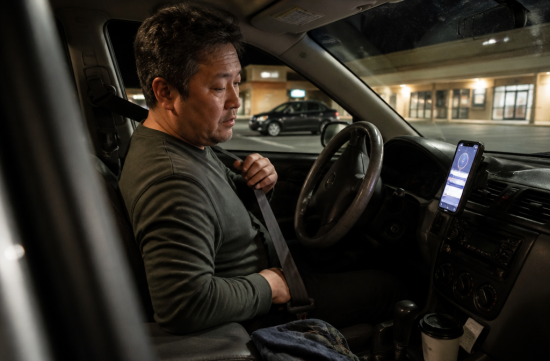
It's that time of year again when I open my insurance renewal notice and sigh. These days, insurance companies are all promising discounts just for downloading their apps.
For someone like me who drives slowly like a panda, it's hard not to be tempted. However, I have a habit of being skeptical about advertising claims, so I started digging through the official pages.
To cut to the chase, this app doesn't offer discounts to everyone. The benefits and drawbacks are quite clearly divided based on driving patterns.
First, let's look at the stakes. According to Bankrate, the average full coverage in Kansas is $2,477 per year, while in Kansas City, it's $2,801.
Experian's data from May 2026 shows that full coverage in Kansas costs $2,513 per year. The numbers may vary slightly due to different calculation methods, but the burden is the same.
If we take Bankrate's $2,801 and divide it by two, we get about $1,400 for six months. A 10% discount would be $140, and a 30% discount would be $420, which is certainly worth considering. Of course, this is just a simple hypothetical calculation I've made.
Let's look at Progressive Snapshot. Their official page states that customers who received discounts saved an average of $328 at renewal. This is based on a six-month insurance period.
Read that sentence carefully. It's the average among those who received discounts. Those who didn't receive discounts are excluded from the calculation.
The same page mentions that about 2 out of 10 people see their rates increase. It sounds like just 2 people, but those 2 could be me.
They also advertise an average discount of $164 at signup. However, this is only for new customers and ends upon renewal. This is why you shouldn't get too excited just from the first notice.
State Farm's Drive Safe & Save claims a maximum discount of 30% on their official page. A footnote mentions that this varies by state.
Many review sites claim that rates never go up. However, the official page states that the adjustment range can increase or decrease at each renewal. There's also a note that if you exceed 7,500 miles a year while receiving low-mileage discounts, your rates may go up.
Allstate Drivewise shows varying maximum discounts of 25% to 40% across different sources. It's unclear whether rates increase when scores are poor, so it's best to ask an agent directly.
Progressive monitors hard braking, rapid acceleration, mileage, and driving times. They only check phone usage in some states when using the mobile app.
State Farm looks at rapid acceleration, hard braking, sharp cornering, and speeding over 8 miles per hour. Annual mileage is also considered.
The criteria for phone usage are interesting. If your phone moves and the screen is on while the car is in motion, it gets flagged. Those who hold their phones without a mount to navigate should be cautious.
The favorable side is pretty clear. Those who work from home or have short commutes, primarily drive during the day, and drive gently will benefit.
The unfavorable side includes those who work at night. Progressive advises reducing driving from midnight to 4 AM on weekends.
Many Korean business owners drive home after closing their restaurants or shops during those hours. Even if they drive carefully, they could be penalized due to the time of day, which is frustrating.
Long-distance commuters also need to calculate carefully. Mileage itself counts towards the score, and heavy traffic can lead to hard braking.
In this area, hail damage can't be overlooked. Hail damage is covered under comprehensive insurance, and even if you have a perfect app score, you can't prevent what falls from the sky.
We also need to address data issues. The FTC finalized an order against GM and OnStar in January 2026. The incident stemmed from Smart Driver driving records being passed to insurance companies through data firms like LexisNexis and Verisk.
GM cannot share location and driving data with consumer credit reporting agencies for the next five years, and explicit consent must be obtained when collecting data. This incident made me feel uneasy because my driving habits became a product.
However, there are positive aspects. A study published in Marketing Science found that participants in such programs reduced hard braking by an average of 21% after six months. Driving gently reduces the risk of accidents and fuel consumption, which is good for the planet.
For those who have received insurance discounts based on T-map scores in Korea, this may seem familiar. However, in the U.S., the conditions that could be unfavorable vary by company, so don't just rely on that memory and rush to sign up.
If it were me, I wouldn't download the app right away. I would first evaluate my driving distance and the proportion of congested areas over the past two weeks when driving past midnight.
Then, I would ask the agent three questions: whether rates increase with poor scores, how many months are measured, and who the data is shared with.
Make comparisons based on renewal amounts, not signup discounts. If you also look at quotes from other companies without apps, the answer will become clear quickly.
Be sure to check if it's available in Kansas. While Kansas is not listed as an excluded state by State Farm, they didn't specifically mention Kansas on their official page.
My choice is clear. If I drive less at night and don't drive much, it might be worth trying. If I work night shifts, comparing quotes is better than using the app. Today, like a panda munching on bamboo, I'll take my time applying the brakes.
 urban89

 choi family |
 content |
 Carolina border |

 Que Buena |
 juicylol |
 business life |
 1004 Man |

 Kansas City Representative Singer |


 assa man |
 pandaworld |
 lumix88 |
 Lansinger |
 Giant Squid and Sweet Potato Soup |
 InJung Gu |
 cake money |
 swiftlane |
 Love Michigan |
 Lim Ario |
 Rice Shop Uncle BLOG |
 Surrender Novena |
 Street Smart Blog |
 Moscow Kim |
 bubblo |
 Toaster Pizza Magic Show |
 Star Voyager |
 Noodle Noodle |
 Hakuna Matata |
 pixel77 |