
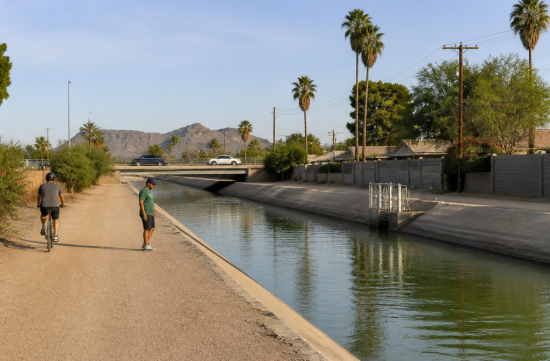
Driving along Camelback Road in the summer, you cross a canal right in the middle of the city. If you roll down the window, you can catch a whiff of wet earth mixed with the hot asphalt smell.
I just assumed it was a local irrigation ditch. But when I dug into the history of this waterway, the story changed completely.
Everyone knows that the name Phoenix refers to the mythical bird, but not many know why it was chosen. The answer lies in this canal.
It all started with the Hohokam people. They were farmers and engineers who diverted water from the Salt River to farm in the desert.
Their tools were quite basic. Roger Lidman, who was the director of the Pueblo Grande Museum at the time, explained in a 2013 KJZZ report that they used stone tools, sharpened wooden sticks, and baskets to dig.
When it comes to scale, it gets even more interesting. Lidman mentioned it was nearly 1,000 miles, while the official history page of Phoenix states it was 135 miles.
That's quite a difference. My guess is that it depends on how you measure it.
According to Lidman, the waterway started near Pueblo Grande north of the Salt River and stretched north to Camelback Road and west to 99th Avenue. They dug that distance without any modern machinery.
Honestly, it gave me chills. It's like there's a map of a canal dug by human hands beneath the road map of a city that can't survive without cars.
However, these people left their village around 1450. The reason is still unresolved.
The city's history page lists a long drought as the prevailing theory. In contrast, other city documents report that major floods between 1358 and 1382 disrupted society.
Fast forward over 400 years to 1867. Jack Swilling of Wickenburg was resting his horse at the foot of the White Tank Mountains, looking out over the Salt River Valley.
What he saw was land that only needed water. He formed the Swilling Irrigation Canal Company, and by March 1868, water flowed through the new canal.
This is the key point. Records indicate that the early canals largely replaced the Hohokam waterways, and later the Salt River Project also used parts of the same route, according to Lidman.
So, the statement that the city was built on a canal is partially true. They reused some of the original paths.
Now it's naming time. Swilling pushed for the name Stonewall, after Confederate General Stonewall Jackson.
Salina was also suggested, as well as Pumpkinville. Can you imagine a team called the Pumpkinville Suns?
Ultimately, it was Darrell Duppa's suggestion that stuck. It means a new city rising from the ruins of an ancient civilization, and the city has noted this as an accepted derivation.
However, Duppa himself remains a bit of a mystery. Other city pages state that it is believed he made the suggestion, and records of his birthplace vary between Kent and Paris.
Still, we have to acknowledge his naming sense. He associated a bird reborn from ashes with the ruins of the desert, which is a branding genius by today's standards.
The official recognition came on May 4, 1868, when Yavapai County created election districts.
The city was officially incorporated on February 25, 1881, the day Governor John C. Fremont signed the Phoenix Charter Bill.
However, I have some reservations here. The story of rising from the ruins is compelling, but it also means that the earlier inhabitants have become mere shadows.
Take the term Hohokam, for instance. The city page introduces it as "the people who have gone," which is a name used by archaeologists, while the O'odham people refer to them as Huhugam.
The descendants include the O'odham, Hopi, and Zuni, and the Salt River Pima-Maricopa Indian Community still resides in this Valley. So, the term "the departed people" doesn't tell the whole story.
That's why I was pleased to hear the news in March 2023. The city's Parks and Recreation Board unanimously voted to rename the Pueblo Grande Museum to S'edav Va'aki Museum.
In O'odham, it means Central Vahki, referring to the large platform mound that remains at the site. Since Pueblo is a Spanish term, it signifies that a place once named in someone else's language has found its true name.
The location is at the southeast corner of 44th Street and Washington Street. I couldn't check the operating hours, so please refer to the city website before you go.
I recommend visiting the museum and then slowly driving along the canal's side road. According to the KJZZ report, you can also see parts of the old canal north of the Park of the Canals parking lot in Mesa.
I still like the name Phoenix. However, I believe the true protagonists of this resurrection story are not the bird but the people who dug the waterways and their descendants who are still here.
Next time you stop at a signal and cross the canal, please take a moment to look down. I'm not the only one who finds this eerie, right?
 SpiegelHat








 Rice Shop Uncle BLOG |

 Noodle Noodle |

 Chino Min |

 Glow Yo |

 Michigan Enthusiast |
 Kitchen Ideas |
 business lim |

 Young Kim |

 Arizona AZ Cowboy |
 nova nova |
 figtop |
 Yahoo LALA |
 Korea News Economic News |
 calvor |
 timistic |
 Lee Sang Don |
 victoria jung |
 The Long Shot |
 Univ Student |
 Bald Eagle Brothers |
 Tora Tora |
 pandaworld |
 lumix88 |
 choi family |
 Lansinger |
 Giant Squid and Sweet Potato Soup |
 InJung Gu |
 cake money |
 swiftlane |