
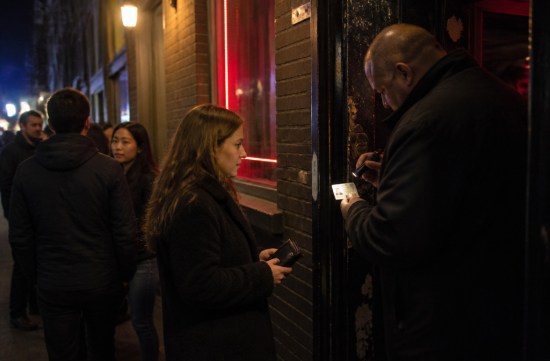
A bright red neon light floods the entrance of the bar, and the doorman extends his hand. He says just one word: "ID."
Most people in line pull out their driver's licenses from their wallets. Even those who seem to live without a car show the card issued by the state.
To someone coming from Korea, this seems quite strange at first. With just a driver's license, you can enter a bar, do banking, and even board a plane.
The U.S. does not have a national ID card like a resident registration card. There is no card that federal agencies are required to issue to all citizens.
In that void, the driver's license has taken its place, although its origins had nothing to do with identity verification.
When Massachusetts and Missouri first required driver's licenses in 1903, there wasn't even a test. The first state to require a test was Rhode Island in 1908.
By 1935, only 39 states issued licenses, and only a few required a test.
Photos came much later. Maryland's driver's license only had a photo added in the mid-1980s.
A photo-less ID seems comical now. This means that for a long time, the card was simply a driving permit.
I believe the turning point was in everyday life rather than in law. In a country where everyone drives, having a photo ID in every wallet became the standard.
Each state issues its own licenses, and licenses from other states are recognized. The colors and designs of the cards vary, making them somewhat interesting to those who take photos.
What if you don't drive? The DMV issues a regular ID, so even those who only take the subway eventually find themselves in that line.
This raises the question: what about the Social Security Number? This number began being issued in November 1936, and within three months, 25 million had been distributed.
The purpose was to track wage records. From January 1946 to January 1972, cards even included a note stating not to use them for identity verification.
The reason that note disappeared is quite a story. Almost everyone got a number, and it became convenient for identity verification.
They wrote not to use it, but since everyone did, they removed the note. However, since this card has no photo, the structure solidified with the driver's license holding the photo and the SSN holding the number.
South Korea took the opposite route. After the Blue House raid on January 21, 1968, the resident registration law was amended that year, assigning a number to each individual.
The issuance of resident registration cards began on November 21, 1968. The main purpose was to identify spies, and the 12-digit number became 13 digits in 1975.
In a security crisis, a number imposed from above contrasts sharply with a card that grew from below in a car culture. Like red and blue, the starting points are distinctly different.
There has been discussion in the U.S. as well. Proposals for a national ID have come up several times, but every legislative attempt has failed.
This is a rare point of unity between progressives and conservatives. Both sides view such a card as a symbol of totalitarianism, and federalism, which values state authority, also played a role.
The turning point was 9/11. The 9/11 Commission recommended federal standards for identification, and the REAL ID Act was signed on May 11, 2005.
The cards are still issued by the states, but the federal government sets minimum security standards. However, states did not comply willingly.
In 2007, Maine and Utah passed resolutions against it, and Missouri even created a law in 2009 to explicitly not comply. That law was only repealed in 2017.
The original deadline of May 2008 kept getting pushed back, and enforcement will begin on May 7, 2025. It has taken nearly 20 years since the law was signed.
Now, to fly domestically or enter certain federal facilities, you need a REAL ID-compliant card or other accepted documents like a passport. According to TSA guidelines, travelers without accepted documents must pay $45.
The Department of Homeland Security states that since the states issue the cards and manage the data, it is not a national ID. In contrast, the ACLU of Maryland warned in 2008 that this card would effectively become a national ID.
In my view, the critics are more accurate. Although it doesn't have a name, its functions have already reached that point.
Conversely, there are movements rising from local levels. IDNYC, started by New York City in 2015, is a municipal ID given for free to residents aged 10 and older.
In terms of convenience, South Korea wins hands down. Anyone who has stood in line at the DMV cannot argue otherwise.
Still, I will side with the American way. I prefer a card that I receive because I need it over a card that the government assigns me with a number. It is certainly a weakness to tie too much to the SSN.
Tonight, someone will pull out their driver's license under the red neon light. That small card carries over 120 years of automotive history and a stubborn distrust of the government.
 HoneyWalker
 FunUSALife






 Noodle Noodle |

 Chino Min |

 Glow Yo |

 Michigan Enthusiast |
 xylora |

 Encyclopedia of New York and Surrounding Areas |

 newyorker 101 |

 wishi |


 Hakuna Matata |
 pixel77 |
 uplifted |
 moo moo |
 winter |
 windstone |
 My winter |
 Gomo Nim |
 oneonly |
 blixon24 |
 canyon |
 juniper |
 novaline |
 sunny side |
 kimchi warrior |
 nero kim |
 refresh |
 rainyday |
 springw |