

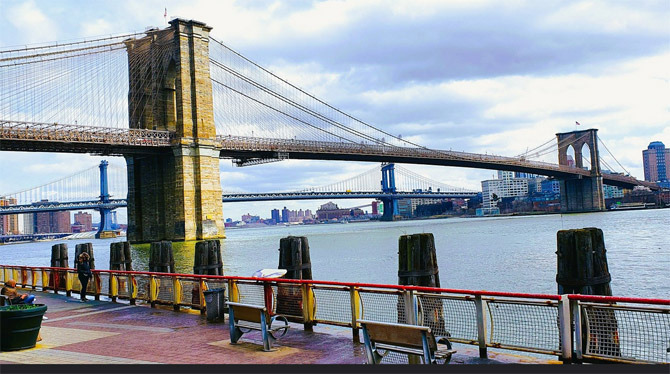
The Brooklyn Bridge is not just a way to cross the river, but a symbol of the city of New York. Walking across it, I understood why. This bridge spans the East River in New York City, connecting downtown Brooklyn and Manhattan's Lower East Side with six lanes of traffic in both directions.
When I visited, tourists were taking pictures in the middle of the bridge, looking towards the Statue of Liberty, and to the east, the Manhattan Bridge and One World Trade Center were visible. The wind was strong, but it added to the refreshing energy of New York.
This bridge has a history of over 140 years, and while walking, it feels like a journey through time. Like the Williamsburg Bridge, there is a wide pedestrian walkway in the middle of the two lanes, making it a popular spot for citizens and tourists traveling between Manhattan and Brooklyn.
It is such an iconic route that it is included in the New York Marathon course, and many people take photos with the bridge in the background from either Manhattan or Brooklyn. It looks great during the day, but the night view is truly beautiful. The stunning sight of the bridge's vintage structure against the backdrop of towering skyscrapers is enough to make anyone want to grab a camera.
While walking across the Brooklyn Bridge, I naturally became curious about whether other bridges in New York require a toll to cross by car.
To conclude, the Brooklyn Bridge, along with the Manhattan Bridge, Williamsburg Bridge, and Queensboro Bridge (59th Street Bridge), are all free to cross. These four bridges are representative connections between Manhattan, Brooklyn, and Queens, and since drivers can cross without paying a toll, they are notorious for being congested during rush hours.
On the other hand, there are many toll bridges. The George Washington Bridge, Lincoln Tunnel, and Holland Tunnel, which connect Manhattan and New Jersey, have tolls, as do the Triborough Bridge (officially RFK Bridge) going from Manhattan to the Bronx, the Whitestone Bridge connecting Queens and the Bronx, and the Throgs Neck Bridge, all of which are toll bridges.
Only a few major bridges connecting Manhattan, Brooklyn, and Queens are free, while most others require payment. Especially, almost all bridges and tunnels operated by the MTA in New York State are toll bridges, so drivers use electronic toll systems like E-ZPass for automatic payments.
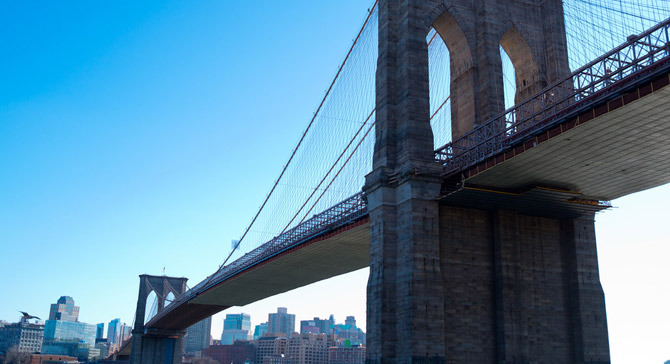
What impressed me the most was that the bridge is still strong. It was called a miraculous structure at the time of its completion, and it continues to safely support countless people and vehicles. Of course, there have been several renovations, and construction is still ongoing in various places, but the basic structure was built so robustly that it remains beloved by New Yorkers and visitors alike.The Brooklyn Bridge was completed in 1883, with a total length of 5,989 feet (about 1.8 km), making it the longest suspension bridge in the world at that time and the tallest structure in New York City. It was also the first bridge to use steel cables, regarded as a pinnacle of civil engineering, and is the world's first suspension bridge and the oldest bridge in the United States.
Just as the Golden Gate Bridge and Bay Bridge in San Francisco are often confused, the Manhattan Bridge next to the Brooklyn Bridge can also be easily mistaken due to its similar appearance. The two bridges are so close that first-time visitors to New York may get confused. However, they can be distinguished upon closer inspection.
The Brooklyn Bridge is a historic bridge, and if you visit New York, it is definitely a must-see spot for a photo.


 candytip |
 Gold Bar |
 Pirate Ship Popcorn Maker |
 Montgomery Mom |
 Anjollinya Blog |
 Starbucks Reserve Roastery Closure |
 river9 |
 Encyclopedia of New York and Surrounding Areas |
 Softember |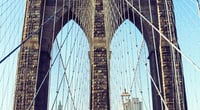
 Tonky |
  viroma |
  cookie |
  Live and that's it |
  Alright Twain |
  eatontown blog |
  HAWAII Korean Church News |
  Amore |
  linex |
  Balancework |
  laro90 |
  MEDBIO American Doctor Blog |
  SWAT TEAM BLK |
  DREAM BIG |
  frostbite |
  330 Forever My Love |
  El Dorado |
  dralix58 |
  Gorama Round |
  Skydiving |