
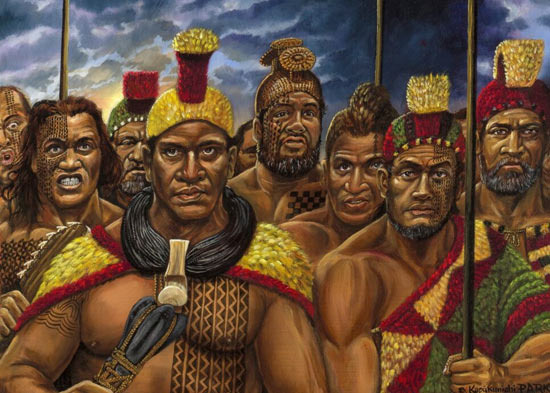
The Kahului area of Maui, Hawaii, may look like a modern city with an airport and a harbor today, but long ago it was an important living space for Native Hawaiians who traveled between the sea and mountains. In particular, Kahului was not just a fishing village; it played a central role in inter-island exchanges. You could think of it as a 'logistics hub' in today's terms. So, did the natives of Maui actually interact with the natives of Oʻahu? To put it simply, yes—they did. And that relationship held significance beyond mere trade.
First of all, the Hawaiian Islands were not isolated from each other for long periods. Modern Hawaiians often say, "Our ancestors knew the paths over the sea." That saying is not just poetic; it is true. Ancient Hawaiians navigated between islands by reading the stars, winds, and currents. Between Maui and Oʻahu lie the islands of Moloka'i and Lāna'i, which served as natural intermediate points. These four islands are still referred to as 'Maui Nui,' originally one large island that split apart thousands of years ago due to volcanic activity and changes in sea level. Thus, the natives of this region were geographically and culturally very close to each other.
Kahului is located on the northern coast of Maui, making it favorable for sea routes. Thanks to this, the natives of this area actively engaged in exchanges with other islands early on. There were many forms of barter trade with the natives of Oʻahu. For example, Maui sent tools made of limestone and lava rock, fishing net cords, and dried fish, while Oʻahu is said to have exchanged bananas, taro, feathers, and honey or coconut oil. At that time, there was no currency, so trade was based on trust. When inter-island relations were good, exchanges were frequent, but sometimes they were interrupted due to political conflicts.
Especially around the 17th century, when each island was under the rule of independent chiefs (Ali'i), competition between Maui and Oʻahu was quite fierce. The chief of Maui, Kamehameha Nui, and the chief of Oʻahu, Kahiakauole, have records of disputes over maritime rights and trade routes. However, in the late 18th century, with the emergence of Kamehameha I, who established a unified kingdom (the founder of the Hawaiian Kingdom), these regional conflicts gradually disappeared and were integrated into a single kingdom system. Since then, Maui and Oʻahu have maintained close political and economic relations.
Interestingly, cultural exchanges were also active. The hula tradition from Oʻahu was passed to Maui, evolving into a slower and smoother form, while Maui's traditional ʻImu cooking method (a way of cooking meat in a stone pit) began to be used in Oʻahu's ceremonial practices. Such cultural exchanges created much deeper connections than merely trading goods. Art, dance, language, and food blended together, weaving all of Hawaii into a single cultural sphere.
In the time of the Kahului natives, navigation was not just a means of travel but considered a sacred act. Crossing the sea was akin to walking on a path made by the gods. They offered sacrifices to the sea god Kanaloa before sailing and would call upon the name of Akua (god) to divine the direction of the wind before departure. This traditional ritual was also shared by the natives of Oʻahu. So, it was not just a physical relationship but also a shared faith and spiritual bond.
Today, the Kahului harbor has transformed into a commercial port with containers and cargo ships, but tracing its roots reveals the 'memories of exchange between islands.' The relationship between Oʻahu and Maui remains similar today. Oʻahu is the center of industry and population, while Maui is the center of nature and agriculture. Goods come from Oʻahu, and food and resources come from Maui. The exchanges that the natives engaged in by loading goods onto canoes 500 years ago have now evolved into port logistics.
Ultimately, the relationship between the Kahului natives and the Oʻahu natives was not merely trade but a 'communal connection.' Though separated by the sea, they were united in spirit. Hawaiians still carry on that tradition, saying, "We may be separated by the sea, but we are connected by the waves." Just as that saying goes, the winds of Kahului still blow toward Oʻahu, and the waves of Oʻahu reach the shores of Maui. Just like the ancient navigators, the islands of Hawaii are still reaching out to each other.





 Hani 1977 |
 Mau Nui |
 Hawaii Tourist Information |

 Hawaii Maui Kahului |
  Korean Mom |
  My NYC |
  moo moo |
  Mr Oh |
  forevergee |
  festival |
  manchester |
  constant |
  Leapfrog Move |
  vibranto |
  Tora Tora |
  yellowbutter |
  Dolly |
  US Embassy |
  NYC saladbar |
  Finding Superfoods |
  lightyear |
  song bang |
  vexomo |
  Indiana Jones |