
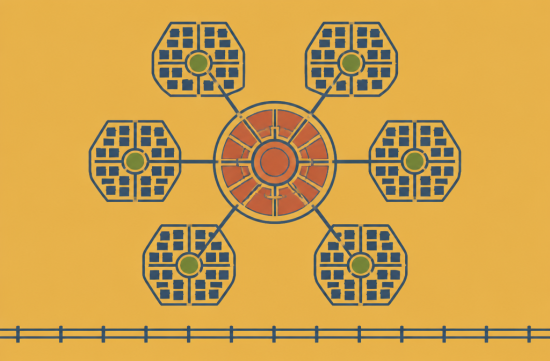
When I first drove into Irvine, I felt something strange. The roads were so straight, and each neighborhood had a similar, tidy atmosphere, making it feel like I was driving on a blueprint that someone had drawn in advance.
Later, I found out that my feeling wasn't wrong. Irvine was actually designed as a city from the beginning.
The story starts on a ranch. Most of the land that is now Irvine was originally a massive ranch called Irvine Ranch, and the Irvine Company traces its origins back to 1864.
The size of the ranch varies slightly in different sources, with figures of 93,000 acres or 94,000 acres. Either way, it's hard to imagine that one family and company owned that much land by today's standards.
The turning point was the university. In 1959, when the University of California chose Irvine Ranch as the site for its southern campus, everything changed.
The person called in at that time was architect William Pereira. As the university's consulting architect, he proposed building a new city around the university.
Typically, cities develop with people gathering first, followed by roads and schools. In Irvine, the order was completely reversed.
On June 20, 1964, President Lyndon Johnson landed by helicopter on this land, which was still a field, to dedicate the UC Irvine site. The campus officially opened on October 4, 1965.
Interestingly, the name UC Irvine did not come from the city name. It was derived from James Irvine, the landowner who operated Irvine Ranch, meaning the university used the name before the city did.
The core concept of the city envisioned by Pereira and the Irvine Company planners was the idea of villages. This involved creating living areas with schools, parks, and shopping centers in each neighborhood.
They also predetermined the locations for industrial, residential, and commercial areas, as well as the green belts connecting them. Essentially, they decided from the start where everything would go.
By 1970, the first phases of early villages like Turtle Rock, University Park, Westpark, El Camino Real, and Walnut were completed.
Then, in December 1971, the residents voted to incorporate the city. The vote passed on December 21 by a 2-to-1 margin, and state certification was granted on December 28.
Interestingly, the city boundaries chosen by the residents were much larger than Pereira's original plan. The residents expanded the scope themselves after receiving the blueprint.
So, what was the population at that time? According to the city website, the population in 1971 was 10,081.
Before writing this article, I had heard that the starting population was 7,000, but I couldn't verify that number in the official data I found. So, I decided to use the figure released directly by the city.
After that, the growth was truly astonishing. According to city data, the population reached 31,750 in 1975, and the county census data recorded 62,134 in the 1980 census.
By 1990, it was 110,330, and in 2000, it was 143,072. In 2010, the population was 212,375, and by the 2020 census, it had risen to 307,670.
Looking at the numbers, it seems like the city has taken a step up every ten years. To me, it looks like the traces of filling in the villages are clearly reflected in the numbers.
The city's financial report for the 2025 fiscal year shows a population of 318,629 as of June 30, 2025. Compared to the year it became a city, that's more than a 30-fold increase.
The original plan's scale varies in different sources. Some describe it as a city for 50,000 people, while UCI library materials mention a plan for 100,000, but in either case, Irvine has far exceeded that now.
Since I work in the automotive industry, I tend to notice the roads when looking at a city. Irvine definitely gives the impression of being designed for easy movement by car.
However, I can honestly understand the opposing viewpoint as well. Many people say that it's too neat and similar, lacking individuality in each neighborhood, and that there's no fun in discovering something by walking around.
The advantage of a planned city is its predictability. Knowing where schools and parks will be makes it a very comfortable place for families raising children.
On the other hand, that predictability comes at a cost. Because a significant portion of the land has been held and developed by one company for a long time, there are ongoing concerns about that company's influence on the city's direction.
I believe both perspectives are valid. The advantages and disadvantages that arise from a city that started on a blueprint stem from the same root.
However, one thing is certain. The fact that the idea of establishing a university on a ranch and designing the surrounding area has led to a city of over 300,000 people in half a century is quite remarkable.
Next time you drive along the main roads of Irvine and see a neighborhood entrance sign, think about it for a moment. The village you are passing through was also a neighborhood that someone sketched out on paper decades ago.
I wouldn't just call this city a soulless planned city. I feel a bit more inclined to see it as a city that was thoughtfully created with consideration for where people would live from the very beginning.
 bluestylecreator1986






 Twist Kim |

 U.S. Weather Bureau News |

 Community Cross |

 Conflite Teacher |

 SEVEN SEVEN |

 MEDBIO American Doctor Blog |

 Piano Teacher Blog |
 All About Cars |

 Tennis City |
 james kim |
 lomira98 |
 calmbridge |
 oneonly |
 Brighto |
 racuse |
 Total Beauty |
 crystal |
 Good Hotels |
 raspberry7 |
 Que que |
 Well Done Sir |
 dance dance |
 sweetpepe |
 vegas mom |
 Olivia's Blog |
 cathywhite |
 heartbreaker |
 Giant Squid and Sweet Potato Soup |