
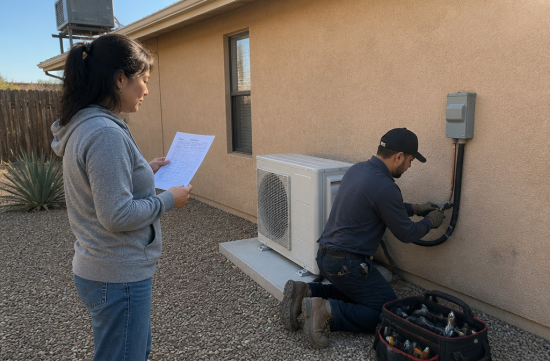
This year, many people who have received estimates for replacing windows or HVAC systems are asking a similar question: "The 30% tax benefit I heard about last year, is it still available?" To put it simply, the federal benefit has already ended.
According to the guidance from the IRS regarding the One Big Beautiful Bill, the Energy Efficient Home Improvement Tax Credit (25C) does not apply to items installed after December 31, 2025. The key date is not the contract date but the actual installation completion date.
If the terminology is unfamiliar, think of it this way: a tax credit is not a deduction from income; it directly reduces the amount of tax you owe. That's why it felt significant.
From 2023 to 2025, you could receive 30% back on costs, with an annual limit of $3,200. Heat pumps had a separate limit of up to $2,000, while windows had a limit of $600.
So, if you installed a heat pump last year, there's no need to recalculate now. You can already claim it on your 2025 tax return using Form 5695.
The issue lies with homes that are undergoing renovations this year and those still contemplating their options. There are no new alternative credits at the federal level.
For reference, some members of the House have sent letters challenging the IRS interpretation, arguing that the expiration date in the law is 2032. However, actual tax reporting will follow IRS guidance, so it's best not to rely on this when making plans.
So, what options remain in Albuquerque? You can think of it in two main categories.
The first is the state government's HEAR rebate. Simply put, this is a discount coupon funded by the federal Department of Energy and distributed by the New Mexico Energy, Minerals and Natural Resources Department (EMNRD).
This program started on September 3, 2024, and will end around 2028 or when the budget runs out. Unlike tax credits, the biggest difference is that the discount is applied directly to the price at the time of installation.
Air-source heat pumps, whether central or mini-split, can receive support of up to $8,000. Heat pump water heaters can receive up to $1,750, and insulation can receive up to $1,600.
The total limit per household is $14,000. You don't have to use it all at once and can spread it out over time.
However, the eligibility criteria are strict. Household income must be below 80% of the area median income (AMI), or the household must be a recipient of support programs like Medicaid or SNAP.
As an example from the state website, the threshold for a family of four is $63,100. The actual criteria vary by county, so be sure to check the specific numbers for Bernalillo County.
You must also own the home and live in it. Renters and owners of multi-family properties may only be included until the end of 2026.
Windows are a bit disappointing. The HEAR program does not have a separate category for windows, and they may only be included under the air sealing category.
The second option is the state income tax credit, SBTC. This stands for Sustainable Building Tax Credit, which reduces New Mexico state income tax for installing energy-saving products.
Eligible items include heat pumps, heat pump water heaters, high-efficiency windows and doors, and insulation. Each product has its own limit, and higher limits apply for low-income households.
There is a point to note here. The state legislature sets an overall approval amount each year, so if you apply late, the allocation for that year may be exhausted.
The exact amounts for each item vary by source, so I won't list them here. It's best to check the latest limit table directly on the EMNRD tax credit page.
Additionally, rebates from utility companies like PNM may be available. The amounts change each year, so check the housing rebate information on the PNM website.
Now, let's compare the two households side by side. If a household meets the income criteria, it may be worth pursuing both the HEAR and state credits, and the burden may even be less than last year.
Conversely, households exceeding the income criteria face a different situation. With the federal 30% benefit gone, they will need to rely solely on state credits and utility rebates, leading to a longer payback period.
Honestly, replacing windows is the most ambiguous option. The original credit limit was already low, and now it's nonexistent, making it hard to justify the change based solely on energy savings.
Heat pumps are a different story. Many homes use gas heating in winter and air conditioning or swamp coolers in summer, so consolidating into one system can be beneficial.
If it were me, I would first check my eligibility for the HEAR program, and if not, I would definitely ask the contractor if the products are eligible for the SBTC on the estimate.
And if you plan to sell your home in the next few years, I believe it's better to invest in HVAC rather than windows. Buyers typically look at the age of the systems in listings.
Tax issues vary by household income structure, so I recommend consulting with a tax professional before proceeding with any renovations. This article is based on IRS and EMNRD public documents as of October 2026.
 PvtKim







 neapolis |

 moo moo |

 ultron78 |

 garlic bread |

 Sugar Cream Door Bulletproof Noodles |

 Que que |

 frostbite |

 Say Yes in English |

 New Mexico Friends MAX |

 Yo Lock Me Up |
 Oh my Julia |
 bibigoo |
 silents |
 Team Korea Psychoanalysis Research |
 North Dakota Ragdoll Cat Owner |
 El Dorado |
 Cap Com |
 Trot King News |
 Blondee |
 some fame |
 rapidfire |
 walnutbo |
 Shinbaram Dr. Blog |
 breaddough |
 Michigan Enthusiast |
 Only Dentalbay |
 postcard |
 Buckwheat Muktudari Notebook |
 Kitchen Ideas |