

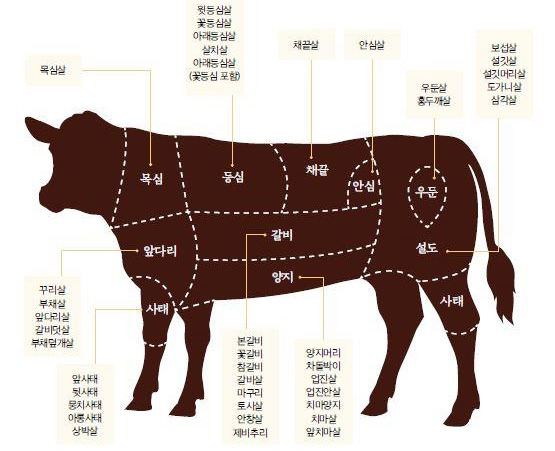
Living in LA, it can be confusing to remember the names of different beef cuts every time you buy meat.
This is true whether you're shopping in Koreatown or at Costco or an American grocery store.
For Koreans, the basic beef cuts usually include tenderloin, sirloin, ribs, and brisket.
And those who know a bit more about beef might also mention shank, round, and flank.
The problem arises when you try to say these in English.
It's not just about saying beef; you have to consider terms like sirloin and tenderloin, and you start to wonder if these correspond to the cuts you know.
To put it simply, Korean beef cuts do not translate neatly to American beef cuts one-to-one.
Korea categorizes cuts based on cooking methods, focusing on how they will be used, such as for soup, bulgogi, or grilling.
Thus, shank is divided into front shank and hind shank, and there are many specific names even within the brisket. In contrast, the U.S. categorizes based on the butchering structure and standards. They start by dividing the cow into large sections and then cut from there, so concepts like chuck, rib, loin, and round are fundamental.
For example, the tenderloin, which is very familiar in Korea, translates clearly to tenderloin in English.
Sirloin can refer to either sirloin or strip loin, but the single cut referred to as sirloin in Korea is divided into several names in the U.S. The flank is called strip steak or New York strip, but even this can vary slightly depending on the butchering method.
Ribs are a bit more complicated. Korean-style ribs translate to short ribs, but American short ribs are typically thick cuts meant for braising. The LA galbi we think of needs to be described as flanken cut short ribs to be understood.
Brisket is also an interesting case. In Korea, brisket is recognized as a very specific cut, but in the U.S., it is closer to a part of the brisket or a fatty cut from the navel, sliced thinly.
So, there isn't a word in the U.S. for ordering brisket as you would in Korea.
Instead, you need to use a description like thin sliced brisket. Shank and round are even more challenging. Shank is close to shank but not exactly the same, and round is related to round but is further divided into top round and bottom round.
If you ask which country has more detailed classifications for beef cuts, the answer is that both have their own methods. Korea has many names, while the U.S. has many categories. Korean beef names are diverse to fit the Korean diet, while the American meat system is industrially segmented.
Thus, from a Korean perspective, the American system feels much more systematically divided.
After living in LA for a long time, you end up thinking in Korean cut names while adapting to names like ribeye and chuck roast in American stores.
And you always think to yourself,
it's the same beef, but when the country changes, you have to learn a new language for meat.




 eatontown blog |
 Toaster Pizza Magic Show |
 US Embassy |
 fortbliss |
 Folding Instructions |
 Weekend Movie Blog |
 Beauty, Health, Lifestyle Blog |
 coloradoman |
 Superman Cat Blog |
 Noodle Noodle |
  Tonky |
  viroma |
  cookie |
  Live and that's it |
  Alright Twain |
  HAWAII Korean Church News |
  Amore |
  linex |
  Balancework |
  laro90 |
  MEDBIO American Doctor Blog |
  SWAT TEAM BLK |
  DREAM BIG |
  frostbite |
  330 Forever My Love |
  El Dorado |
  dralix58 |
  Gorama Round |
  Skydiving |