

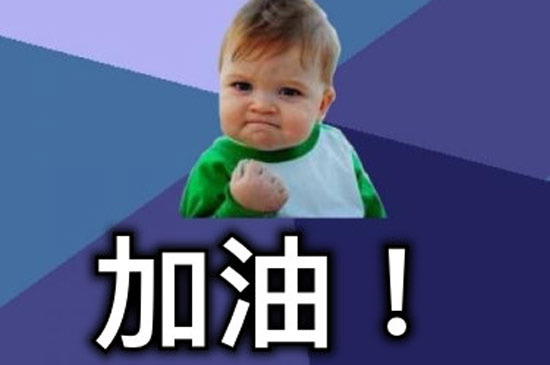
Do you know the most commonly used cheer expression "加油" in China?
Whether in China or anywhere in the world, when Chinese people cheer for others, they use this phrase just like Koreans use "fighting" at any time.
In Korean, it reads as ga.yu. But... ga-yu? Where to ga-yu? Haha.
I wondered when this expression started being used in this way, and it turns out it has been used in China for quite a long time.
The term "加油" literally means "to add oil."
This phrase was originally used not for people but for machines and vehicles. In the early 20th century, as cars and machinery began to be widely adopted in China, mechanics and drivers used "加油" to mean to refuel. This is why gas stations in China prominently display the sign "加油站." This period is roughly from the 1910s to the 1920s.
However, it is estimated that this expression began to be used for people after the 1930s. As urban culture developed in China and modern collective activities like school, sports, and factory labor increased, the phrase "add oil" naturally began to extend metaphorically to people.
Especially in situations like sports competitions, school exams, and military training, it started to mean "don't give up now, keep pushing forward." From this point on, "加油" became not just a fuel expression but a rallying cry urging action.
The nationwide spread of this expression occurred in the 1950s and 60s. After the establishment of New China, large-scale industrialization and collective labor progressed, and "加油" was used as an official encouragement slogan in almost all collective spaces like factories, schools, sports fields, and military bases.
Repeated in propaganda slogans, broadcasts, rallies, and school assemblies, it became a common phrase used by everyone from children to the elderly. During this time, "加油" took on the character of a slogan for not only personal encouragement but also national efforts and collective goals.
After the opening of the market economy in the 1980s and 90s, the usage of "加油" expanded further in line with the competitive social atmosphere.
It became a versatile cheer used in almost all life situations, including exams, business, romance, employment, immigration, entrepreneurship, and even dieting.
In summary, "加油" has evolved through the following stages: early 20th-century machine terminology → began to be used for people in the 1930s → official cheer in collective society in the 1950s and 60s → a common expression among all Chinese people today.
Currently, for Chinese people, "加油" encapsulates the life attitude of "don't give up now, endure." This is why it continues to be widely used in today's internet age, in line with the times.
I personally wonder if there will come a day when we Koreans no longer use 'fighting', or if Chinese people will stop using the term '加油' first.







 novapixel |
 Peter Pan Pet |
 horse |
 Sunset Oregon |
 daisypat |
 garlic bread |
 Yo Lock Me Up |
 California Information News |
 My Town My Way Blog |
  manchester |
  constant |
  Leapfrog Move |
  vibranto |
  Tora Tora |
  yellowbutter |
  Dolly |
  US Embassy |
  NYC saladbar |
  Finding Superfoods |
  lightyear |
  song bang |
  vexomo |
  Indiana Jones |
  meloncat |
  mortrix |
  Esther 1983 |
  fortbliss |
  Moscow Kim |