
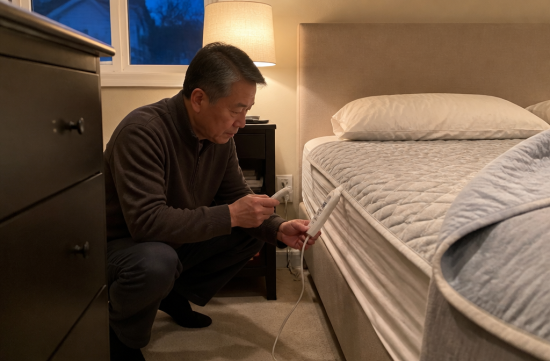
As November brings colder nights, many of you might be pulling out your electric blankets from the closet. Whether you brought them back from Korea, or have been storing them for years, everyone has their own story.
However, if you're just plugging it in without checking the plug shape, please pause for a moment. Today, I'll summarize what you need to do.
First, let's look at a number. According to data released by the Fire Department in November 2020, out of 8,544 heating device fires in the last 10 years, electric blankets accounted for 2,443 cases, making up 28.6% of the total.
During the same period, 47 people died and 263 were injured due to electric blanket fires. I was a bit surprised to see that blankets were more prevalent than electric heaters or wood stoves.
The timing of these fires is also predictable. From November to February, there were 1,549 cases, which accounted for 63.4% of the total over the past decade.
It's no different in the United States. In March 2023, the CPSC announced a recall of 350,000 Bedsure electric blankets and pads due to controller malfunctions.
There were 137 reports of fires, burns, smoke, and overheating related to this issue, including 17 reports of burns.
In July of this year, the CPSC warned against using Melinora electric blankets sold on Amazon. There were five reports of smoke, burning, and melting, and the manufacturer reportedly did not respond to the recall request.
If a company ignores these issues, it ultimately leaves consumers at risk. While I believe regulations should do more to protect consumers, for tonight, we must each check our own devices.
The first thing to check is the label on the controller or cord. In Korea, household electricity is 220V 60Hz, while in the U.S. it is 120V 60Hz.
If the label only states 220V, it is intended for the Korean market. A piggyback adapter only changes the plug shape but keeps the voltage the same.
What happens if you plug such a blanket into a U.S. outlet? If it's a simple resistive heating wire, the heat produced will be less than a third of what it should be, and there's no guarantee that the controller will function properly.
This is why some people look for voltage converters. Here, you need to be careful about the direction. To use a 220V product in the U.S., you need a step-up converter that raises the U.S. voltage to 220V.
The capacity must also be sufficient. Some sellers recommend a capacity that is double the power consumption for heating devices, while others advise against running them at maximum load for extended periods.
I personally wouldn't use it. Using a transformer with a blanket means running two heat-producing devices next to your bed. It's better to buy one that is already compatible with the U.S. voltage of 110V.
When purchasing a new one, check if it has certification marks from accredited testing organizations like UL or ETL. Don't just trust the wording on the sales page; double-check with the label.
UL only allows certified products, and they advise against buying from second-hand stores or garage sales. In Korea, the Fire Department recommends KC safety-certified products, but KC is a Korean certification and cannot be considered a substitute for U.S. certification.
If you have a used product, check the recall list at cpsc.gov. It only takes a minute.
Now, let's talk about usage. Most U.S. guidelines are based on electric blankets, but since heating wires are used in blankets as well, I apply the same principles.
Do not fold it while it's on. UL warns that folded heating wires can overheat or spark. When storing, avoid folding and roll it up instead.
Avoid piling blankets on top of it while it's on. Both the Fire Department and UL emphasize this point because heat cannot escape.
If you use a latex topper, be especially cautious. The Fire Department advises against using it with latex mattresses that do not allow heat to escape, and data from Seoul shows related fires numbered 33 in 2016, 39 in 2017, and 41 in 2018.
Another common oversight in American beds is not to place cords under rugs or between the mattress and box spring. UL also advises against using them with sofa beds and adjustable beds.
Plug it directly into the wall outlet. The Electrical Safety Foundation International (ESFI) advises against using extension cords or power strips.
This is the hardest rule to follow. UL recommends turning it on 30 minutes before lying down and turning it off before sleeping, and ESFI advises against leaving it on while you sleep.
Thinking about the habit of sleeping on a warm floor all night is honestly disappointing. Still, I would choose to set a timer or turn it off before falling asleep.
When leaving, turn off the power and unplug it after use. If you have pets, make sure to keep the cords out of their reach.
Don't forget to check it when you take it out. Lay it flat and look for any burn marks. Check if the cord and plug are cracked, and ensure there are no bends in the heating wire.
If you find any issues, don't think about repairing it; just throw it away. According to Fire Department statistics, 50.1% of causes were electrical factors. This means that issues like poor cord contact were much more common than negligence (19.4%).
Make sure to check the blankets at your elderly relatives' homes this weekend. The Fire Department advises caregivers to check them since they are primarily used by seniors. UL also notes that they do not recommend them for infants and that those with diabetes may be more susceptible to burns.
In summary, the steps are simple: check the label, verify the certification, plug it directly into the wall outlet, and turn it off before sleeping. You can't afford to lose your home just to save on a blanket.
 OceanHarbor79




 DO Main TODAY |

 Caribbean |

 tredolo |

 Anjollinya Blog |
 Kitchen Ideas |
 Community Cross |
 Famous Attractions in the United States |

 U.S. Military Recruitment Information |
 People Moon |

 US Home Buying Information Home Insurance |
 American History This and That |
 goldenleaf |
 mistily |
 selviro |
 strongman |
 Waiting for Godot |
 Sunny Mom |
 Blondee |
 El Dorado |
 passive |
 gardener 007 |
 zanero |
 Arlington house |
 Cali M Law Group |
 Delicious Food Finder |
 ultron78 |
 pet dog |
 networky |
 Sandiego Auntie |
 Macon Boy |