
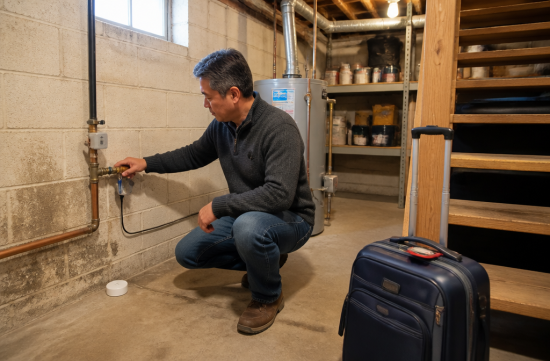
Let's take an example of a house that will be vacant for two weeks while traveling to Korea at the end of December. If a leak detector is installed before leaving, can it reduce insurance costs and lessen worries about the house?
Discounts may be available, but not all insurance companies offer this benefit. In my view, the value of this equipment lies more in preventing accidents than in the discounts.
According to data from the Insurance Information Institute (III) from 2019 to 2023, there are 1.50 claims per 100 homes annually for water damage and frozen pipes. The average claim amount is $15,400.
The average homeowners insurance premium in Illinois for 2022, as reported by the same organization, is $1,343. While this data is from different time periods and cannot be directly compared, a single incident can exceed 11 times the annual premium, making it a serious concern.
Now, let's follow the situation of that house. Assume a cold wave hits the Chicago area three days after departure, causing the exterior plumbing to freeze and burst.
If there is no equipment, the homeowner will only open the basement door on the day of their return. The duration of the water flow will determine the extent of the damage.
Now, let's summarize the discount discussion. When NerdWallet surveyed insurance companies in 2022, most offered discounts for water damage, fire, and theft prevention equipment, with advertised maximums of 13%.
However, this 13% is a cap that varies depending on the equipment and location. Not everyone will receive this amount for just one leak detector, and the survey was conducted several years ago.
Conditions vary significantly by company. According to a summary by Experian in July 2025, USAA requires two or more leak detectors to be connected and share data to qualify for a discount.
In the same article, Hippo states that customers save an average of $64 to $91 annually with their basic monitoring equipment. It needs to be verified whether this product is available in Illinois.
American Family only mentions on their official page that having a leak detector may qualify for a discount. There is no percentage provided, and it varies by state and terms.
One distinction to make here is between discounts on insurance premiums and discounts on equipment costs; they are different benefits.
The Liberty Mutual partnership announced by Moen in April 2025 offers customers benefits for devices and installation costs, but does not mention premium reductions. State Farm's free leak package from ADT also does not specify discount rates.
There are mainly two types of equipment. Sensor types that notify you via phone when water is detected, and shut-off types that directly close the main water supply.
For homeowners in Korea, sensor alerts are only a partial solution. Even if they receive an alert in the early morning, if there is no one to rush over, the water will continue to flow.
The retail price for shut-off types, according to a comparison guide updated in July 2026, is $559 for Moen Flo and $579.99 for Phyn Plus. These require installation costs as they are directly inserted into the plumbing.
The YoLink kit, which sits on existing valve handles, costs $269.99. The same guide explains that this product can close the valve without internet or electricity, while the plumbing-insert type ties notifications and remote control to the cloud.
It is difficult to recoup costs solely through discounts. Even dividing the $559 device by Hippo's top annual savings of $91 results in over six years, not including installation costs.
Before considering discounts, the frozen pipe clause should be examined. Many policies using standard forms state that reasonable precautions must be taken to maintain heating or shut off water and drain plumbing when the house is vacant to qualify for frozen pipe coverage.
Therefore, just because a detector is installed, you should not turn off the heating. The American Red Cross advises not to lower the heating below 55 degrees Fahrenheit when leaving the house vacant.
Simply shutting off the water is also risky. If the clause requires both shutting off and draining, failing to drain the plumbing could be an issue, and if there are sprinklers, it's better to consult a plumber first.
Duration also matters. If the household remains, it is typically classified as unoccupied rather than vacant, and vacancy clauses usually define a period of 30 to 60 consecutive days, but definitions vary by company.
A two-week trip may not be a major concern. If staying in Korea or Florida for the entire winter, call ahead to ask if additional coverage is needed.
When speaking with an agent, ask about three things: whether my policy includes a leak detector discount, which type applies (sensor or shut-off), and what documentation is required.
It's convenient to prepare documentation in advance. Moen advises that submitting a confirmation received through their app to the insurance company may lower premiums, but does not guarantee an amount and suggests contacting the insurance company for details.
Also, check the conditions for maintaining discounts. Some companies, like Hippo, require the equipment to remain operational, so it may be worth reconsidering the habit of turning off the router while traveling.
If the answers are unclear, you can refer to the Illinois Department of Insurance consumer guide. There is a separate section for homeowners insurance discounts, and if issues arise with the insurance company, the consumer support department will investigate.
The pre-departure checklist for that house is summarized as follows: check if the main valve is actually turning, close the internal valve on the outdoor faucet, keep heating above 55 degrees, and leave the keys with a neighbor.
Clauses and discounts vary by policy and personal circumstances. This article provides general information, so please verify your specific policy language with your agent.
If I frequently leave my house vacant for more than two weeks in winter, I would install a shut-off type. While discounts are appreciated, the primary goal is to avoid a $15,400 accident, which is the right calculation.
 moonvalley








 Dr. Kelso |

 silents |

 Choco Choco Star |

 gentle |

 neapolis |

 Arlington house |

 dreamer20 |

 Alright Twain |
 zanero |
 Cali M Law Group |
 Delicious Food Finder |
 ultron78 |
 pet dog |
 networky |
 Sandiego Auntie |
 Macon Boy |
 Moscow Kim |
 zoryan |
 Noodle Noodle |
 Anjollinya Blog |
 Texas Migration Story |
 Elastico |
 peltra |
 banleaf |
 humpday sonata |
 silver |
 Queens Blues |