
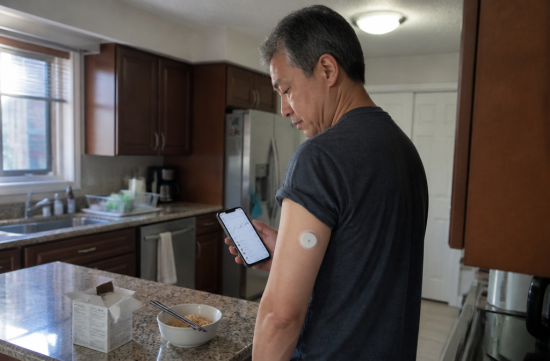
These days, I often notice people in the company cafeteria during lunch with a white circular patch on the back of their arms. In the past, I would have assumed they were diabetic, but now I can't make that assumption.
This is because continuous glucose monitors, known as CGMs, can now be ordered online without a prescription. The idea of seeing how my blood sugar fluctuates after meals on my phone intrigued me as well.
However, before hitting the purchase button, I carefully considered my options. To sum it up, while you can buy one, it's not something I would recommend for everyone.
First, let's look at the legality. The FDA approved Dexcom's Stelo as the first CGM to be sold without a prescription in March 2024.
The target audience is adults aged 18 and older who do not use insulin. This includes those managing diabetes with oral medications and those without diabetes who want to monitor the effects of diet and exercise.
In June 2026, the approval expanded to include children over the age of 2 who do not use insulin, under the supervision of an adult.
Abbott's Lingo is also available without a prescription. According to the company, it is intended for adults aged 18 and older who do not use insulin and is not for diagnosing any diseases, including diabetes.
I checked the prices on the official site in early November. Stelo is listed at $89 per month, down from $99.
The lifespan of one sensor is up to 15 days, and maintaining a subscription for a year costs $1,068. Looking at the numbers, it's not a small amount to casually spend out of curiosity.
Lingo offers a 2-week plan for a single sensor at $54, with no automatic renewal. Since it can be used for up to 14 days, this option feels less burdensome for a trial.
One more detail to note is that the footnote on the Stelo official site states that 77.9% of sensors lasted the full 15 days. Conversely, this means that there are quite a few sensors that stop working prematurely, so be sure to read the replacement conditions in advance.
There are also tips regarding payment. The Stelo site indicates that it can be purchased using HSA and FSA funds, but adds that you should check with your plan management company for actual reimbursement requirements.
Now, here's the real question. Being able to buy something and actually benefiting from it are two very different matters.
A review led by researchers from the University of Gothenburg in Sweden, published in JAMA Internal Medicine in August this year, is quite straightforward. It states that there is no scientific evidence that CGMs improve health or prevent disease in people without diabetes.
The researchers were concerned about over-interpretation. They warned that normal fluctuations in blood sugar could be misinterpreted, leading to unnecessary dietary restrictions or anxiety.
I recalled how adults in Korea often agonize over a single number on their health check-up reports for days. I, too, would likely be glued to an app that shows my readings every 15 minutes.
A study from Mass General Brigham followed a similar direction. They had 972 adults over 40 wear the Dexcom G6 for up to 10 days and compared CGM readings with HbA1c levels.
In those with type 2 diabetes, the two values aligned well, but the relationship weakened in those with prediabetes. There was almost no correlation in people with normal blood sugar levels.
Thus, the authors concluded that CGM data cannot replace HbA1c for people without diabetes. However, they left open the possibility of using it as a biofeedback tool to show the real-time effects of food and activity.
There are also safety issues to be aware of. Those experiencing dangerous hypoglycemia should not use Stelo, as the FDA has clearly stated that this device is not designed to warn of such situations.
The FDA has also advised against making medical decisions based solely on device readings. Individuals taking medication should never adjust their dosages based on their readings alone.
If you are concerned about your readings or their relationship with your medications, consult your doctor or pharmacist. The same goes for situations where symptoms and readings do not align.
Smartwatches and smart rings that advertise blood sugar monitoring are a different story. The FDA warned in February 2024 that it has not approved any devices that measure blood sugar without breaking the skin, so they should not be used.
For those using insulin, they are not the target audience for over-the-counter products. According to Medicare guidelines, diabetic patients receiving insulin treatment or with a history of problematic hypoglycemia may qualify for prescription CGMs, provided they have a record of a medical visit within the last six months before ordering.
This is where I feel a bit disheartened. According to Medicare guidelines, those managing diabetes with medication and genuinely curious about their readings must pay out of pocket. It seems only fair that those in need should receive coverage first, but many households may find that cost burdensome.
If it were me, I would choose not to buy one if I don't have diabetes and am sensitive to my readings, and instead focus on my HbA1c levels during regular check-ups.
However, if I were still curious, I would try a product without automatic renewal for just two weeks. I would just observe how my readings change after eating ramen and would not subscribe.
If I were managing diabetes with medication, the situation would be different. I would first consult my primary care physician before purchasing and would review the readings together.
Dear readers, remember that a monitor only shows you the numbers; it does not provide answers. Before trusting an $89 graph, decide what changes you will make based on that graph.
 SsamjangAlien








 Anjollinya Blog |

 United States Army |

 premium |
 The Emperor Must Grow |

 squidogame |

 washington mom |


 El Dorado |

 Eldorado 88 |

 heartbreaker |
 Waiting for Godot |
 Sunny Mom |
 Blondee |
 passive |
 gardener 007 |
 zanero |
 Arlington house |
 Cali M Law Group |
 Delicious Food Finder |
 ultron78 |
 pet dog |
 networky |
 Sandiego Auntie |
 Macon Boy |
 Moscow Kim |
 zoryan |
 Noodle Noodle |
 Texas Migration Story |