

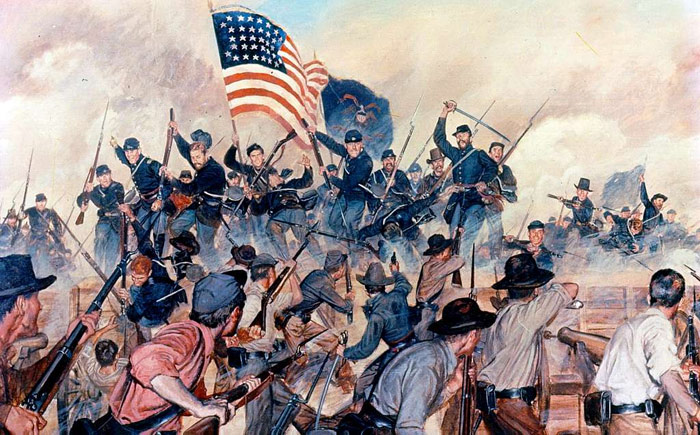
The American Civil War was a large-scale civil war fought between the Union and the Confederacy from 1861 to 1865. It is often simply summarized as "a war sparked by conflicts over slavery and tariffs," but in fact, there were various intertwined economic, political, and social factors behind it.
As the United States rapidly grew after the War of Independence, a widening gap emerged between the North and the South. The North developed its industry and manufacturing, operating on a model of "hiring labor for wages," while the South relied on slavery to cultivate cotton, tobacco, and other crops on its vast farmlands.
Moreover, there were serious differences regarding how much authority should be granted to states and what the federal government's (central government's) powers should be. Consequently, every time a new state was incorporated into the United States, fierce confrontations arose over whether it would be a "slave state or a free state." This accumulation of conflicts eventually led to war.
In 1860, when Abraham Lincoln of the anti-slavery expansion Republican Party was elected president, Southern states reacted by saying, "You threaten our economy and way of life!" Several Southern states, starting with South Carolina, declared their secession from the Union and formed their own 'Confederate States of America.' In modern terms, it was akin to saying, "We will establish our own country within the nation."
In April 1861, the full-scale war began when Confederate forces fired on Union troops at Fort Sumter in South Carolina. Initially, both sides thought it would be a "quick war," but once the battles began, it turned out to be much longer and fiercer than expected.
Lincoln's Decisive Action
In the middle of the war, President Lincoln issued the 'Emancipation Proclamation' (effective January 1, 1863). At the time, it stated that "slaves in areas occupied by the South would be freed," but it also had a significant effect in declaring to the world that "the North fights with the goal of abolishing slavery." International opinion turned more favorably towards the North, and the justification for emancipation helped garner human and material support for the war.
The Later Stages and Conclusion of the War
By 1864, the North had overwhelmed the South in manpower and industrial production. General William Sherman successfully executed the "March to the Sea" campaign, effectively diminishing the South's war capabilities.
Ultimately, in April 1865, the Confederate forces under General Robert E. Lee unconditionally surrendered at Appomattox in Virginia, bringing the war to an end. Later that year, Lincoln was assassinated before the fervor of victory had cooled, but at least the worst scenario of "the United States being divided" was avoided.
The Results and Impact of the War
Abolition of Slavery: The 13th Amendment was passed in 1865, officially abolishing slavery throughout the United States. Although subsequent amendments (14th for civil rights in 1868 and 15th for voting rights in 1870) opened the way for guaranteeing the rights of African Americans, racial discrimination remained severe in society, and discrimination and conflict continued during the Reconstruction era.
Strengthening Federal Power: The Union's victory in the war solidified the federal system in the United States. While concerns about state powers persisted, the basic perception that "the United States is one nation" became established.
Economic and Social Changes: After the Civil War, the United States accelerated its industrialization, embarking on a path of rapid industrial growth. Railroads, steel, and manufacturing began to develop explosively, laying the foundation for the United States to play a leading role on the global economic and political stage.
In summary, the Civil War was a significant event that revealed the greatest internal division in the United States, accompanied by horrific loss of life and widespread destruction. However, it can be evaluated that it ultimately led to the abolition of slavery and opened the path for the United States to unite as a federal nation and grow stronger.
After the war, the phrase "all men are created equal" was firmly established in the Constitution, but it took over a century for African Americans to truly enjoy equality in society. Nevertheless, the Civil War is regarded as one of the most significant turning points in American history and is remembered as an important watershed that laid the foundation for modern American society.







 Magic Cabbage School of Martial Arts |
 Vacation on Hawaii |
 morvex37 |
 Ari Songhan American Immigration Life |
 Bearded Strawberry Smoothie |
 Chino Min |


 DREAM BIG |
 Information on All Regions of the United States |
  laro90 |
  MEDBIO American Doctor Blog |
  SWAT TEAM BLK |
  frostbite |
  330 Forever My Love |
  El Dorado |
  dralix58 |
  Gorama Round |
  Skydiving |
  dreamport |
  Yellow Snowman |
  Toaster Pizza Magic Show |
  velvetnom |
  Anytime Journey |
  Mrs. Duluth |
  jaxter |
  Atlanta Mama |
  Baguette Blog |
  Tan Sol |