
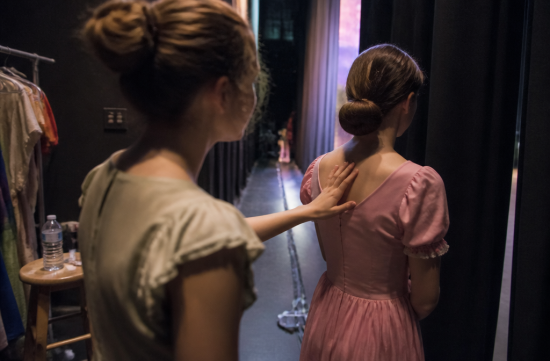
If you walk behind the stage before a school play or musical in the U.S., you might see something amusing.
Just before an actor steps onto the stage, their colleagues don't say "good luck"; instead, they say "break a leg."
Literally, it means "may your leg break," and it's puzzling at first why they would wish injury while trying to encourage someone.
In fact, this isn't a curse but a long-standing tradition of encouragement in the American theater community.
Once you know the reason, there's an interesting superstition behind it.
Among performers, there was a belief that saying "good luck" outright would actually cause that luck to disappear.
The moment you speak a good word, luck is thought to hear it and become spiteful.
So, the practice of throwing out a bad word to ward off misfortune and safely invite good luck took hold.
It's oddly logical that you have to speak mischievously for good things to come, isn't it?
I looked into when this expression started being used, and I was surprised to find it's more recent than I expected.
According to the Oxford English Dictionary, the oldest recorded use is from 1925, and it first appeared in a newspaper in 1948 in West Virginia with a theatrical meaning.
I thought it was a tradition that had been around for centuries, but it turns out it only became established in the 20th century, which was a bit unexpected.
There are several theories about its origin.
One theory suggests that the curtains hanging vertically on either side of the stage are called "legs" in English, and the act of walking through them onto the stage was expressed this way.
There's also a theory that it originated from horse racing.
In horse racing, openly wishing good luck was thought to bring bad luck, so there was a culture of exchanging harsh words, which may have transferred to the theater.
During World War I, German pilots reportedly wished each other "Hals und Beinbruch," which means "may your neck and legs break," for safe flights.
It's interesting that, regardless of country or era, the psychology of saving good words and using harsh words to invite luck is similar.
A similar superstition exists in the French theater, where French actors say "merde" instead of "good luck."
Literally, it means "shit," and it comes from the 19th century when audiences arrived at theaters by carriage, and the more guests there were, the more horse manure piled up in front of the theater.
So, saying "merde" was essentially a roundabout way of expressing "may the audience be full today."
In American theaters, there's another superstition about avoiding the mention of the name of Shakespeare's play Macbeth inside the theater.
So, actors refer to it as "the Scottish play," and if someone accidentally says the name, they must go outside, spin around three times, and spit as part of a ritual.
It seems that the American theater community is particularly sensitive about words.
By the way, there's a rumor that this expression is related to the assassination of President Lincoln, but that's unfounded speculation.
It's just a forced connection between the fact that the assassin injured his leg when he jumped from the stage and the timing doesn't match at all.
Even after exploring various theories, linguists have not been able to conclude a definitive origin.
As a result, this expression is sometimes referred to as a "dead metaphor" because its roots are impossible to trace.
Nowadays, this expression is naturally used beyond the theater, for auditions, important interviews, or major presentations.
Living in America, I find myself hearing this phrase surprisingly often before school presentations or company pitches.
When I first heard it, it felt a bit eerie, but now that I know the origin, I find myself wanting to use it when someone has an important task ahead.
Even if the exact origin is unknown, just remembering that it's a phrase used with good intentions can make it a surprisingly useful expression in American life.





 Giant Squid and Sweet Potato Soup |
 Lol Life |
 lavender |
 logger |
 Conflite Teacher |
 lunexa |
 moomoon |

 Nebraska Center Director TOP |
 noraro |
  UNI Lover |
  Choco Mint Creator |
  Chili Boy Club |
  NE Hodori Preik |
  torvik |
  charger |
  holy cheese |
  Pleasant K |
  Rolling Joy Life |
  lidus |
  French Macarons |
  Central Intelligence Agency Deputy Director |
  ATL Power 1 |
  MP Forever |
  Soy Angelino |
  San Jose Pop |
  Pronunciation Yo |
  hamooo |
  Entip |