
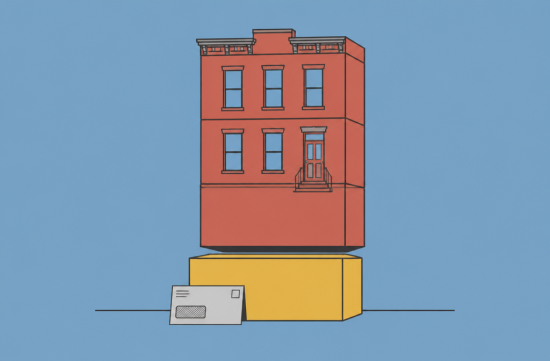
If you've owned your home for several years and notice that your property tax bill is significantly higher than your neighbors', the first thing to check is the Homestead Exemption. In Philadelphia, this one application can save you nearly $1,400 on your taxes for the same home.
The application deadline is December 1, 2026. You must submit your application by this date for the benefits to be reflected in your 2027 property tax bill.
The Homestead Exemption is a program that deducts $100,000 from the assessed value of your primary residence. According to city guidance, most homeowners can save $1,399 per year.
Understanding where this number comes from makes it easy to see its significance. For the 2026 tax year, the Philadelphia property tax rate is 1.3998% of the assessed value, with 0.7839% going to the school district and 0.6159% to the city.
Multiplying $100,000 by 1.3998% results in $1,399.80. Essentially, this is the annual difference between homes that receive the exemption and those that do not.
Let's look at an example from a report by the City Controller in August 2026. It compares two homes, each with an assessed value of $250,000.
The home that received the exemption has a taxable value of $150,000, resulting in a tax bill of $2,100. The home that did not apply for the exemption is taxed on the full $250,000, resulting in a bill of $3,500.
These are similar homes in the same neighborhood, yet a single piece of paperwork can lead to a $1,400 difference. I was a bit surprised by the significant difference when I first saw this table.
For a home with an assessed value of $400,000, the tax would be $5,599 without the exemption and $4,199 with it. Regardless of whether home values rise or fall, the amount saved remains fairly consistent.
However, homes with assessed values below $100,000 will see smaller savings. This is why the city uses the term "up to $1,399."
A common concern is whether you can apply if you still have a mortgage or if your taxes are slightly overdue.
According to city guidance, neither of these disqualifies you. There are no age restrictions or income criteria, so anyone who owns a home and uses it as their primary residence is eligible.
If your name is not on the deed, there may still be a way to receive a conditional exemption. If the estate is still being settled, you should inquire separately.
Conversely, there are clear cases where you cannot apply. New constructions or remodeled homes that are receiving a 10-year tax abatement, as well as homes registered in the LOOP program, cannot receive the Homestead Exemption.
Rental properties or second homes that you do not occupy are also not eligible. Those who own multiple properties should be particularly cautious.
The city has been quite strict about this issue lately. According to the Controller's report, the tax office reviewed 22,041 properties receiving benefits and canceled 13,355 ineligible exemptions, resulting in an additional $33.5 million in tax revenue.
The Controller's office has also identified 58,000 properties with risk factors. They have recommended that future applications be closely scrutinized for duplicate submissions or exemptions claimed by owners living outside Philadelphia, so if your eligibility is unclear, it's better not to apply aggressively.
How can you find out if your home is already registered? You can search your address at property.phila.gov.
If the Homestead Exemption line in the Property Details section shows Yes, you are registered; if it shows No, you have not yet received the benefit. Surprisingly, many people assume someone else has taken care of this for them.
There are three main ways to apply. The easiest is to apply online at the Philadelphia Tax Center (tax-services.phila.gov) using your OPA number to find your home.
Online, you can apply solely for the Homestead Exemption or choose a consolidated application to apply for all five of the city's property tax assistance programs at once. If you're unsure whether you qualify for other programs with income criteria, the consolidated application may be the better option.
You can also apply by phone at the Homestead Hotline at (215) 686-9200. To apply by mail, print and complete the application, then send it to City of Philadelphia, Department of Revenue, P.O. Box 52817, Philadelphia, PA 19115.
Once approved, you do not need to reapply each year. However, if there are changes to the deed or if you no longer live in that home, the situation may change.
This year, timing is also important. The city began sending out notices of assessed values for the 2027 tax year starting at the end of June, and the new assessed values will take effect on January 1, 2027.
The city estimates that the change in property taxes for the median home in 2027 will be $97. The deadline for appealing assessed values has already passed on October 5, so the most certain way for homeowners to take immediate action is through the Homestead Exemption.
Property tax bills will be sent out starting December 1, with a payment deadline of March 31, 2027. If you find it burdensome to pay all at once, seniors or those who meet income criteria should also look into the 11-month installment payment plan.
If I were in the same situation, I would start by searching my address this evening. If it's already registered, I can relax; if it shows No, applying online before December 1 is the easiest way to save $1,400 in a year.
 LunaDream







 Choco Choco Star |

 gentle |
 neapolis |

 moo moo |
 ultron78 |

 DelphiaMo |
 elated |

 Northeastern |

 Pennsylvania Information News |

 heartwarming |
 ROLDU WAY |
 dreamming |
 greenloop |
 Glow Yo |
 Jersey City |
 content |
 FROM Wyoming |
 My Love Bambino Alaview |
 Lord Island |
 fantastic |
 nero kim |
 Alaska Salmon Buyer |
 solvix18 |
 California Information News |
 HAWAII Korean Church News |
 Raomi News |
 My Love DS |
 Hardworking CPA |
 People Moon |