
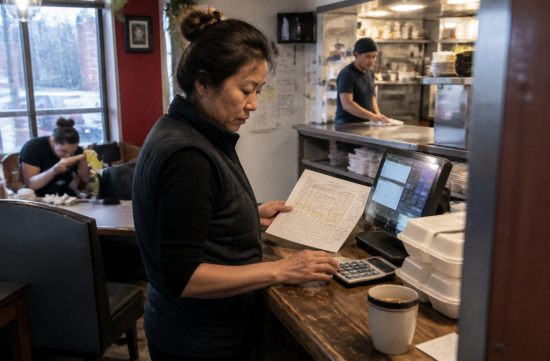
These days, the most common phrase among restaurant owners in Providence is "It will go up again in January." The minimum wage in Rhode Island will increase to $17 per hour starting January 1, 2027.
It has been exactly one year since it rose from $15 to $16 last January. Today, I will break down what this change means for restaurant accounting in numerical terms.
First, let's clarify the legal basis. In 2025, the state legislature passed Bill H 5029, which was signed by Governor Dan McKee, confirming the schedule of $16 in 2026 and $17 in 2027.
The vote was 55 to 10 in the House and 33 to 4 in the Senate, generally following party lines. There is no automatic increase clause for inflation after 2027 included in this law.
You might be curious about the next steps. Bills like H7769 and S2620 proposed raising the minimum wage to $20 in 2027, but there is no record of them passing. The confirmed figure as of now is $17.
Additionally, there is no separate minimum wage for the city of Providence. Rhode Island uses the same standard across the state, so whether in Providence or Warwick, the same $17 applies.
Here's something restaurant owners need to distinguish: employees who receive tips and those who do not. The calculation methods are completely different.
The cash minimum wage for tipped employees, such as servers and bartenders, is $3.89 per hour. This figure has not changed since 2017.
There have been several proposals to raise the tipped wage to $6.75 or gradually align it with the general minimum wage, but these have been repeatedly held in committee. Therefore, it is likely that the $3.89 will remain unchanged next year.
So, does that mean server wages won't increase? Not exactly. The key point is that the total of the cash wage of $3.89 plus tips must exceed the minimum wage.
This year, the maximum tip credit that employers can claim is $12.11, but next year it will increase to $13.11, which is $17 minus $3.89. The baseline has gone up by $1.
For example, if a server works 30 hours a week and receives $300 in tips, that amounts to $10 per hour in tips.
Adding the cash wage of $3.89 gives a total of $13.89. Since this is $3.11 short of $17, the owner must add $93.30, which is 30 hours multiplied by $3.11.
If the same server received $450 in tips, then the total would be $15 plus $3.89, equaling $18.89, so there would be no additional burden. Ultimately, the issue arises during slow weekday shifts.
To use the tip credit, employers must notify employees in writing beforehand. Verbal agreements are not recognized, and employers are prohibited from taking a portion of the tips.
Now, let's move on to calculating for kitchen staff who do not receive tips. For employees like dishwashers or prep cooks earning minimum wage, working 40 hours a week will increase their weekly pay from $640 to $680, which is a $40 increase per week.
But it doesn't stop there. The employer also pays a 7.65% Social Security and Medicare tax, so the actual burden increases by about $43.06 per week.
If there are six such employees, that totals $258.36 per week, which amounts to $13,434.72 annually when calculated over 52 weeks. For a small-town restaurant, this is nearly the cost of one part-time employee.
However, the real calculations become more complicated. When experienced employees earning around $17 realize that their pay is nearly the same as new hires, wages at the top also tend to rise.
I refer to this as the invisible increase in the books. If you only calculate and budget for minimum wage employees, you will definitely be mistaken.
It's also important to hear from the industry. During a state hearing, restaurant representatives claimed that 95 cents of every dollar in sales goes back to costs.
In an industry with such thin margins, any increase in labor costs must be absorbed through menu price adjustments, reduced hours, or automation like kiosks. This is why there are warnings that entry-level jobs may decrease.
Personally, I am skeptical about the state government's method of raising wages annually. I believe wages should be determined by productivity and the market.
However, the law is the law, so what owners can do is to run the numbers in advance. If I were an owner, I would do three things right away.
First, I would review the work schedules from the past few months and calculate the weekly hourly tips for each server. I would see how many weeks fall short of $17 when adding $3.89.
Second, I would revise the hourly wage chart for kitchen staff. By determining in advance how much to raise employees just above $17, it reduces the stress of negotiations in January.
Third, adjusting menu prices all at once on January 1 is less effective than spreading it out over several items to reduce customer backlash. Customers are aware of the news.
If you are working, make sure to check your first paycheck in January to see if your hourly wage has changed to $17. If you are a server, also check if you received the difference for any weeks where your total hourly amount including tips fell short of $17.
In summary, the general minimum wage will rise to $17, the tipped wage will remain at $3.89, but the guaranteed total including tips will rise to $17. I recommend checking the detailed guidelines from the Rhode Island Department of Labor and Training (DLT) once more.
 SilverStone71



 Valley Hong |

 Casa Mia |

 CA Real Estate |
 Eldorado 88 |

 limestone |

 USALATU BLOG |

 Sunny Sunday |


 Jazz Queen |
 content |
 FROM Wyoming |
 My Love Bambino Alaview |
 Lord Island |
 fantastic |
 nero kim |
 Alaska Salmon Buyer |
 solvix18 |
 California Information News |
 HAWAII Korean Church News |
 Raomi News |
 My Love DS |
 Hardworking CPA |
 People Moon |
 Carolina border |
 korian87 |
 dancing in the rain |
 bravo777 |
 yolo1990 |