
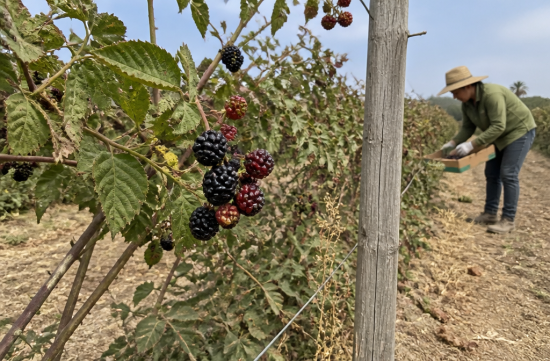
When I first heard the name boysenberry, I honestly thought it was some kind of brand name. It's an ambiguous purple fruit that's neither blackberry nor raspberry, but it turns out it's named after a person.
However, this fruit was almost lost in a weed patch. The person who saved it was Walter Knott, a farmer in Buena Park.
The story begins with Rudolf Boysen, a horticulturist who worked as the park management supervisor for Anaheim from 1921 to 1950.
Boysen experimented with crossbreeding various berry varieties in the 1920s. He is known for creating a hybrid that mixes blackberry, raspberry, and loganberry.
The problem came next. His partner passed away, and he himself suffered a serious back injury in an accident, which made commercialization impossible.
Eventually, he abandoned his experiments and sold his farm. The berries were large and delicious, but without anyone to cultivate them, they were left to wither.
In the late 1920s, George Darrow, a berry expert from the USDA, began to investigate rumors of a large, red-purple berry growing somewhere in Anaheim.
Darrow sought help from Walter Knott, who was already known for berry cultivation. The two found Boysen's old farm overgrown with weeds.
They discovered a few struggling vines barely hanging on. They were literally in a dying state.
Knott transplanted these vines to his farm in Buena Park and personally cared for them until they bore fruit again.
For reference, the Knott family settled near Buena Park in 1920. At that time, they sold berry seedlings and fruits and jams at roadside stands to make a living.
In 1932, Knott began selling this berry at the farm stand. When customers asked for its name, he named it after its creator, calling it boysenberry.
As an analyst, I should mention that details vary across sources. Some list the year as 1933, and there are versions that say Knott received the seedlings directly from Boysen.
Still, the core storyline remains the same: Boysen created it, Darrow tracked it down, and Knott revived it and named it.
Personally, what impresses me most is that Knott didn't name it after himself. He credited the original owner.
The next turning point was the Great Depression. As the farm struggled financially, Knott's wife, Cordelia, began selling fried chicken dinners in June 1934.
According to the National Park Service (NPS), the first day they sold dinners, they served eight portions at a price of 65 cents per plate. Naturally, boysenberry pie was served for dessert.
This chicken dinner became a huge hit, leading to wait times of several hours. To keep waiting customers entertained, Knott began building a Wild West-style town in 1940.
This is now known as the Ghost Town at Knott's Berry Farm. The amusement park came later; the berries and chicken came first.
The first admission fee was charged in 1968, and it was 25 cents at that time. Thinking about ticket prices now is a bit shocking.
Cordelia passed away in 1974, and Walter in 1981. After a period of family management, it was sold to Cedar Fair, and in July 2024, Cedar Fair merged with Six Flags, making it part of Six Flags now.
Ownership has changed several times, but the boysenberry remains the identity of this park. The boysenberry festival, which started as a small two-week event in 2014, is held every spring.
The festival will celebrate its 10th anniversary in 2025, featuring over 80 different foods and drinks, including some unimaginable dishes like boysenberry barbecue short rib lasagna.
One more fun fact: even today, boysenberry vines still grow under the Silver Bullet roller coaster in the park.
Although this fruit originated in California, New Zealand is now known as the largest producer in the world. Within the U.S., Oregon is the center of commercial cultivation.
Boysen himself has not been forgotten. In Anaheim, there is a 24-acre park named after him.
Reading this story made me realize that innovation is not solely the result of one person's genius. There were creators, discoverers, and cultivators involved.
Especially, I appreciate that a public researcher collaborated with a private farmer to save a disappearing variety. It's a case that illustrates why public infrastructure, like agricultural research, is necessary.
If you ever find yourself in Southern California, consider picking up a jar of boysenberry jam at the market near the entrance of Knott's Berry Farm. There are shops you can visit without entering the park.
And when you take a bite, think of those few vines that were struggling in the weed patch. I find that thought changes the taste of the jam for me.
 TownInfo




 Michigan Enthusiast |
 xylora |
 Tan Zoo |

 hot chocolate |
 Chichiki Chicago Train |

 Baguette Blog |
 Agenda Center |

 Team Korea Psychoanalysis Research |

 Koreab Date |

 American Blog Forge |
 Flying Shooting Star |
 silents |
 ROLDU WAY |
 dreamming |
 greenloop |
 Glow Yo |
 heartwarming |
 Jersey City |
 content |
 FROM Wyoming |
 My Love Bambino Alaview |
 Lord Island |
 fantastic |
 nero kim |
 Alaska Salmon Buyer |
 solvix18 |
 California Information News |
 HAWAII Korean Church News |
 Raomi News |
 My Love DS |