
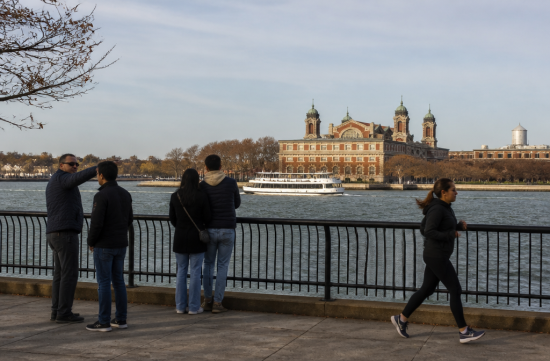
Standing on the Liberty State Park walkway, you can see the red brick buildings of Ellis Island right in front of you. It's a quick ferry ride away, and it feels like you could swim there if you wanted to.
However, most of the mugs sold in the souvenir shop say New York on them. So today, I want to bring up a very old question: which state does Ellis Island actually belong to?
To cut to the chase, the answer is both. However, in terms of area, New Jersey overwhelmingly has the larger portion. The interesting part of this story is that it had to go all the way to the U.S. Supreme Court to reach this conclusion.
The story begins in 1834. New York and New Jersey had been at odds over the boundary of the Hudson River and the harbor for a long time, and they reached an agreement in 1833 that was approved by Congress in 1834.
The content of that agreement was peculiar. It stated that the island of Ellis Island itself would be under New York's jurisdiction, but the land beneath the surrounding waters would be under New Jersey's jurisdiction.
At that time, Ellis Island was just a small island, about the size of a palm. According to court documents, its original area was 2.74 acres, while the National Park Service describes it as 3.3 acres. Either way, it's about the size of two or three soccer fields.
The problem arose next. On January 1, 1892, the immigration inspection station opened, and the federal government began to fill in the surrounding waters to expand the land.
This filling continued from the 1890s until 1934, and the island grew to 27.5 acres. This means it became nearly ten times its original size.
From an IT perspective, this presents a classic bug. The 1834 agreement did not consider the edge case of the island growing in size.
The land beneath the water belongs to New Jersey, but what about the new land created by piling dirt on top? New York argued that since the island originally belonged to them, the expanded portion should naturally belong to them as well.
New Jersey had a different perspective. Their logic was that if the dirt was piled on top of their land, then that land should also belong to them. It's similar to asking if putting a deck in someone else's yard makes that yard yours.
In the meantime, Ellis Island welcomed over 12 million immigrants until it closed in November 1954. Large-scale immigration processing effectively ended in 1924, and afterward, it was mainly used as a detention facility.
The main building, which had been neglected for a long time, reopened as an immigration museum in 1990. As people began to flock back, the dormant ownership issues also resurfaced.
Eventually, New Jersey filed a lawsuit against New York in the Supreme Court. Disputes between states are original jurisdiction cases that the Supreme Court handles directly, so this case did not go through lower courts.
The Supreme Court appointed a special master named Paul Burkill to gather evidence. In a report in 1997, Burkill stated that the filled land was under New Jersey's jurisdiction.
Oral arguments were held on January 12, 1998, and the ruling was issued on May 26 of the same year. The result was a victory for New Jersey, with a vote of 6 to 3.
The majority opinion was written by Justice David Souter, joined by Chief Justice Rehnquist, and Justices O'Connor, Kennedy, Ginsburg, and Breyer. Justice Stevens wrote a separate dissenting opinion, and Justice Scalia also dissented along with Justice Thomas.
The crux of the ruling is simple. The average low water line of the original island in 1834 is New York, while the land created by filling is New Jersey.
Thus, today, approximately 80 to 90 percent of Ellis Island is under New Jersey's jurisdiction. Different sources report it as 83 percent or 90 percent, but the point remains that New Jersey has the majority.
The logic of the dissenting opinion is also worth considering. Justice Scalia argued that the wording of the agreement was ambiguous, and that the long-standing practice of everyone considering the island to be New York land should be respected.
In this regard, I would like to side with the majority opinion. If the wording in the contract is clear, changing it just because of practice would undermine trust in contracts for business people.
Interestingly, the Supreme Court did not accept the special master's boundary adjustments. Instead of refining the line practically, they insisted on following the original shoreline of the island.
As a result, the boundary line is not straight but rather winding. It is said that while walking down a hallway in one building, you might cross state lines, which could confuse mapping apps.
So, has much changed since the ruling? Honestly, not much in daily life. The owner of the island has been the federal government from the beginning, and the National Park Service manages it as part of the Statue of Liberty National Monument.
This lawsuit was a battle over sovereignty and jurisdiction, not ownership. The real issue was which state's laws would apply to matters involving state government authority, such as taxes or development regulations.
Still, the symbolism was significant. Which state's story a place filled with the memories of countless immigrant families belongs to is a matter of pride.
As a Korean immigrant, this island does not feel like someone else's story to me. The only difference is that I arrived by boat instead of by plane; the tension of stepping onto unfamiliar land would have been similar.
The ferry to Ellis Island departs from both Manhattan's Battery Park and Liberty State Park in Jersey City. For locals, the Liberty State Park side is a much more convenient option due to easier parking.
The next time you have guests and take them to see Ellis Island, feel free to add a comment: most of it is New Jersey land, and the Supreme Court has acknowledged that.
If a New York friend challenges you with a mug, you can respond like this: even if the mug was made in New York, the shelf it sits on is probably in New Jersey.
 SummerVision





 Michigan Enthusiast |
 xylora |

 Tan Zoo |

 hot chocolate |

 Chichiki Chicago Train |

 Uptown |
 Living in New Jersey blog |



 U.S. Weather Bureau News |
 greenloop |
 Glow Yo |
 heartwarming |
 Jersey City |
 content |
 FROM Wyoming |
 My Love Bambino Alaview |
 Lord Island |
 fantastic |
 nero kim |
 Alaska Salmon Buyer |
 solvix18 |
 California Information News |
 HAWAII Korean Church News |
 Raomi News |
 My Love DS |
 Hardworking CPA |
 People Moon |
 Carolina border |
 korian87 |