
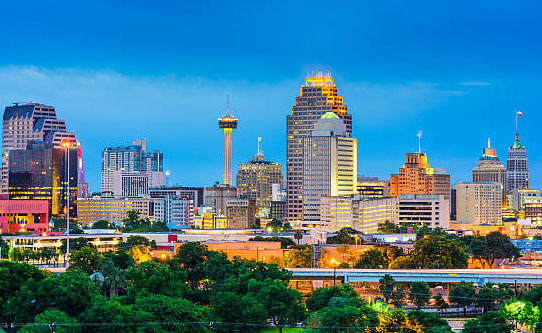
It's warm in winter, there's no state income tax in Texas, housing prices are manageable for a big city, H-E-B is in every neighborhood, the food is delicious, and people are generally friendly.
However, it feels like they keep cooking with good ingredients in a strange way.
First, let's talk about housing prices.
In the past, the biggest advantage of San Antonio was undoubtedly its affordable housing costs. It was cheaper than Houston or Dallas, and people coming from California would look at the prices and say, "You can buy a house for this price?"
But as people flocked in, housing prices went up.
Of course, it's still not at the level of LA or San Diego. The problem is that the income of San Antonio residents is not at the level of LA or San Diego either.
Housing prices are rapidly catching up to those of other major cities while salaries are slowly following, making this growth less than welcome for residents.
Traffic is similar.
The city keeps growing, but it's difficult to live in most places without a car. So as the population increases, the number of cars increases too. With more cars, they are reconstructing 1604, fixing I-35, and doing construction here and there.
The problem is that by the time the construction is finished, the population has increased again.
In the end, it's a strange system where roads are congested for years to create wider ones, and once completed, they become congested again.
Education issues are even more sensitive for families with children.
Even though it's the same San Antonio, the school situation varies completely depending on which neighborhood you live in. So families with kids look at school districts first before considering the house.
People flock to find good schools, housing prices in those neighborhoods go up, and ultimately, economic power divides the educational environment.
Describing the crime issue as dangerous for the entire city is an exaggeration. Living in a northern area like Stone Oak can be quite peaceful.
However, that can also mask the problems.
Just because my neighborhood is quiet doesn't mean the whole city is quiet. There are significant differences in safety and living conditions depending on the area.
Ultimately, all these issues converge in one place.
People with money seek good school districts and move north, living in relatively safe and newly built neighborhoods, managing two cars. If you lack money, your housing options decrease, school choices diminish, and traffic issues feel even more pronounced.
Even though they live in the same San Antonio, the quality of life can be completely different.
So I don't think San Antonio is necessarily a bad city to live in.
In fact, it's the opposite.
It's a city with a lot of potential, which makes it even more disappointing.
The weather is nice, the economy is growing, it has a stable military base, decent healthcare facilities, and a unique cultural scene. It has most of what a big city needs.
But what will happen if the basic living conditions like traffic, education, housing, and safety don't improve at the same pace as the population grows?
In the end, news about the city's growth keeps coming out, but long-time residents end up saying this.
"So what has improved in my life?"
Housing is getting more expensive, roads are congested, construction is increasing, and neighborhoods with good schools are becoming pricier.
Just because the city's population has increased doesn't mean the city has improved.
Whether San Antonio will truly become a livable big city in the future or become an ordinary big city that loses its affordable and convenient advantages one by one is what matters from now on.
Personally, I hope it doesn't become the latter.







 Helpful Life Stories |
 American Man in a Mask |
 Hajiwon Blog Hair Salon |
 Make My Day |
 TEXAS Fishing Boat |
  US Embassy |
  Korean Mom |
  My NYC |
  moo moo |
  Mr Oh |
  forevergee |
  festival |
  manchester |
  constant |
  Leapfrog Move |
  vibranto |
  Tora Tora |
  yellowbutter |
  Dolly |
  NYC saladbar |
  Finding Superfoods |
  lightyear |
  song bang |
  vexomo |
  Indiana Jones |