
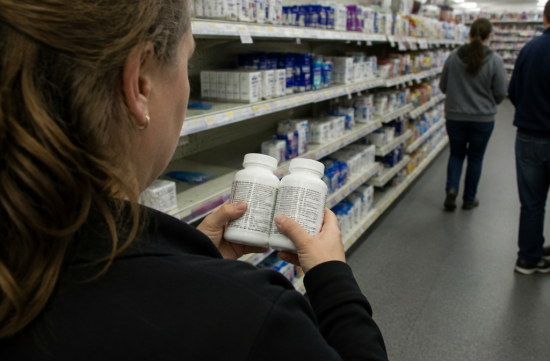
I went to the drugstore to buy band-aids and found myself standing in front of the display for a long time. Next to Neosporin, there was a nearly identical store brand ointment, so I compared the ingredient lists on the back.
Bacitracin zinc, neomycin sulfate, polymyxin B sulfate. The three active ingredients and their amounts were exactly the same.
The prices were different. At Walmart, a 1-ounce tube of Neosporin Original costs $9.87, while the same size Equate triple antibiotic ointment is $2.84.
A $7 difference for one tube of ointment. I don't think that's an amount to ignore.
If you open the medicine drawer at home in the U.S., the items are usually similar. Fever reducers, antihistamines, antacids, cough and cold medicine, antibiotic ointments, band-aids, and disinfectants are the basics.
If this list is filled entirely with brand names, a significant amount of money can be wasted in just one drawer. Once you switch to store brands, you automatically save on those items from then on.
It's important to note that this is not just a coincidence; it's a systemically guaranteed structure. The FDA requires that store brand over-the-counter medications have the same active ingredients, amounts, formulations, and routes of administration as their brand-name counterparts.
Manufacturing facilities are also held to the same quality standards whether they produce store brands or brand-name drugs. This means there's no room for differences in efficacy; the only difference is the label.
In practice, this is how it works. Perrigo, the largest manufacturer of store brand over-the-counter medications in the U.S., supplies more than half of the market by volume and delivers products under various store labels to 300 retailers.
This means that whether it's a Walgreens label or a CVS label, the products could come from the same production line.
There's an interesting piece of data. A study published in the Quarterly Journal of Economics in 2015 analyzed purchase records for headache medications and found that pharmacists chose brand-name drugs only 9% of the time.
In the same category, regular consumers chose brand-name drugs 26% of the time. This indicates that the group most knowledgeable about the ingredients spends the least on brand names.
So, I went through the list of over-the-counter medications I have at home, checking prices one by one.
For heartburn medication, Prilosec OTC 42 tablets cost $22.98 at Walmart, while the same 42 tablets of Equate omeprazole 20mg are $9.97. That's a $13 difference, or 56% cheaper.
The gap for allergy medications is even wider. Zyrtec 90 tablets cost $38.96, while the store brand cetirizine 10mg 90 tablets are $12.88.
That's a unit price of 43.3 cents versus 14.3 cents. For someone taking one a day during allergy season, that could add up to over $100 a year.
Pain relievers also involve packaging sizes. For ibuprofen 200mg, Equate 500 tablets cost $8.78, which is a unit price of 1.8 cents.
Costco's Kirkland brand offers a pack of 500 tablets for $10.99. In contrast, Advil 100 tablets cost $9.98.
The price of fever reducers and pain relievers is clearly reflected in the numbers. Tylenol Extra Strength 500mg 100 tablets are priced between $10.97 and $12.47 at Walmart.
That's over 11 cents per tablet. The store brand with the same 500mg acetaminophen ingredient is available in a much larger bottle right next to it.
Sometimes, smaller packaging can be a trap. Walgreens' own brand ibuprofen 200mg 24 tablets is priced at $4.49, while a similar product from CVS is $4.69.
Even though it's a store brand, the unit price exceeds 18 cents. In urgent situations, the small package is more about capacity than brand.
So, is there no reason to buy brand-name drugs at all? That's not the case either.
Even if the active ingredients are the same, the inactive ingredients can differ. Excipients like dyes, lactose, and starch can vary by manufacturer, and some people may react to these less common ingredients.
If you have lactose intolerance or are sensitive to certain dyes, it's better to check the inactive ingredients on the label. Differences in formulation, such as coating or gel caps, can also affect how easy they are to swallow.
For children's liquid medications, calculating the dosage is more important than the ingredients. Even if you switch brands, it's essential to check the concentration and the measuring device included each time.
The selection process itself is simple. Just look for the "Compare to" statement on the front of the store brand packaging, and check that the active ingredients on the back match those of the brand-name product.
Next, look at the unit price, which is usually printed small under the price tag. This number ultimately determines your actual spending.
However, a larger bottle isn't always the answer. If you buy a 1000-tablet bottle of a medication you only use a few times a year, you may end up throwing it away before it expires.
It's also a good idea to organize your drawer while you're at it. Remove any expired medications and keep the remaining ones upright so the labels are visible, which can help reduce duplicate purchases.
Membership programs can also be worth considering. CVS offers a 20% discount on store brand products for ExtraCare Plus members.
If it were me, I would fill my medicine cabinet with store brands for simple and frequently used items like fever reducers, antihistamines, antacids, and antibiotic ointments. The cost associated with the logo is more related to advertising than efficacy.
However, if it's a medication you're trying for the first time or for a child, it's wise to ask a pharmacist before switching. I believe that saving money ultimately starts with reading the ingredient labels.





 Softy |
 Michigan Enthusiast |
 Anna Life |
 JESIKYEOALBA BLOG |
 Dad's Tribute TC |
 Vivid U.S. Regional Information |
 zentra95 |
 yorvik12 |
 axelon47 |
 Coco Chanel |
  Waiting for Godot |
  parlon |
  Say Yes in English |
  Sayonara H |
  rigid |
  Ohio Ohayoung Hello |
  U.S. Military Recruitment Information |
  You Turn Me On |
  DaeBak Electronics CNET |
  Anjollinya Blog |
  solid90 |
  elion |
  xylora |
  Study Abroad Life Know-How Tips |
  cheesepup |
  carpflow |
  mapsina |
  Mr. Largo |
  breezem |