
$800. In New York, if the total amount paid to freelancers over the last 120 days exceeds this amount, a written contract is legally required.
California has a lower threshold. A written contract is mandatory starting from projects worth $250, effective January 2025.
Illinois will implement similar laws starting July 2024, and Los Angeles has been doing so since July 2023. However, there are still many states without such laws, and Florida is one of them.
Ultimately, freelancers working in Florida should not expect the law to protect them. They need to write contracts carefully to reduce the chances of not getting paid later.
The first thing to address is the scope of work clause. If you write something vague like "website design," there's no basis to stop the client from making continuous additional requests.
If the scope of work is unclear, it can also be detrimental to the client. Misaligned expectations can lead to conflicts during the project.
Specify the numbers clearly, such as one main homepage, five subpages, and mobile responsiveness included. Listing items that are not included separately can also reduce disputes later.
Next is the limitation on the number of revisions. Without this clause, clients may keep asking for changes until they are satisfied, requiring freelancers to work for free each time.
Typically, it's set for 2 to 3 revisions, with additional costs specified for any beyond that. This ensures freelancers can work with peace of mind.
The contract must also include a statement that the freelancer is an independent contractor, not an employee. If this is missing, it can create ambiguity regarding taxes or insurance later.
A confidentiality clause stating that the freelancer will not disclose client information or project details is also commonly included. Startups or new product-related work often require this clause upfront.
Payment terms should not be vague. The total amount, deposit percentage, milestone payment timing, and final payment due date must all be clearly stated.
New York law stipulates that payment must be made within 30 days after the work is completed, and failure to comply can result in double damages and attorney fees. There is also a separate $250 civil penalty for not providing a contract at all.
Since Florida has no such law, you need to write this regulation directly into the contract to achieve a similar effect. It's perfectly fine to use provisions from states that have them.
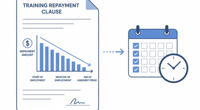
A penalty clause, or kill fee clause, should also be included. This clause provides compensation for work done if the client cancels the project midway.
The limitation of liability clause is another easy part to overlook. It's wise to set a cap on damages to the amount received for the work to avoid unlimited liability for damages caused by the deliverables.
The timing of copyright transfer is also a detail that can be easily missed. It should be stated that ownership of the deliverables does not transfer until full payment is received to prevent situations where files are taken without payment.
It's necessary to determine in advance which state's laws will apply in case of disputes and where they will be resolved. Many freelancers opt for arbitration, which is less costly than litigation.
Conditions for contract termination should not be omitted. It should be specified whether either party can terminate with prior notice and how to settle for work done up to that point.
Many freelancers still start work verbally with "let's settle later" without a contract. It's not uncommon to see cases where they end up not getting paid for months.
As you add these clauses, the contract may become lengthy and cumbersome. However, spending thirty minutes writing a contract is much cheaper than going to court over unpaid money later.
Rather than expecting the government to take care of you, it's much more practical to write a solid contract yourself. Ultimately, it's not the legal provisions that protect you, but the sentences you've written in advance.
 AlpacaScarf






 moname |
 mapsina |
 Mr. Largo |
 Victory 1988 |
 Infinite Style |
 Well Done Sir |
 Taco Bell Candy Note Blog |
 Kims Spring |

 windylotus |
  Mia Flori |
  velaro29 |
  velaro |
  foxtrot83 |
  mapleline |
  US Legal Consultation on Trials |
  UNI Lover |
  Karina's Blog |
  California Dreamer |
  Choco Mint Creator |
  Chili Boy Club |
  NE Hodori Preik |
  Giant Squid and Sweet Potato Soup |
  torvik |
  charger |
  holy cheese |
  Pleasant K |
  Rolling Joy Life |