
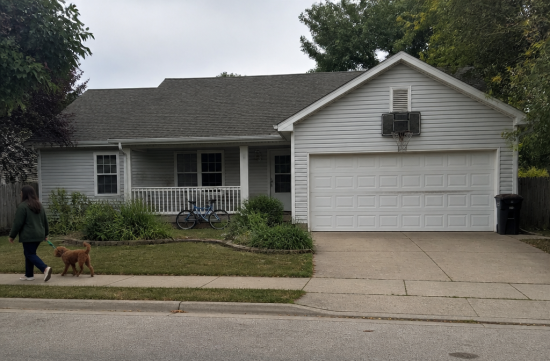
Several years ago, I had an American business partner, and after hearing that home prices in his neighborhood had risen quite a bit, I found myself asking, "How about selling now?"
The response was unexpected. He said he had no intention of selling.
From a business perspective, I found it hard to understand. If asset values have increased, isn't it common sense to cash out or upgrade to a larger asset?
When I asked for the reason, the answer was even more impressive. He mentioned that it was the room where his children grew up and that there was a specific corner for setting up the Christmas tree every year.
This was a strange way of calculating things for someone like me, who only looked at numbers. However, after spending a long time in America, I realized that this was not just a unique way of thinking for him.
That said, this perspective wasn't purely emotional. When selling a house in America, the combined costs of agent fees, taxes, and various expenses typically take about 8 to 10 percent off the sale price.
Even if the market value has increased, after deducting moving costs and these expenses, the actual profit you end up with is not as significant as one might think.
I also noticed that English has two words for house. There's "house" referring to the building and "home" referring to the life within it.
Since there is no such distinction in Korean, I initially struggled to understand why Americans felt the need to use two separate words.
This way of thinking also has a historical background. The Servicemen's Readjustment Act, known as the GI Bill, enacted in 1944, supported returning World War II veterans in purchasing homes at low interest rates.
As a result, the number of new homes built increased from 114,000 in 1944 to 1.7 million by 1950. Suburban developments like Levittown emerged during this time.
The government's push for housing was not simply due to a shortage of homes. There was a belief that citizens who owned their homes were socially more stable.
The single-family homes and white picket fences built in the suburbs soon became symbols of the American Dream. Homes became a sign of success and a symbol of settlement.
However, when it comes to investment returns, homes are not that attractive of an asset. According to economist Robert Shiller's analysis, real housing prices, adjusted for inflation, have remained nearly stagnant for over a century from the 1890s to the 1990s.
As someone in business, I was honestly surprised by this point. Is it a rational choice to buy an asset whose real price has hardly increased over a hundred years, especially when taking out loans?
Yet, the reason Americans continue to buy homes seems to lie elsewhere, not in the calculations of returns. A recent survey by the real estate company Redfin found that 74 percent of homeowners said there's no place they would rather be than their home.
In the same survey, 74 percent said their home is a space that reflects themselves, and 72 percent felt a sense of belonging to their neighborhood.
Another survey conducted by a company called Unison showed similar trends. Ninety-one percent of respondents felt a sense of stability or success from owning a home, and 70 percent felt emotionally attached to their home.
In the same survey, 51 percent said that their home is an important part of their life. This means that a significant percentage of people feel satisfied with a choice that, numerically speaking, seems close to a loss.
I also initially viewed a house merely as an asset. However, after spending a few years in this neighborhood, my perspective has shifted a bit.
Ultimately, whether one sees a house as an asset or a home is not a matter of calculations but a matter of priorities. I still tend to look at the numbers first, but I can understand this priority.
 RatPoisonOk


 Giant Squid and Sweet Potato Soup |
 Lol Life |
 lavender |
 logger |
 Conflite Teacher |
 Goroke Geureoke News |


 swiftlane |

 moname |
  mapleline |
  US Legal Consultation on Trials |
  UNI Lover |
  Karina's Blog |
  California Dreamer |
  Choco Mint Creator |
  Chili Boy Club |
  NE Hodori Preik |
  torvik |
  charger |
  holy cheese |
  Pleasant K |
  Rolling Joy Life |
  lidus |
  French Macarons |
  Central Intelligence Agency Deputy Director |
  ATL Power 1 |
  MP Forever |