
Recently, a friend of mine shared a concern. Right after starting their job, the company sent them to a few weeks of paid training and covered the costs for certification exams, but now, less than six months later, they received a great job offer.
The issue was that they discovered a clause in the paperwork they signed upon hiring that stated, "If you leave within a year, you must repay the training costs." Upon rereading the contract, they found that this clause was indeed there.
This type of clause is referred to in the U.S. as a training repayment clause, or TRAP for short. It's a contract where the company agrees to cover training or certification costs, but if the employee leaves before a specified period, they must repay those costs.
Such clauses are particularly common in professions that require certifications or special licenses, like airline pilots, truck drivers, cosmetologists, and nurses. Since training costs can run into the thousands of dollars, companies want to have some form of security.
However, these clauses are not universally enforceable, and this has been a growing issue in recent years. Lawsuits have increased, and state-level regulations are emerging quickly.
In 2025, California passed a law known as AB 692, which largely prohibits such stay-or-pay clauses. Companies that violate this law must pay either the actual damages or a larger amount of $5,000 per employee.
New York has similarly passed the Trapped at Work law, which invalidates most training repayment contracts. The New York State Department of Labor can impose fines ranging from $1,000 to $5,000 for each violation.
However, many states still lack specific prohibitive laws, so contracts can still be legally recognized in those areas. This means outcomes can vary significantly depending on the state you live in.
That said, companies cannot just collect whatever they want. According to the Fair Labor Standards Act (FLSA), it is illegal to deduct training costs from final paychecks in a way that brings the hourly wage below the minimum wage.
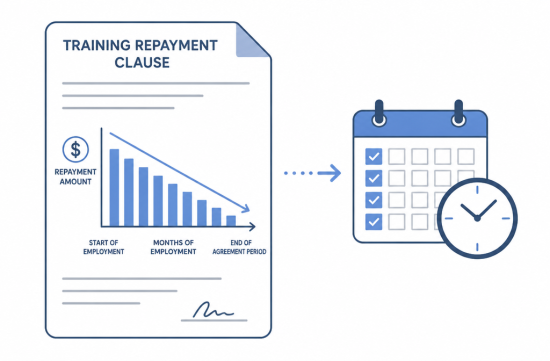
Judicial rulings tend to favor repayment structures where the amount decreases proportionally with the length of employment, rather than fixed amounts that do not consider the duration of service. Clauses that appear punitive are generally viewed unfavorably.
The Federal Trade Commission and the Department of Justice have also expressed concerns that such clauses excessively restrict employees' freedom to change jobs, potentially harming competition in the labor market. This indicates that it's not just a matter of company versus individual.
In fact, in July 2025, the attorneys general of California, Colorado, and Nevada reached a settlement with a large healthcare organization over a clause that required new nurses to repay costs if they left within two years after receiving special training.
Therefore, when you receive an offer letter or onboarding documents, it's crucial to carefully review sections mentioning training costs, certification fees, and signing bonuses. If the language is vague, it's best to ask the HR team directly before signing.
If the contract includes a table showing that the repayment amount decreases monthly based on the number of months worked, that's generally a more acceptable form. Conversely, if there's a clause stating that you must repay the full amount immediately upon leaving, there may be grounds for legal dispute later.
It's also subtly important whether the company refers to this money as a loan or a penalty. If the repayment amount is close to the actual training costs, it's more likely to be recognized as a loan, but if it's significantly inflated, it could be seen as a penalty and thus invalid.
For reference, my friend ultimately inquired with HR about the clause and confirmed that the repayment amount decreases based on the length of employment, which allowed them to comfortably decide to change jobs. They were glad they asked in advance.
This suggests that the training repayment clause itself isn't necessarily bad; rather, the key is whether the amount is reasonable and decreases over time. I would thoroughly check this aspect before signing a contract.
There's no need to panic if you've already signed. If the clause seems excessively unfavorable, it's advisable not to sign and, if the situation has already occurred, to consult with the labor department or an employment attorney.
 MichiganTime








 mapsina |
 Mr. Largo |
 Victory 1988 |
 Infinite Style |
 novapixel |
 calvor |
 ramen |
 moname |
 velaro |
  foxtrot83 |
  mapleline |
  US Legal Consultation on Trials |
  UNI Lover |
  Karina's Blog |
  California Dreamer |
  Choco Mint Creator |
  Chili Boy Club |
  NE Hodori Preik |
  Giant Squid and Sweet Potato Soup |
  torvik |
  charger |
  holy cheese |
  Pleasant K |
  Rolling Joy Life |
  lidus |
  French Macarons |
  Central Intelligence Agency Deputy Director |